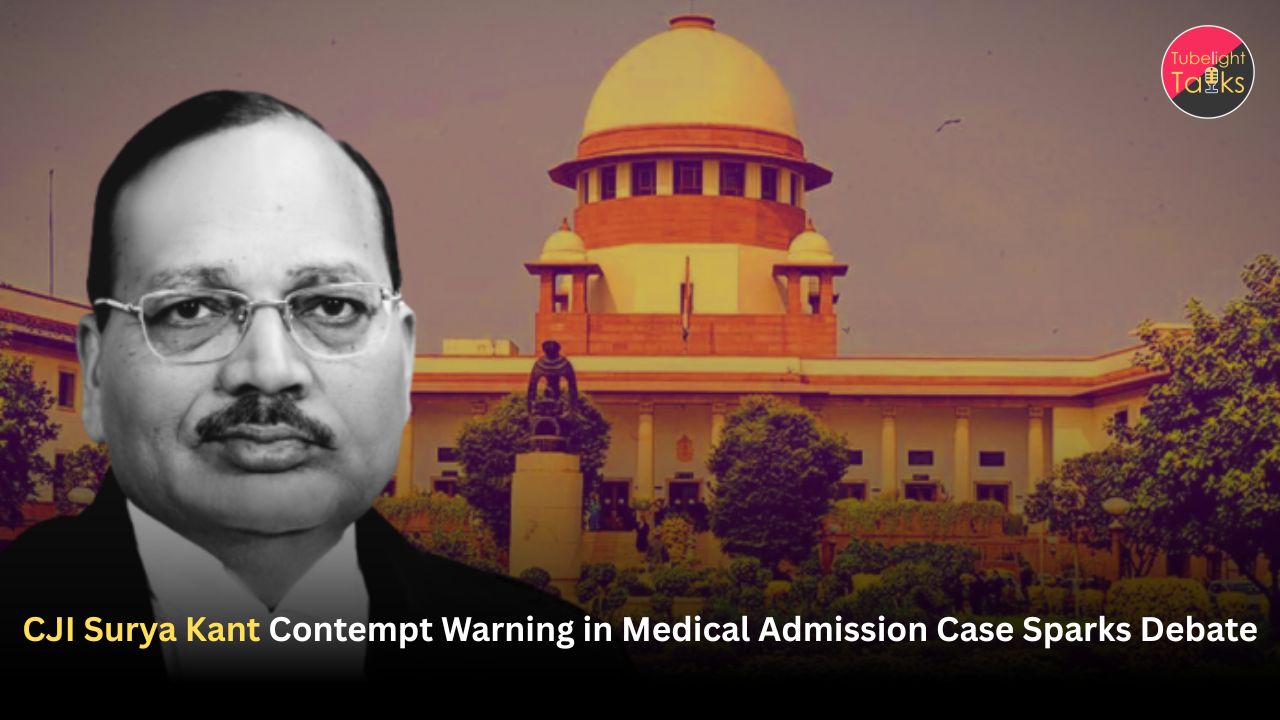
CJI Surya Kant Contempt Warning Turns Medical Admission Hearing Into Integrity Debate
Chief Justice of India Surya Kant made national headlines on March 25 after a striking courtroom exchange linked to the CJI Surya Kant contempt warning, in which he accused a petitioner’s father of trying to reach his family over an order passed in a medical admission case. The Supreme Court was hearing a plea involving two general-category students from Haryana who said they had converted to Buddhism and sought admission under the Buddhist minority quota in a minority medical college.
During the hearing, the CJI said the father of one petitioner had called his brother and questioned how such an order could have been passed. He then openly asked why contempt proceedings should not be initiated.
The words that followed have resonated far beyond the courtroom. According to Indian Express and LiveLaw, the CJI said, “He dares to call my brother on the phone and tell him how CJI has passed this order! He will dictate me?” He also warned that even if such a person hid outside India, the court knew how to deal with “these kinds of people,” and he told counsel that if a client was engaging in misconduct, withdrawal should be considered.
The exchange has gone viral not just because of its dramatic language, but because it touches a nerve in public life: whether India’s courts can remain insulated from informal power, social influence, and pressure tactics.
Why this incident matters far beyond one hearing
The Supreme Court was not just angry; it was defending a constitutional principle
At one level, this was a courtroom reprimand. At another, it was a public assertion of judicial independence. When a Chief Justice says in open court that a litigant’s relative tried to reach his family over a pending matter, the issue immediately becomes larger than one petitioner or one case. It becomes a warning about the line that cannot be crossed.
Courts can be challenged through appeals, arguments, review petitions, and lawful advocacy. They cannot be approached through family channels or private social pressure. That is the principle at the center of this episode.
That is also why the CJI’s anger matters institutionally. His remarks were not framed as personal hurt alone. They were framed as misconduct threatening the integrity of the legal process itself. Indian Express reported that he asked why contempt should not be initiated, while NDTV reported that he described the act as an attempt to question a judicial order through a private call to his brother. The message was unmistakable: if parties begin to treat judges’ families as parallel routes to influence, then the court system itself is under threat.
The phrase “He will dictate me?” captured the public mood instantly
Some courtroom lines stay within legal reporting circles. This one did not. “He will dictate me?” spread rapidly because it condensed a larger constitutional idea into plain, emotional language. It sounded like what many citizens would hope a judge says when confronted with back-channel pressure: that judicial orders will not be written under private intimidation.
That directness is one reason the episode has become today’s most talked-about judiciary story. This is an inference from the prominence given to the quote across reports and its headline treatment in multiple outlets.
The public significance is also tied to trust. Courts depend not only on law but on public confidence that law is being applied without hidden influence. A dramatic rebuke like this can reassure people that the highest court recognizes the danger and is willing to confront it publicly. That reassurance may matter even more in a time when many institutions face accusations of opacity, power-broking, and unequal access. This is an analytical reading based on the nature of the exchange and the institutional role of the Supreme Court.
Also Read: Congress Eviction Notice Turns Akbar Road and Raisina Road Issue Into Political Flashpoint
The case itself was already controversial before the phone-call episode
The dispute centered on minority-quota admission after conversion to Buddhism
The underlying case was not routine. Indian Express, LiveLaw, and NDTV all reported that the matter involved two general-category students from Haryana who claimed they had converted to Buddhism and wanted the Supreme Court to intervene for admission under the Buddhist minority quota in a Buddhist minority medical college.
The bench had already shown skepticism earlier in the case and had sought information from the Haryana chief secretary regarding the claimed conversion and minority certificates. That context matters because it shows this was already a legally sensitive matter involving caste, religion, conversion, and access to reserved educational benefits.
According to the reports, the bench had raised doubts on January 28 and wondered whether the conversion claim was a fraudulent attempt to secure admission. NDTV said the Court had earlier described the plea as a “new kind of fraud,” while LiveLaw said the bench expressed doubts about the bona fides of the conversion and ordered an inquiry.
The petitioners’ factual claim triggered deeper judicial suspicion
The reports suggest that the Court’s concern was not simply about conversion as a religious act, but about whether the conversion was being used instrumentally to unlock minority benefits in a postgraduate medical admission context.
NDTV reported that the petitioners were siblings, Nikhil Kumar Punia and Ekta Punia, and that the bench questioned how candidates who had earlier appeared as general-category applicants could later claim minority benefits after conversion. LiveLaw similarly noted that the Court had been especially doubtful because the candidates belonged to the Punia community and appeared to have converted in proximity to the admission process.
This helps explain why the later attempt to reach the CJI’s family was viewed so harshly. In a case where the Court was already probing whether the process itself had been manipulated, any private contact outside court would naturally look even more serious. That does not legally decide the underlying admission dispute, but it does explain the intensity of the judicial reaction. This is an inference supported by the case background in the cited reports.
Why “backdoor influence” is such a dangerous phrase in the judiciary
Because informal access can corrode equality before law
A courtroom is supposed to be the place where all parties stand on record, through counsel, under procedure, subject to the same rules. The moment a litigant or relative begins reaching out privately to a judge’s relatives, the equality of that system is threatened. Even the attempt creates a hierarchy of access: one person is no longer relying only on law and advocacy, but on proximity, pressure, or implied social leverage. That is why the CJI’s reaction was so severe.
This danger is not merely theoretical. If such conduct were tolerated, it would create a deeply corrosive message for ordinary litigants: that judgments are influenced not just by what happens in court, but by who can reach whom outside it. The Supreme Court’s rebuke therefore worked on two levels—punitive and preventive. It addressed a specific alleged act, and it warned everyone else watching. This is an analytical conclusion drawn from the nature of the misconduct described in the reports and the contempt warning issued in court.
The contempt warning was meant to protect process, not just prestige
Indian Express reported that the CJI asked why contempt proceedings should not be initiated against the father of the petitioner. LiveLaw reported the same and added that the CJI said he had dealt with “these kind of elements” for 23 years. In law, contempt is not supposed to be a tool to protect ego; it exists to protect the administration of justice from obstruction, scandalization, or intimidation. That is what makes the warning significant. The Court was signaling that outside attempts to influence it may be treated as interference with justice itself.
Whether contempt is eventually pursued is a separate procedural question. But as of the hearing covered by these reports, the Court had clearly placed the possibility on record. That alone makes the incident more serious than a passing oral rebuke. It signals that the Court views such behavior as potentially punishable misconduct, not just poor etiquette.
The exchange also says something about the burden on judges in high-stakes cases
Judicial office brings scrutiny, but it cannot be allowed to invite private pressure
Judges, especially at the Supreme Court level, already function under extraordinary public scrutiny. Their orders affect careers, institutions, governments, admissions, businesses, and fundamental rights. In such an environment, there is always pressure.
But a constitutional democracy survives only if that pressure is channeled through lawful forms: arguments, precedent, evidence, and appellate procedure. Once it shifts into personal networks, the system begins to deform. The present episode is powerful because the Chief Justice openly identified that deformation the moment he saw it.
That public identification may itself become the larger legacy of the story. Many influence attempts likely remain private, unprovable, or whispered. Here, the Court put the allegation into open proceedings and rejected it emphatically. That does not solve the larger problem forever, but it creates a visible benchmark for how such conduct should be treated. This is an inference based on the public nature of the rebuke and the institutional position of the speaker.
What happens next
The admission case continues, but the misconduct issue now shadows it
The reports indicate that after counsel apologized and said he was unaware of the conduct, the matter was adjourned or re-listed for a later date. That means the substantive medical admission dispute has not ended. But it is now inseparable from the misconduct allegation. Even if the case proceeds on its merits, the alleged attempt to contact the CJI’s family has changed how the entire matter will be viewed publicly and institutionally.
There is also a broader possibility that the incident will trigger more formal reflection within the legal community about ethical boundaries for litigants and their families. Courts already expect advocates to maintain distance from improper contact. This case may revive attention on the responsibility of clients as well, especially in emotionally charged admission, reservation, and education disputes. This is an inference from the CJI’s instruction that counsel should verify and even consider withdrawal if the client is engaging in misconduct.
Sat Gyaan and the lesson against manipulation
Teachings associated with Sant Rampal Ji Maharaj place repeated emphasis on truth, honest conduct, and rejecting deceitful or manipulative behavior in pursuit of worldly gain. Seen in that light, the lesson from this courtroom episode is larger than one legal scandal. When a person tries to bend a just process through back channels instead of truth, the damage reaches beyond one case—it weakens trust in the entire system.
Sat Gyaan teaches that real justice and lasting success cannot come through pressure, fear, or manipulation, but through righteousness and sincerity. This is an interpretive spiritual reflection rather than a legal conclusion.
Call to Action
This episode should be read as a warning, not just a headline. Anyone with a grievance against a judicial order has lawful remedies: review, appeal, fresh argument, documentary proof, and legal representation. Attempting to reach a judge’s relatives or use social access to influence a matter attacks the fairness of the system itself.
Citizens should reject that culture wherever they see it, because once informal pressure becomes normal, equal justice becomes impossible.
FAQs: CJI Surya Kant Contempt Warning
1. What triggered CJI Surya Kant’s strong remarks?
The CJI said the father of a petitioner in a medical admission case had contacted his brother and questioned an order passed by the Court.
2. What case was the Supreme Court hearing?
It was hearing a plea by two general-category students from Haryana who claimed they had converted to Buddhism and sought admission under the Buddhist minority quota in a minority medical college.
3. What exactly did the CJI say in court?
Reports quote him saying, among other things, “He dares to call my brother… He will dictate me?” and warning that contempt proceedings could be initiated.
4. Did the Court mention contempt?
Yes. Indian Express and LiveLaw both reported that the CJI asked why contempt proceedings should not be initiated against the petitioner’s father.
5. Why is this incident important beyond one case?
Because it raises a larger issue of judicial independence and the danger of litigants trying to influence proceedings through personal or family contacts rather than lawful process. That is an inference from the Court’s remarks and the nature of the allegation.
6. What happened after the exchange?
Counsel apologized and said he was unaware of the conduct, and the matter was adjourned or re-listed for a later date.
Related Stories










Discussion (0)