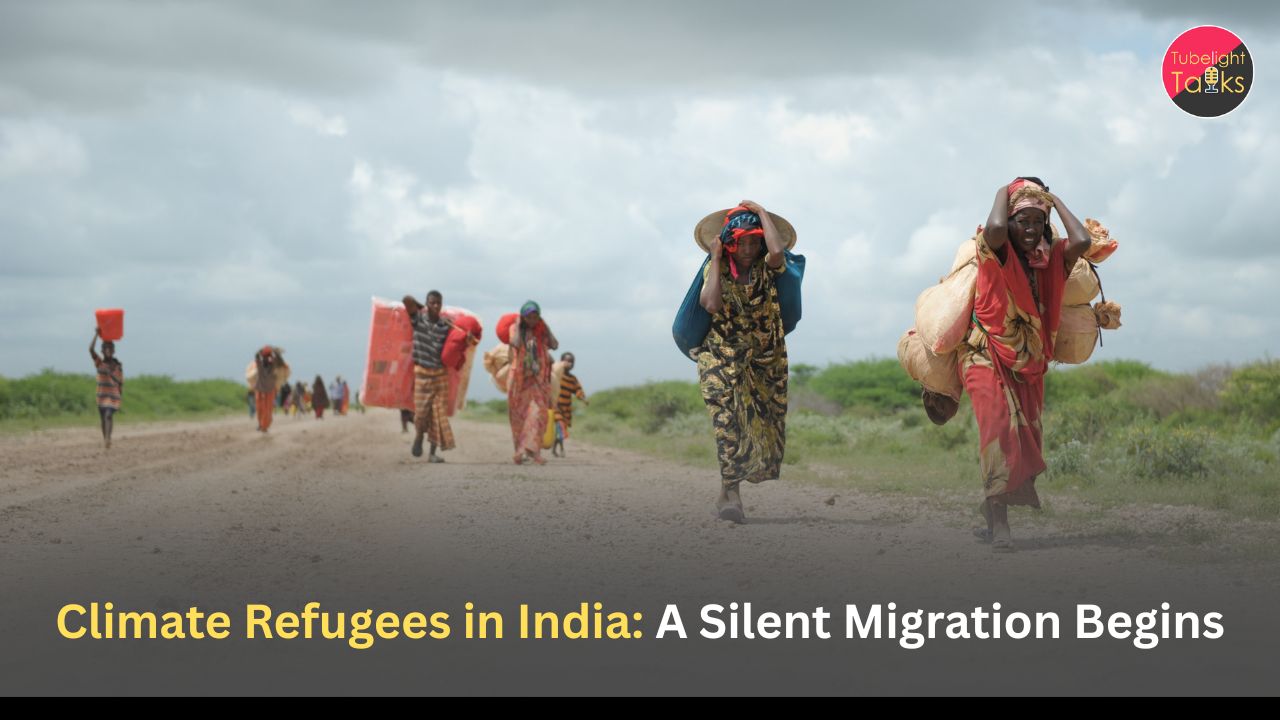
Climate Refugees in India: A Silent Migration Begins
Climate Refugees in India: India, once described as a land of stable seasonal rhythms, is now facing extreme and unpredictable weather events with increasing regularity. From prolonged droughts to record-breaking heatwaves and devastating floods, climate change is not just a future threat—it is a present disaster. Among the most urgent and underreported consequences is the rise of climate refugees: citizens forced to migrate within their own country to escape uninhabitable conditions.
This is a silent humanitarian crisis unfolding across rural and urban landscapes, turning climate change from an environmental issue into a national emergency.
What Are Climate Refugees?
Understanding the Term
Climate refugees, also known as environmental migrants, are people who are forced to leave their homes due to sudden or gradual environmental changes—like rising sea levels, desertification, floods, or heatwaves—that threaten their livelihood or survival.
In India, this phenomenon has been intensifying year after year, particularly in low-lying, flood-prone states and drought-hit farming regions.
Internal Climate Migration: The Shocking Numbers
According to a 2021 report by the World Bank, India could see over 45 million internal climate migrants by 2050. However, as of 2026, early signs indicate that we are well ahead of that estimate. Here’s how:
Key Statistics (2025-2026)
- 3 million displaced in Assam and Bihar due to record monsoon floods.
- 2.5 lakh families migrated from Bundelkhand and Marathwada due to failed crops and water shortages.
- Chennai and parts of Odisha face rapid urban influxes from rural areas rendered uninhabitable.
- Over 6,000 villages marked as “climate vulnerable zones” across 12 states by NITI Aayog.
Source: Ministry of Environment & Forests, NDMA Reports, World Bank (India Climate Migration Models)
Also Read: Census 2027 Digital Revolution Glory: Apps & Self-Enumeration Unlock New India’s Accurate Pulse
Top Affected States in India
1. Assam & Bihar – Riverine Disasters
The Brahmaputra and Ganga basins flood annually, swallowing homes, destroying crops, and displacing lakhs. In 2025 alone, Assam reported 24 major floods, the highest in recorded history.
2. Bundelkhand & Marathwada – Drought & Water Crisis
These semi-arid regions face severe groundwater depletion. Entire villages have become ‘ghost villages’, with only elderly left behind as working-age people migrate to Delhi, Pune, or Hyderabad.
3. Sundarbans (West Bengal) – Rising Sea Levels
Encroaching saltwater is destroying arable land, with over 100 islands in danger of submergence. Climate-induced migration has surged in the region.
4. Odisha & Andhra Pradesh – Cyclones & Coastal Erosion
Frequent storms and cyclones are wiping out homes, pushing poor fishing communities further inland. Livelihoods are vanishing overnight.
Livelihood Disruption and Urban Burden
As climate refugees pour into nearby urban centers, cities are ill-prepared to handle the influx. The result?
- Slum expansion in Mumbai, Kolkata, Delhi
- Rising urban unemployment and homelessness
- Resource stress on water, housing, and sanitation systems
- Increased crime and mental health disorders among displaced populations
This slow, uneven migration is not yet recognized under national refugee laws, leaving millions without access to formal rehabilitation, housing rights, or relief.
The Invisible Refugees: No Policy, No Protection
Unlike refugees of war or political conflict, climate refugees in India suffer in legal limbo. There is no national policy or official recognition under disaster laws or the National Migration Framework. The Internal Displacement Monitoring Centre (IDMC) highlights India as one of the worst-affected countries without a dedicated climate displacement policy.
Children, Women & Elderly: The Most Vulnerable
Among those displaced are:
- Children forced to drop out of school
- Women vulnerable to trafficking and exploitation in transit and urban slums
- Elderly abandoned or left behind in empty villages
This deepens the cycle of poverty and inequality, making climate migration not just an environmental issue—but a moral and social one.
Government Response: Are We Doing Enough?
Promises Made
- The government launched National Action Plan on Climate Change (NAPCC) and State Action Plans (SAPCC) to address climate resilience.
- Smart Cities Mission added a climate resilience component.
- The NCRMP (National Cyclone Risk Mitigation Project) received international funding.
Ground Reality
- Most programs lack effective implementation or climate migration-specific frameworks.
- Rehabilitation budgets are thin, slow, or misused.
- Early warning systems exist but are inaccessible to poor rural communities.
A 2025 audit by CAG (Comptroller and Auditor General) found major gaps in climate adaptation spending in disaster-prone states.
International Spotlight: A Global Crisis with Indian Roots
India is now among the top 5 countries globally for climate-induced displacement, according to UNHCR and IPCC reports. Yet, there’s no formal inclusion of climate refugees in the Paris Agreement mechanisms or international asylum policies.
Without global and national acknowledgment, India’s climate refugees remain statistical shadows—unheard, unseen, and unaided.
Spiritual Insight: A Refuge Beyond Refugees
While governments struggle to offer shelter, jobs, and justice to climate refugees, Sant Rampal Ji Maharaj offers a higher truth and eternal refuge. According to Sat Gyaan, the root cause of natural calamities lies in adharma (unrighteous living) and disconnection from the Supreme God.
“When the soul forgets its origin and purpose, nature too forgets its harmony.” – Sant Rampal Ji Maharaj
In the holy scriptures, it is written that Satlok is a divine, immortal realm where no disasters—natural or manmade—can exist. No death, no suffering, no heat, no hunger. The only true way to escape the cycle of birth, calamity, and displacement is through Naam Diksha (Initiation) from a Complete Guru and sincere devotion.
To watch how spiritual knowledge aligns with scientific truth and climate safety, visit the Sant Rampal Ji Maharaj Official YouTube Channel.
Take Shelter Before the Next Storm
National & Local Governments Must:
- Recognize climate migration legally
- Create a Climate Refugee Protection Policy
- Expand disaster-resilient affordable housing
- Develop climate-resilient rural economies
- Implement early alert systems at the grassroots
Citizens Must:
- Reduce carbon footprints
- Support climate-aware leadership
- Practice compassion towards displaced people
But most importantly—
Seek spiritual knowledge that goes beyond temporary shelters. Build an eternal refuge within, with the guidance of a True Saint.
FAQs on Climate Refugees in India
Q1. What is a climate refugee?
A person forced to migrate due to environmental disasters like floods, droughts, or heatwaves that make their habitat unlivable.
Q2. How many climate refugees are there in India?
As of 2026, estimates suggest over 12 million people have been displaced due to climate events in the last 5 years.
Q3. Are climate refugees recognized under Indian law?
No. India does not currently have a legal framework that classifies or protects climate refugees.
Q4. Which Indian states are worst affected?
Assam, Bihar, Bundelkhand, Marathwada, Odisha, and coastal Tamil Nadu are among the worst-hit regions.
Q5. Can spiritual practice really help in times of disaster?
Yes. According to Sant Rampal Ji Maharaj, spiritual devotion builds inner strength, divine protection, and guidance—especially during crises.
Related Stories









Discussion (0)