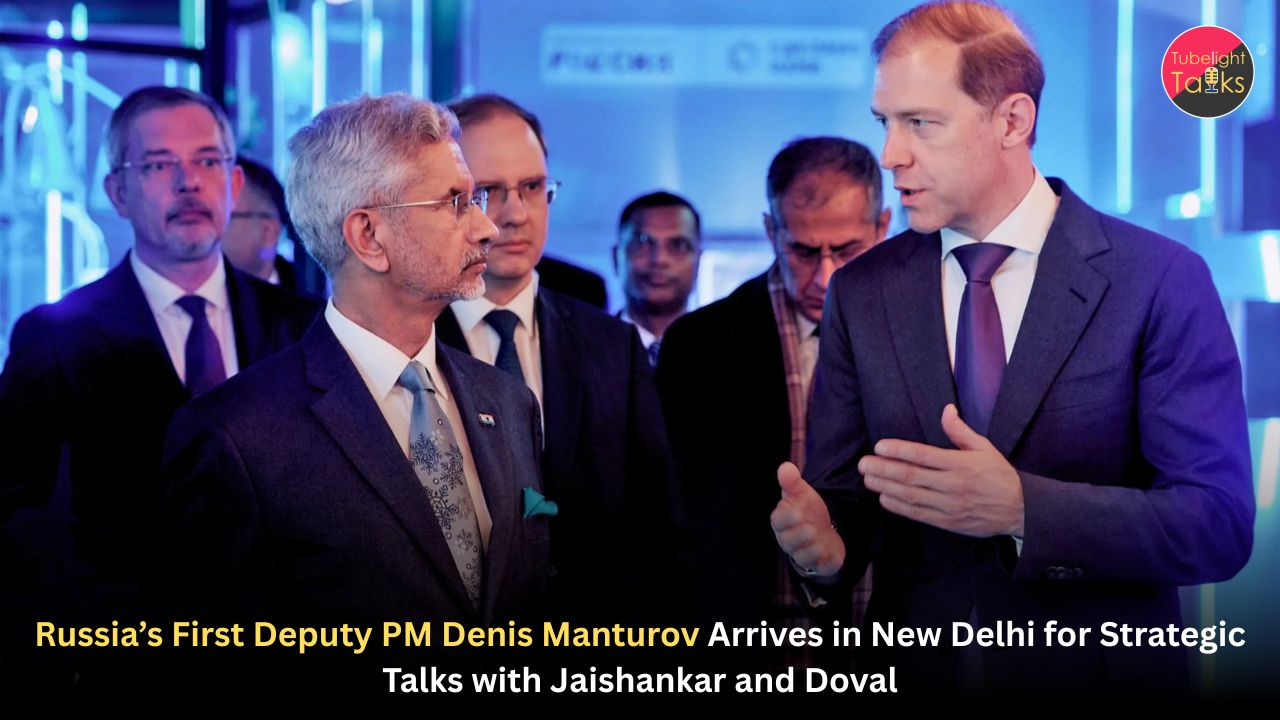
Russia’s First Deputy Prime Minister Denis Manturov Arrives in New Delhi for Two-Day Strategic and Economic Talks
Russia’s First Deputy Prime Minister Denis Manturov arrived in New Delhi in the early hours of April 2 for a two-day official visit that places defence, strategic coordination and economic cooperation back at the center of India-Russia engagement.
The Ministry of External Affairs has officially scheduled his meetings with National Security Advisor Ajit Doval, Finance Minister Nirmala Sitharaman and External Affairs Minister S. Jaishankar on April 2, with departure planned for April 3.
The visit is officially underway
MEA has confirmed the schedule
India’s Ministry of External Affairs released the formal media advisory for Manturov’s visit on April 1. It states that he arrived in Delhi at 00:10 on April 2, is scheduled to meet Ajit Doval at 3:00 PM, Nirmala Sitharaman at 4:00 PM, and S. Jaishankar at 7:00 PM, before departing on April 3. News on Air also reported on April 2 that Manturov had arrived in New Delhi and reiterated the same lineup of meetings.
Why these meetings matter
The structure of the schedule itself signals the seriousness of the visit. A sequence involving the NSA, Finance Minister and External Affairs Minister shows that the agenda is not narrowly diplomatic. It spans security, strategic coordination, external relations and economic decision-making. Business Standard, citing the MEA and the Russian Embassy, reported that Manturov’s visit is centered on talks with these key Indian officials.
Defence and security are expected to dominate the strategic side
Ajit Doval meeting points to hard-security discussions
The user’s headline describes strategic defence talks with NSA Ajit Doval, and that is consistent with current reporting around the visit. Hindustan Times reported that Doval and Manturov are expected to discuss cooperation in crucial areas such as defence, security, energy and trade, while Deccan Herald said the visit comes as India recently cleared procurement of a fresh batch of S-400 missile systems from Russia.
That matters because India-Russia ties in recent years have remained strongest in defence and strategic systems even as the broader international environment has become more complicated. A meeting with the NSA usually indicates discussions that go beyond formal diplomacy into strategic coordination, security assessment and sensitive bilateral issues. This is an inference from the level and nature of the meeting, but it is strongly supported by current reporting on the expected agenda.
Also Read: Putin India Visit 2025 Glory: Modi’s Remarks Forge Unbreakable Indo-Russian Destiny
Economic talks are likely to focus on energy, trade and supplies
Oil, LPG and fertilisers are central to the economic agenda
Economic Times reported ahead of the visit that Manturov’s trip is expected to focus on strengthening the Economic Cooperation Programme between India and Russia, with particular attention to oil, LPG and fertilisers. It also described the visit as coming amid deepening trade and investment ties, co-production partnerships and increasing imports of key commodities from Russia.
This context is especially relevant because Reuters recently reported sharp stress in India’s fuel market from the West Asia crisis, including higher prices for jet fuel and commercial LPG. At the same time, Reuters also reported that India had secured 60 days of crude supply despite disruption around the Strait of Hormuz. In that environment, any India-Russia economic discussion involving energy is automatically more strategic than routine commerce.
Trade and market access remain important background issues
India and Russia have spent years trying to deepen trade beyond defence and crude oil, including market-access and trade-balance issues. Reuters’ earlier reporting on Manturov’s India engagement in 2023 noted that discussions with Indian ministers covered trade, finance, industry, energy, agriculture, transport, healthcare, education and culture. While that was a prior visit, it helps explain why the current visit is being seen as both strategic and economic rather than tied to one single sector.
Also Read: Markets Reel as Rupee Breaches 95-Mark, but the Bigger Story Is India’s Oil Shock Exposure
The West Asia crisis adds urgency to the trip
Geopolitics is shaping the timing
Hindustan Times reported that developments in West Asia are expected to be part of the discussions during Manturov’s visit. That fits the broader backdrop: the region’s instability has disrupted energy flows, pushed up prices and forced countries like India to reassess supply resilience and strategic partnerships.
Because Russia has recently re-emerged as a major crude supplier to India, the visit arrives at a practical moment. Reuters reported in late March that India had secured short-term oil supplies despite Hormuz disruption, while other current reporting noted that Russian crude flows to India have gained renewed relevance in recent weeks. This makes the economic side of the trip directly connected to India’s immediate energy-security concerns.
What the visit signals about India-Russia ties in 2026
The relationship remains active and layered
The visit suggests that India-Russia ties remain institutionally active even under geopolitical strain. MEA’s formal scheduling of Manturov’s meetings across security, finance and foreign affairs shows that the relationship still operates across multiple channels at once. It is not limited to ceremonial diplomacy or legacy defence cooperation.
This is about coordination, not just optics
A visit like this usually matters most in the substance that follows: energy flows, defence coordination, trade mechanisms and strategic messaging. Reports ahead of the trip point to a mix of hard security and practical economics, which is often how India and Russia manage their relationship during periods of global uncertainty. In that sense, Manturov’s New Delhi visit looks less like a symbolic appearance and more like a working review of a complex but still consequential bilateral partnership.
When diplomacy works best
Lasting cooperation between nations requires clarity, restraint and serious intent. That principle connects naturally with the teachings of Sant Rampal Ji Maharaj, which emphasize truthful conduct, peaceful engagement and responsibility in action.
High-level talks may focus on defence, trade and strategy, but their deeper value lies in whether they reduce conflict, protect people and serve wider stability. Real progress, whether between individuals or nations, is strongest when guided by balance rather than ego and by responsibility rather than aggression.
Call to Action
The real significance of Manturov’s India trip will be measured less by the meetings themselves and more by what follows them. Readers should watch for concrete outcomes on defence cooperation, energy coordination, trade balancing and official statements from the Indian side after the meetings with Doval, Sitharaman and Jaishankar. In a year shaped by geopolitical disruption and energy volatility, substance matters more than protocol.
FAQs: Russia’s First Deputy PM Denis Manturov Arrives in New Delhi for Strategic Talks with Jaishankar and Doval
1. When did Denis Manturov arrive in New Delhi?
According to the MEA media advisory, Denis Manturov arrived in Delhi at 00:10 on April 2, 2026.
2. How long is his India visit?
The visit is officially scheduled for April 2-3, 2026, making it a two-day trip.
3. Whom is Manturov meeting in New Delhi?
The MEA schedule lists meetings with NSA Ajit Doval, Finance Minister Nirmala Sitharaman and External Affairs Minister S. Jaishankar.
4. Are defence issues expected to be discussed?
Yes. Current reporting says the agenda is expected to include defence and security cooperation, especially in Manturov’s meeting with Ajit Doval.
5. What economic sectors are likely to feature in the talks?
Reports say the visit is expected to focus on oil, LPG, fertilisers, trade and wider economic cooperation.
6. Why is this visit important right now?
It comes during a period of West Asia-linked energy disruption and fragile global supply conditions, making India-Russia coordination on energy and strategy especially significant.
Related Stories


Discussion (0)