Dust Storm Warning: Critical Phoenix Updates Amid Monsoon Surges
Residents across Maricopa County are currently on high alert following an urgent dust storm warning issued by the National Weather Service. As the August 2026 monsoon season intensifies, sudden and dramatic shifts in atmospheric pressure are driving massive walls of dust and isolated storms toward the Phoenix metro area.
This critical alert requires immediate attention from daily commuters facing sudden zero-visibility conditions, municipal policy experts managing emergency protocols, and meteorology enthusiasts tracking real-time radar data. Understanding the timeline and threats associated with these atmospheric shifts is crucial for public safety.
Also Read: Understanding the Cascading Impact of Chicago O’Hare Flight Delays Across North American Aviation
Immediate Impact: Understanding the Current Dust Storm Warning
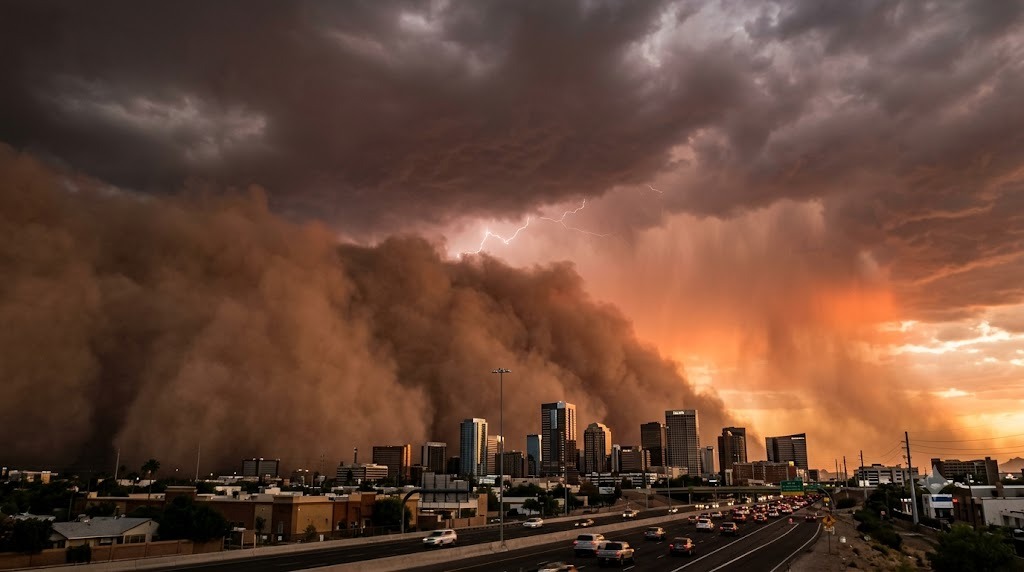
When the National Weather Service broadcasts a dust storm warning, it indicates that visibility will rapidly drop to a quarter-mile or less due to blowing dust. The current atmospheric conditions over Arizona feature high-pressure systems colliding with intense monsoon moisture.
This collision generates powerful downdrafts from isolated thunderstorms, which sweep across the desert floor and pick up massive amounts of loose topsoil, creating a phenomenon known locally as a haboob.
Local authorities emphasize that an official dust storm warning is not a mere advisory; it is an urgent alert demanding immediate action. Drivers on major interstates like I-10 and the Loop 202 face the most severe risks, as moving walls of dust can consume a highway in seconds, completely blinding motorists.
Timeline of Isolated Storms and Dust Threats
The dynamics of this particular weather event involve highly unpredictable, isolated storm cells. While one neighborhood might experience heavy, localized rainfall, an adjacent area might face dry, severe wind gusts carrying tons of dust. Tracking the timeline allows residents to secure property and avoid hazardous travel.
| Time (MST) | Weather Event | Affected Region | Threat Level | Visibility Hazard |
| 4:00 PM | Initial Thunderstorm Downdrafts | Pinal County | Moderate | 1 to 2 miles |
| 5:30 PM | Dust Wall Formation (Haboob) | South Phoenix / Chandler | Severe | Under 0.25 miles |
| 6:45 PM | Peak Warning Window | Central Phoenix / I-10 | Critical | Near Zero |
| 8:00 PM | Isolated Storms & Flash Flooding | Scottsdale / Mesa | High | Rain-wrapped dust |
| 10:00 PM | Dissipation and Lingering Dust | Entire Metro Area | Moderate | Hazy conditions |
Key Hazards for the Phoenix Metro Area
Severe Visibility and Driving Conditions
The most life-threatening aspect of any dust storm warning is the instantaneous loss of visibility. The Arizona Department of Transportation strictly advises drivers to “Pull Aside, Stay Alive.”
If you are caught on the road when a dust wall hits, you must pull completely off the paved portion of the roadway, turn off all vehicle lights, and take your foot off the brake. Leaving lights on often causes trailing vehicles to follow the lights, resulting in devastating multi-car pileups.
Also Read :France Spain Wildfires: Historic 300,000 Evacuations as Temperatures Soar
Air Quality and Health Precautions
Beyond the immediate traffic dangers, an active dust storm warning brings severe health risks. The airborne particulate matter (PM10) carried by haboobs contains valley fever spores, urban pollutants, and fine sand that can deeply penetrate the lungs.
Public health policy experts urge residents, especially those with asthma or compromised immune systems, to remain indoors, seal windows, and run air purifiers until the dust settles.
How Meteorologists Track the Threat
For tech enthusiasts and meteorologists, tracking the data that triggers an emergency alert involves cutting-edge radar technology. The National Weather Service utilizes dual-polarization Doppler radar to differentiate between heavy rain, hail, and airborne dust particles.
When isolated storms collapse, their massive downdrafts hit the desert floor and spread outward. Satellites monitor these outflow boundaries from space, while ground-based radar scans the lower atmosphere to measure the height and density of the dust wall.
This real-time data ingestion allows predictive algorithms to issue a localized dust storm warning minutes before the haboob strikes a populated area. Continuous advancements in these warning systems have saved countless lives over the past decade.
Regional Policy and Emergency Preparedness
From a civic management perspective, a persistent alert strains municipal resources. Power outages are highly common as severe winds snap utility poles and knock down power lines. Regional policy dictates that emergency response units remain on standby, and utility companies preposition repair fleets around the Phoenix metro area during the August monsoon peak.
Homeowners must also take proactive steps. Securing loose patio furniture, trimming dead tree branches, and preparing an emergency kit with flashlights, water, and first-aid supplies are vital protocols. When the alert hits your mobile device, respecting the emergency protocols is your best defense against the chaotic forces of nature.
Finding Calm Amidst Nature’s Fury: A Deeper Perspective
When a massive wall of dust swallows a city, turning daylight into sudden darkness, it serves as a profound reminder of human vulnerability. No matter how much technology we possess or how advanced our infrastructure becomes, a severe natural event can instantly halt our daily routines. These physical storms mirror the unpredictable tempests of human life—sudden illnesses, financial crises, and personal losses that strike without warning, leaving us blinded and seeking a safe refuge.
Just as we respect weather alerts and take shelter inside our homes to protect our physical bodies, we must also seek a permanent, indestructible shelter for our souls. According to the profound spiritual knowledge delivered by Sant Rampal Ji Maharaj, the world we live in is temporary and fraught with continuous hardships. True peace cannot be found in navigating the endless cycles of worldly chaos.
Sant Rampal Ji Maharaj imparts the exact spiritual methodology and true worship of the Supreme God Kabir, providing a spiritual anchor that remains steady regardless of the worldly storms raging around us. Through authentic devotion and taking refuge in the Supreme Creator, humanity can find lasting peace, divine protection, and ultimately attain salvation, breaking free from the turbulent cycle of life and death. To discover this transformative spiritual path and understand the deeper purpose of human life, explore the profound discourses in the holy book Gyan Ganga, which is available free of cost.
FAQs on Dust Storm Warning
Q1. What exact conditions trigger a dust storm warning?
The National Weather Service issues a dust storm warning when widespread blowing dust is expected to suddenly reduce visibility to one-quarter mile or less. This is typically caused by strong wind outflows from collapsing isolated thunderstorms hitting dry, loose soil.
Q2. How should drivers react to a dust storm warning on the highway?
When a dust storm warning affects your route, you must immediately pull your vehicle completely off the paved portion of the road. Turn off all lights, take your foot off the brake pedal, and wait inside the vehicle until visibility improves.
Q3. How long does a typical dust storm warning last?
These warnings usually remain in effect for one to three hours, depending on the size of the haboob and the speed of the storm system. However, the most severe zero-visibility conditions often pass over a specific area within 10 to 30 minutes.
Q4. Are isolated storms common during a dust storm warning?
Yes, isolated thunderstorms are the primary catalyst for massive dust storms during the Arizona monsoon season. The powerful downdrafts from these rainstorms create the massive wind shear that kicks up dust walls.
Q5. Does a dust storm warning impact local air quality?
Property owners and residents should note that a dust storm warning severely degrades air quality due to high concentrations of particulate matter. Health officials advise all residents to remain indoors with windows closed until the storm completely dissipates.
Related Stories








Discussion (0)