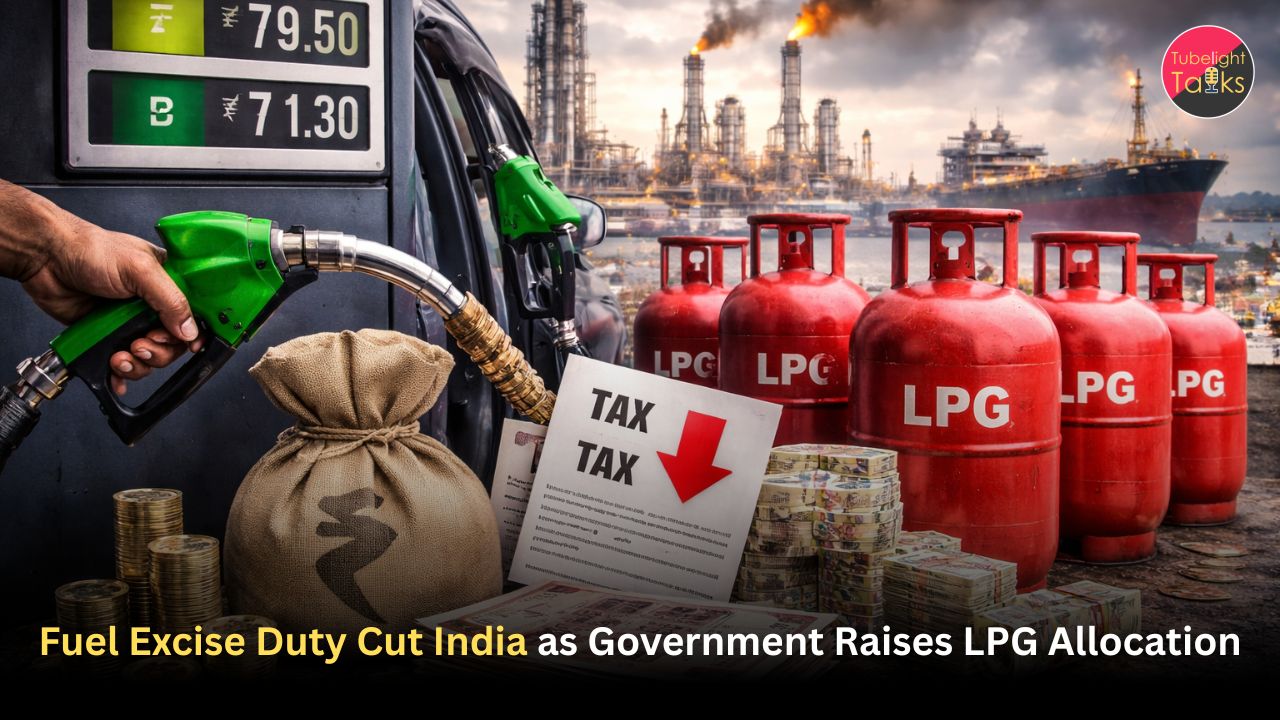
Fuel Excise Duty Cut India as Government Expands LPG Supply Amid Oil Shock
India has moved to blunt the domestic impact of the West Asia energy crisis through a fuel excise duty cut India policy move, cutting the special additional excise duty on petrol and diesel and increasing the commercial LPG allocation for states. Reuters reported that the government reduced the special excise duty on petrol to ₹3 per litre from ₹13 and cut the duty on diesel to zero from ₹10 per litre.
In the same broader response, the petroleum ministry raised commercial and industrial LPG supply by another 20 percentage points, taking total allocation to 70% of pre-crisis levels.
This is one of the most consequential economic decisions of the day because it shows how New Delhi is choosing to handle the oil shock: not by denying the seriousness of the crisis, but by shifting part of the burden from consumers and fuel retailers onto the exchequer. Reuters said the move came as global oil prices stayed above $100 per barrel after the near closure of the Strait of Hormuz, a route that handles a large share of India’s crude imports.
What exactly the government changed
Petrol duty was cut sharply, diesel duty was scrapped
The most immediate headline measure is the excise-duty cut. Reuters reported that a government order released late on Thursday reduced the special excise duty on petrol to ₹3 per litre and removed the duty on diesel entirely. Times of India and Economic Times reported the same revised rates and described the cut as a ₹10-per-litre reduction in both cases relative to the earlier levy structure.
That is a large tax adjustment by recent standards. It signals that the Centre sees the current oil shock as serious enough to justify a direct fiscal response rather than relying only on administrative reassurance or hoping that crude prices cool on their own. Reuters also reported that the move is intended to protect consumers and rein in a potential spike in inflation.
Commercial LPG allocation was raised to 70%
The second half of the government’s response is just as important, even if it has drawn less public attention than petrol and diesel. Reuters reported that in a letter dated Thursday, the petroleum ministry said it would raise LPG allocation to commercial and industrial users by 20%, taking the total supply to 70% of pre-crisis levels. Economic Times and Times of India separately reported the same increase and said the additional allocation is meant to support priority industries and state-level distribution needs.
This matters because India had already cut non-cooking LPG allocation after the start of the Iran war. The latest increase therefore represents a partial easing of emergency curbs, not a return to normal. It suggests the government believes some immediate supply pressure can now be relieved, but only in a controlled way. Reuters said priority would go to sectors such as steel, automobiles, textiles, and other essential industries.
Why the government acted now
The oil shock is no longer theoretical
The decision is clearly tied to the worsening West Asia crisis. Reuters reported that global oil prices surged past $100 per barrel after the near shutdown of the Strait of Hormuz. For India, that is especially serious because the country imports most of its fuel needs and remains heavily exposed to Gulf-linked energy flows. The same Reuters report said Hormuz serves as a conduit for 40% of India’s crude imports.
That means the government is responding not only to international headlines, but to an immediate macroeconomic threat. High crude prices put pressure on inflation, the rupee, current-account balances, and retail fuel management. Raising commercial LPG allocation alongside the excise cut shows the Centre is trying to contain both price pressure and physical supply stress at the same time. That is an inference drawn from the combined design of the two measures.
Also Read: Sensex Nifty Fall as Dalal Street Faces War Pressure and Rupee Weakness
The move is also meant to shield domestic consumers and oil companies
Reuters quoted Oil Minister Hardeep Singh Puri as saying the government had taken a “huge hit” on tax revenues so that the very high losses of oil companies could be reduced at a time of sky-high international prices. Reuters also reported that state-run oil marketing companies, which dominate India’s retail fuel network, do not always fully pass on global crude increases to consumers, meaning either the government or the companies absorb part of the shock.
That point is crucial. The policy is not just about lowering a tax rate on paper. It is about stabilizing a stressed fuel system in which retail prices, company margins, and political tolerance for inflation are all under pressure at the same time. In that sense, the excise cut is a buffer mechanism as much as a relief measure. This is an inference supported by Reuters’ description of how India’s fuel-pricing system works in practice.
Also Read: Rupee Falls to Record Low as India Activates Fuel Relief Measures
Will consumers actually see cheaper petrol and diesel?
The answer may be more complicated than it looks
A tax cut this large would normally suggest immediate pump-price relief. But multiple reports indicate the real-world effect may be more nuanced. Reuters said the duty cut is meant to reduce the losses of oil marketing companies while protecting consumers from price spikes. Economic Times reported that the tax cut may not translate into a full or immediate reduction in retail prices because oil companies are facing extraordinary cost pressure from war-driven crude prices.
That means the move may work less like a windfall discount for motorists and more like a shield against sharper increases that might otherwise have been unavoidable. This distinction matters because it changes how the policy should be understood. It is better read as shock absorption than as a simple ₹10 relief pass-through. That is an inference based on Reuters’ reporting on OMC losses and ET’s reporting on limited immediate retail impact.
Diesel’s zero-duty status is especially important for inflation
Even if consumers do not instantly feel the full arithmetic benefit at retail pumps, cutting diesel duty to zero still matters. Diesel has a much wider inflation footprint than petrol because it affects freight, logistics, agriculture, and industrial transport. A sharp rise in diesel prices would spill quickly into food, manufacturing, and distribution costs.
That is why the diesel decision may matter more macroeconomically than the petrol one. This is an inference based on diesel’s role in the Indian economy and the government’s stated desire to restrain inflation.
Why the LPG decision matters beyond industry
Commercial LPG shortages were becoming a real pressure point
The increased commercial LPG allocation is aimed at preventing a deeper supply crunch in sectors that cannot easily switch fuels. Economic Times reported that the extra 20% allocation is meant to stabilize operations and support priority industries. Times of India’s related reporting said the Centre’s communication to states was meant to ensure continued gas availability for sectors relying heavily on LPG amid the global energy crisis.
This is especially relevant because India’s dependence on imported LPG remains high. Reuters reported that India consumed 33.15 million metric tons of cooking gas last year, with imports accounting for about 60% of demand and about 90% of those imports coming from the Middle East. That import profile explains why LPG management has become such a central part of the government’s crisis response.
The government is trying to prevent shortages from spreading across sectors
The allocation increase also shows the Centre is aware that an LPG crisis would not remain confined to one industry. If hotels, food-processing units, small manufacturers, and other commercial users start facing deep supply cuts, the economic pain would spread quickly. By raising availability to 70% of pre-crisis levels, the government appears to be trying to keep those sectors functioning without fully normalizing supply. That is an inference from the allocation figure and the priority-based approach reported in current coverage.
The fiscal cost is real
The excise-duty cut will not be free for the government. Reuters cited economist Madhavi Arora estimating an annualized fiscal hit of nearly ₹1.55 trillion if current conditions persist. Reuters also said the government did not specify the full cost in the order itself.
This is what makes the move politically and economically significant. The Centre is effectively choosing to sacrifice part of its revenue base in order to reduce inflation risk and fuel-system stress. That does not settle the long-term fiscal question, but it shows the government believes the immediate cost of inaction would be worse. This is an inference based on the timing and scale of the tax cut.
The policy package includes more than just relief
Reuters reported that along with cutting excise duty on petrol and diesel, India imposed windfall taxes on exports of diesel and aviation turbine fuel, setting them at ₹21.5 per litre and ₹29.5 per litre respectively. That is an important part of the policy package because it shows the government is also trying to protect domestic availability and discourage excessive exports during a supply shock.
So this is not simply a tax giveaway. It is a balancing exercise: reduce domestic pressure on key fuels, support oil retailers, and tighten control over export incentives where needed. That broader structure makes the response look more like crisis management than a one-line populist measure. This is an inference from the simultaneous excise cut and export-duty increase reported by Reuters.
The question of relief in difficult times
Teachings associated with Sant Rampal Ji Maharaj emphasize compassion, responsible conduct, and protecting society from unnecessary suffering. Read in that light, policy relief in a time of crisis carries value when it genuinely shields ordinary people rather than only easing pressure at the top. In an energy shock, the real test of governance is whether it acts with balance, fairness, and concern for those who feel inflation first and hardest. This is a spiritual reflection, not an economic forecast.
Call to Action
This decision should not be judged only by the duty cut headline. The real indicators to watch now are whether pump-price increases are contained, whether commercial LPG supply actually eases, and how long the government can carry the fiscal burden if the war-driven oil shock continues.
FAQs: Fuel Excise Duty Cut India
1. What did the government change in fuel taxes?
India cut the special additional excise duty on petrol to ₹3 per litre from ₹13 and reduced the duty on diesel to zero from ₹10, according to Reuters.
2. Why was this decision taken now?
Reuters said the move was made as global oil prices surged because of the Iran war and disruption around the Strait of Hormuz, creating inflation and supply risks for India.
3. Has commercial LPG allocation really been raised to 70%?
Yes. Reuters reported that the petroleum ministry raised commercial and industrial LPG allocation by 20 percentage points, taking total supply to 70% of pre-crisis levels. ET and TOI reported the same increase.
4. Will petrol and diesel prices fall immediately?
Not necessarily in full. Reuters and ET indicate the tax cut is also meant to reduce oil marketing company losses and cushion consumers from sharper hikes, so the immediate retail benefit may be limited.
5. Which sectors are likely to benefit from the LPG increase?
Reuters reported priority would go to sectors such as steel, automobiles, textiles, and other essential industries.
6. What is the likely fiscal cost of the excise cut?
Reuters cited an estimate by economist Madhavi Arora that the annualized fiscal hit could be nearly ₹1.55 trillion.
Related Stories







Discussion (0)