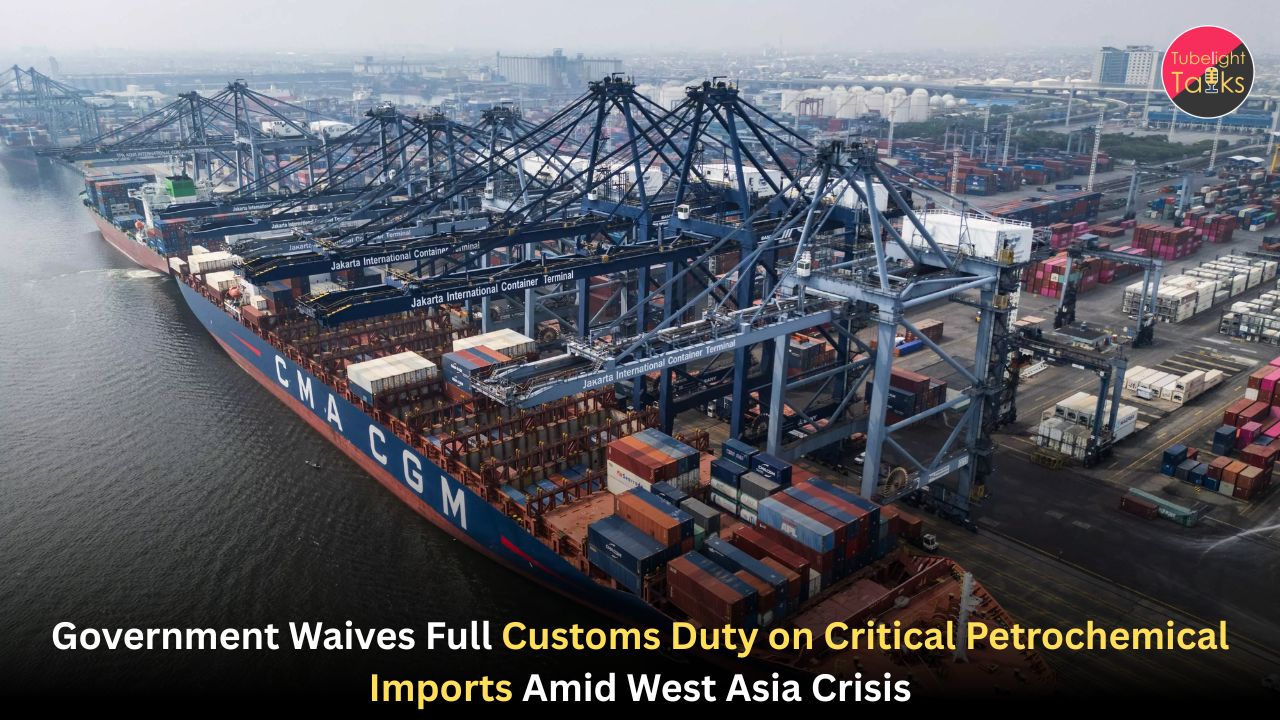
Economic Relief Measures: Government Grants Full Customs Duty Exemption on Critical Petrochemical Imports
The Government of India has granted full customs duty exemption on critical petrochemical imports in response to the ongoing conflict in West Asia. Official PIB search results describe it as a “targeted relief,” while Reuters reports that the exemption covers 40 petrochemical products and will remain valid until June 30, 2026. The move is meant to cushion domestic industry from supply disruptions, higher feedstock costs and rising freight stress linked to the Iran war and the closure-related disruption around the Strait of Hormuz.
The relief is broad enough to matter immediately
Reuters reported that India has abolished import tax on petrochemicals used for making plastics and pharmaceutical goods, and that the exemption applies to 40 products. That makes this more than a symbolic tariff tweak. It is a short-term supply-side intervention aimed at sectors that feed into packaging, healthcare, chemicals and other manufacturing chains.
The government is also framing the measure as part of a wider response to war-driven shortages. Reuters reported separately that New Delhi has already cut excise duties on petrol and diesel and rolled out support measures worth about ₹18 billion, including the petrochemical duty waiver, as it tries to limit inflation and supply stress.
Why the government acted now
According to Reuters, the immediate trigger was a sharp distortion in India’s domestic gas and petrochemical balance after the Iran war. Days after the U.S.-Israeli strikes on Iran, the Indian government directed companies to divert locally produced petrochemical components toward LPG production because of cooking-gas shortages. Since India imports about 60% of its LPG needs, that shift tightened domestic feedstock availability for petrochemical producers.
That created a chain reaction. Reuters says local producers began facing tighter feedstock supply, higher prices and rising premiums, while downstream industries were left exposed to cost increases. The customs duty exemption is therefore designed to fill the gap created by domestic diversion and stabilize supplies for industries that cannot easily absorb prolonged shortages.
The West Asia conflict has turned petrochemicals into a domestic inflation risk
Reuters reported that the Middle East conflict has disrupted India’s gas supplies and affected parts of manufacturing, air travel and shipping. It also noted that energy and freight costs have surged because the conflict has effectively closed the Strait of Hormuz, a route that typically carries about 20% of the world’s oil flows.
That matters because petrochemicals are not niche industrial inputs. They are embedded in plastics, packaging, pharmaceuticals and a wide range of consumer and industrial goods. When supply tightens and feedstock costs rise, the pressure eventually spreads into factory margins and then into consumer prices. The duty exemption is therefore an attempt to prevent a supply shock from becoming a broader price shock. This is an inference based on Reuters’ description of the sectors affected and the purpose of the relief.
Also Read: West Asia Crisis Escalates as U.S. Hits Karaj Bridge and Threatens Wider Iranian Infrastructure
The measure is temporary, but strategically significant
Reuters says the exemption is valid only until June 30, 2026. That suggests the government sees the move as emergency relief rather than a permanent tariff change. The time-bound design also indicates that policymakers are trying to bridge a period of acute geopolitical stress without making a lasting change to the tariff regime.
Even so, the signal is important. Reuters reported that the government is examining additional import-duty cuts on other critical raw materials and may regulate exports if necessary to ensure domestic availability. So this petrochemical step may be the first in a wider package of crisis-management measures rather than a one-off intervention.
Downstream sectors stand to benefit the most
The clearest beneficiaries are industries that rely on petrochemical derivatives as regular inputs. Reuters specifically identified plastics and pharmaceutical goods, and an industry analyst quoted by Reuters said the decision should help ease cost pressures across downstream industries and provide relief to end consumers amid ongoing global supply disruptions.
That is significant because these sectors sit close to everyday economic life. Relief on petrochemical inputs can help protect manufacturing continuity, reduce the risk of price spikes, and limit disruption in essential goods. The measure may not eliminate all pressure, especially if oil and freight costs keep rising, but it does reduce one important layer of stress.
A practical response to a geopolitical shock
The customs waiver shows how quickly global conflict can reshape domestic economic policy. A war in West Asia has not only moved oil prices and currencies; it has now forced India to rethink input availability, trade costs and tariff settings for core industrial materials. Reuters’ reporting makes clear that the government is moving from observation to intervention, especially where supply constraints threaten domestic stability.
In that sense, this is not just a petrochemical story. It is a broader example of how supply-chain resilience has become a central part of economic governance. When external shocks hit, governments increasingly respond not only through diplomacy or fuel-price adjustments, but also through targeted customs and trade measures. This is an inference supported by Reuters’ reporting on India’s broader review of duties and exports.
Real stability comes from wise and timely action
Economic pressure often tests both systems and people. A timely policy step can prevent panic and reduce suffering when supply chains are under stress. That naturally aligns with the broader principle that wise action should protect the many, not merely react after damage is done. A society remains stronger when decisions are guided by balance, foresight and responsibility.
Call to Action
Businesses in plastics, pharmaceuticals and related sectors should track the exemption window carefully and reassess sourcing plans while the relief remains in force. Citizens and market observers should also watch whether the government expands similar measures to other critical inputs if the West Asia conflict continues to disrupt energy and freight routes. The bigger story now is not only this exemption, but how far India may go to shield domestic supplies from a prolonged external shock.
FAQs: Government Waives Full Customs Duty on Critical Petrochemical Imports Amid West Asia Crisis
1. What has the government announced on petrochemical imports?
The government has granted full customs duty exemption on critical petrochemical imports in view of the ongoing conflict in West Asia.
2. How many products are covered?
Reuters reported that the exemption covers 40 petrochemical products.
3. How long will the exemption remain in force?
It is valid until June 30, 2026.
4. Which sectors are expected to benefit?
Reuters said the relief applies to petrochemicals used for plastics and pharmaceutical goods, which means downstream manufacturing in those sectors should benefit most directly.
5. Why was this measure needed?
Reuters reported that India diverted local petrochemical components toward LPG production due to shortages caused by the Iran war, which tightened domestic supply and raised costs.
6. Is this part of a broader economic response?
Yes. Reuters reported that India is also reviewing further duty cuts and possible export regulation on essential goods to protect domestic availability during the West Asia crisis.
Related Stories







Discussion (0)