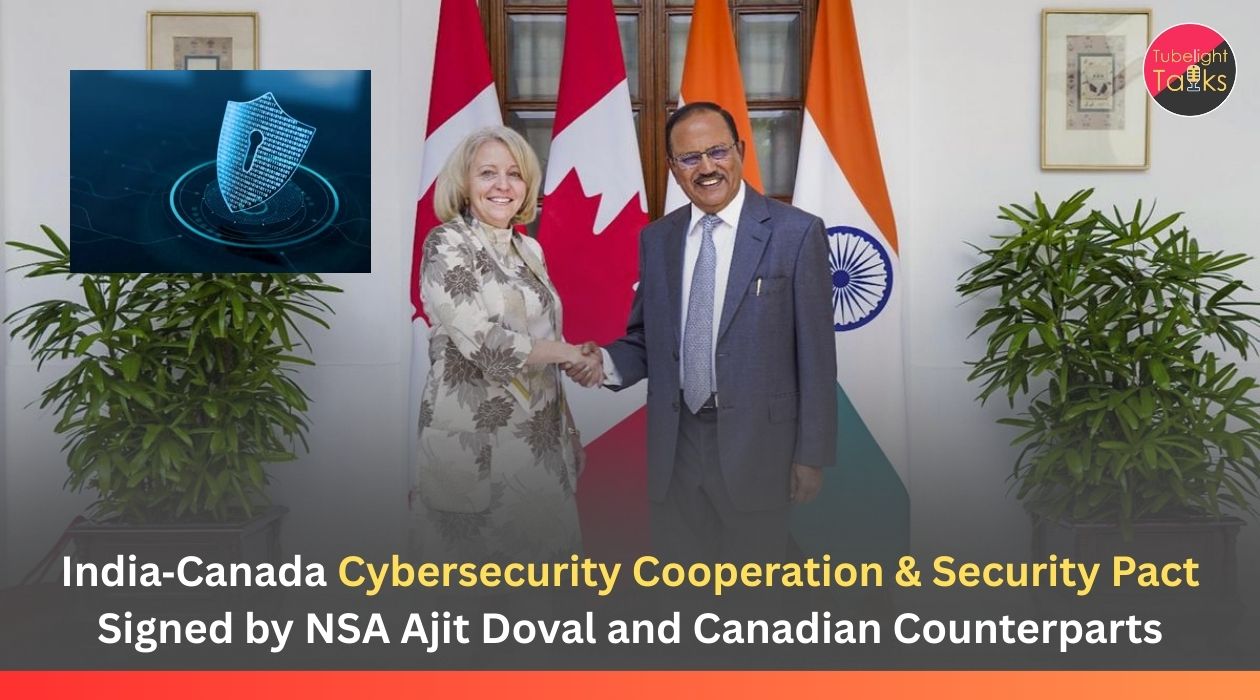
India‑Canada Cybersecurity Cooperation & Security Pact Signed by NSA Ajit Doval and Canadian Counterparts
India‑Canada Cybersecurity Cooperation: India and Canada have taken a major step to bolster bilateral security cooperation, including cybersecurity and law enforcement collaboration, following high‑level talks between India’s National Security Adviser Ajit Doval and Canada’s Deputy Clerk and National Security and Intelligence Adviser Nathalie Drouin during his two‑day visit to Ottawa.
The two sides agreed on a shared work plan that will guide cooperation on national security, law enforcement, and cybersecurity, laying the groundwork for information sharing, joint strategic planning, and practical collaboration on issues of mutual concern.
Key Features of the Security & Cyber Pact
Shared Work Plan for Security Cooperation
Under the new framework, India and Canada will work together using a structured “work plan” to deepen cooperation on national security priorities. Agencies from both countries will build on existing ties to streamline communication and coordinate efforts more effectively.
Establishment of Security Liaison Officers
A significant outcome of the agreement is the decision to establish security and law‑enforcement liaison officers in each other’s capitals. These officers will serve as direct points of contact, facilitating real‑time exchange of intelligence and insights on emerging threats.
This mechanism is expected to significantly improve the timeliness and accuracy of shared information, especially on transnational organized crime networks and the illegal flow of drugs, including fentanyl precursors — a priority for both nations.
Formal Cybersecurity Cooperation
Both sides also committed to formalising cooperation on cybersecurity policy and information sharing related to cyber threats. This step aims to strengthen defences against cyber‑enabled crime, ransomware attacks, and other malicious digital intrusions targeting critical infrastructure, governments, and private sectors in both countries.
The agreement also includes continuing discussions on collaborative measures to combat fraud and immigration enforcement challenges, while respecting each country’s domestic laws and international obligations.
Also Read: India-Japan Defense Tech Partnership 2026: Drones, Cybersecurity & AI for a New Strategic Era
Context: Reset in India‑Canada Relations
The new security cooperation pact comes at an important juncture in bilateral ties. Relations between India and Canada were severely strained in previous years, particularly after allegations surrounding the killing of a Khalistani separatist in 2023, which led to diplomatic tensions and reciprocal expulsion of diplomats.
The recent talks between NSA Doval and Canadian counterparts — including Public Safety Minister Gary Anandasangaree — signal a concerted effort by both countries to normalise relations and focus on shared security interests, moving beyond past disagreements.
Canadian officials have also indicated that extremist groups provided safe haven in Canada will receive focused attention under this cooperation framework, with Canada reaffirming its commitment to enforce domestic laws against violent extremism and support joint approaches to common threats.
Strategic Importance of the Pact
Combating Cyber Threats
As cybercrime continues to evolve rapidly — affecting governments, private sectors, and critical infrastructure worldwide — structured cooperation between India and Canada will enable better incident response, threat intelligence fusion, and policy alignment to protect national interests.
Transnational Crime & Drug Networks
The agreement also enhances cooperation on transnational crime, particularly focusing on illicit drug precursor trafficking — a growing concern for law enforcement in both countries. Liaison officers and shared procedures are expected to make bilateral responses more agile.
Global Reactions to the Security Pact
International observers view the India‑Canada security cooperation pact as an encouraging development that strengthens global collaboration against cyber threats, organised crime and other cross‑border security challenges. The pact has been welcomed as a strategic step by two democratic nations with expanding global influence and shared interests in safety, stability, and rule‑based order.
Inner Security in an Uncertain World
Finding Inner Strength Beyond Geopolitical Ties
While nations work toward cooperation to protect physical and digital borders, every individual also faces the persistent challenge of finding lasting security in a world full of uncertainties.
Sant Rampal Ji Maharaj’s teachings remind us that true protection — beyond physical alliances or digital shields — lies in connecting with the eternal Supreme God. According to his spiritual guidance, worldly efforts to build security, however crucial, are impermanent. Real, everlasting peace and stability come from attaining inner enlightenment and spiritual liberation, transcending fear, conflict, and worldly anxieties.
In a world increasingly prone to cyber threats, geopolitical tension, and social instability, the path of Satlok, as described by Sant Rampal Ji Maharaj, offers individuals a source of unshakeable peace and inner strength.
FAQs: India‑Canada Cybersecurity Cooperation
1. What does the India‑Canada cybersecurity pact involve?
It involves a shared work plan for cooperation on national security, the establishment of liaison officers, and a commitment to share cybersecurity information and policy coordination.
2. Who are the key officials behind the agreement?
The pact was agreed upon by India’s NSA Ajit Doval and Canada’s Deputy Clerk and National Security and Intelligence Adviser Nathalie Drouin, with additional talks involving Canada’s Minister for Public Safety.
3. Why is cybersecurity cooperation important?
Cybersecurity cooperation helps both countries defend against growing cyber threats, ransomware attacks, and other digital crimes, while improving policy alignment and intelligence sharing.
4. What other areas are covered in the pact?
Besides cybersecurity, the pact includes cooperation on law enforcement, transnational crime, immigration enforcement, and mechanisms to improve bilateral communications.
5. How does the pact affect India‑Canada diplomatic relations?
The pact represents a strategic reset and an effort to move forward from past tensions, indicating a more collaborative era in security and law enforcement cooperation.
Related Stories










Discussion (0)