West Asia War Escalates: Iran Ceasefire Collapses as US and Israel Strike
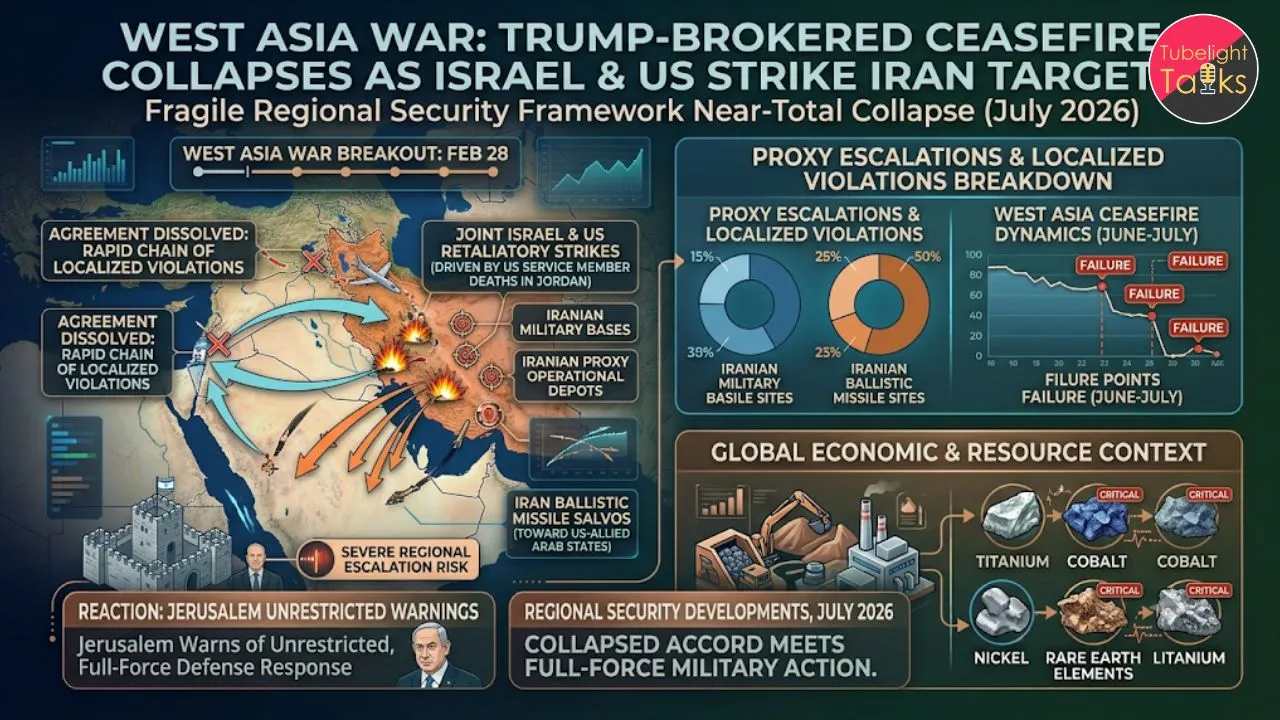
Iran Ceasefire Collapses: The fragile regional security framework in the Middle East has entered a state of near-total volatility as of July 2026. The 60-day interim agreement signed in mid-June—which temporarily paused the high-intensity war that broke out on February 28—has completely dissolved following a rapid chain of localized violations and deadly proxy escalations. As the Iran Ceasefire Collapses, driven by the recent deaths of American service members stationed in Jordan, the United States military has unleashed a punishing wave of naval and aerial strikes across southern and western Iran.
Tehran has responded by firing dense salvos of ballistic missiles toward US-allied Arab states, bringing the war directly to the borders of Israel and prompting severe warnings of an unrestricted, full-force defense response from Jerusalem.
Direct Engagement Escalates as Iran Ceasefire Collapses
US Airstrikes and Nuclear Facility Disruption
The latest military operations represent a major escalation in target selection by Western planners. Now that the Iran Ceasefire Collapses, US Central Command (CENTCOM) confirmed that its forces deployed Tomahawk cruise missiles and strike aircraft to target key military coastal surveillance nodes, early-warning air defense radars, and deep-mountain missile storage depots.
Crucially, Iranian state media confirmed that these strikes caused significant damage to the construction site of the planned Darkhovin nuclear power facility located in southwestern Iran, drawing sharp warnings and calls for immediate operational restraint from the UN’s International Atomic Energy Agency (IAEA).
Also Read: Anchor of the Indo-Pacific: India–US Strategic Ties Expand Across Defence and Critical Minerals
The American air campaign is explicitly structured to quickly diminish the Islamic Revolutionary Guard Corps’ (IRGC) ability to enforce a total shipping blockade across the critical Strait of Hormuz. By targeting key logistics networks, including bridges connecting southern ports like Bandar Abbas to inland hubs, the coalition aims to paralyze local tactical transport.
However, as the Iran Ceasefire Collapses, these deep military actions have unified the political rhetoric within Tehran, effectively suspending all remaining diplomatic conversations regarding long-term nuclear enrichment limitations or sanctions relief frameworks.
Current West Asia Conflict Matrix (July 2026)
| Theater / Operational Hub | Executed Military Actions | Strategic Objectives & Impact |
| Mainland Iran Targets | US Tomahawk cruise missile strikes on radar and Darkhovin nuclear sites. | Degrading IRGC control channels and defensive coastal arrays. |
| Jordanian Airspace | Interception of three heavy Iranian ballistic missiles over Aqaba. | Protecting strategic US support hubs and regional staging bases. |
| Kuwaiti Coastline | Secondary drone strikes targeting vital water desalination plants. | Threatening local utility stability to pressure Arab state support. |
| Strait of Hormuz | Forced navigation accidents and severe warnings to commercial fleets. | Restricting international energy transit to cause global shocks. |
The Expansion of the Conflict Zone
The Targeting of Allied Infrastructure
Rather than focusing its immediate response solely on Israeli borders, Iran has shifted its military strategy toward striking the wider network of US-aligned Arab states across the Gulf Cooperation Council (GCC). In a series of highly coordinated night operations, Iranian units launched missile arrays targeting critical civilian infrastructure in Kuwait, Jordan, and Bahrain. Kuwait reported severe damage to a major power generation and water desalination facility for the second time in forty-eight hours, directly threatening the primary drinking water supply of the arid nation and drawing sharp accusations of regional war crimes from local Arab diplomats.
Concurrently, the conflict has pushed right up against the borders of Israel. A heavy ballistic missile salvo directed toward the Jordanian port city of Aqaba was intercepted by a joint combination of local air defenses and Israeli military systems based out of neighboring Eilat. The close proximity of the explosions caused air-raid sirens to sound across Israel’s southern territories for the first time in weeks.
Israeli Defence Minister Israel Katz issued an absolute warning, stating that any direct missile impact on sovereign Israeli soil would be met with an unrestricted, “full force” counter-strike against mainland Iran, a move that would immediately expand the conflict into an open, multi-front war.
Service, Humility and Public Duty
The tragic return to open war across these historic lands offers a stark reminder of the limits of worldly agreements built on strategic deterrence, military pride, and political posturing. Sant Rampal Ji Maharaj’s spiritual guidance teaches us that true safety can never be won through the destruction of civilian infrastructure or the precision of ballistic missiles.
SatGyan reveals that regional conflicts burn out of control when national leadership lets ego, territorial ambition, and retaliatory pride dictate public policy. According to the eternal spiritual laws of Supreme God Kabir, ultimate security and global peace are achieved only when leaders approach governance with deep humility, protecting the sacred value of all human life and recognizing the unity of the human family over geopolitical dominance.
FAQs on the Middle East Conflict Escalation
Why did the June interim ceasefire between the US and Iran collapse?
The truce dissolved following a series of localized violations, culminating in the deaths of US service members in Jordan and subsequent heavy American retaliatory strikes.
Which sensitive facilities inside Iran were hit during the latest US strikes?
US forces targeted deep-mountain missile storage bases, air defense radar networks, and the construction site of the Darkhovin nuclear power plant.
How has Iran modified its retaliatory target selection in July 2026?
Iran has focused its missile strikes on critical civilian infrastructure within US-allied Arab states, heavily targeting water desalination and power plants in Kuwait and Jordan.
What warning has the Israeli government issued regarding the latest missile fire?
Defence Minister Israel Katz warned that if any Iranian missiles spill over to hit sovereign Israeli territory, Israel will respond with an independent, full-force military counter-offensive.
What is the current operational status of the Strait of Hormuz?
Shipping traffic has dropped to historic lows as maritime authorities warn of high risks due to active military operations and hostile naval maneuvers.
Related Stories










Discussion (0)