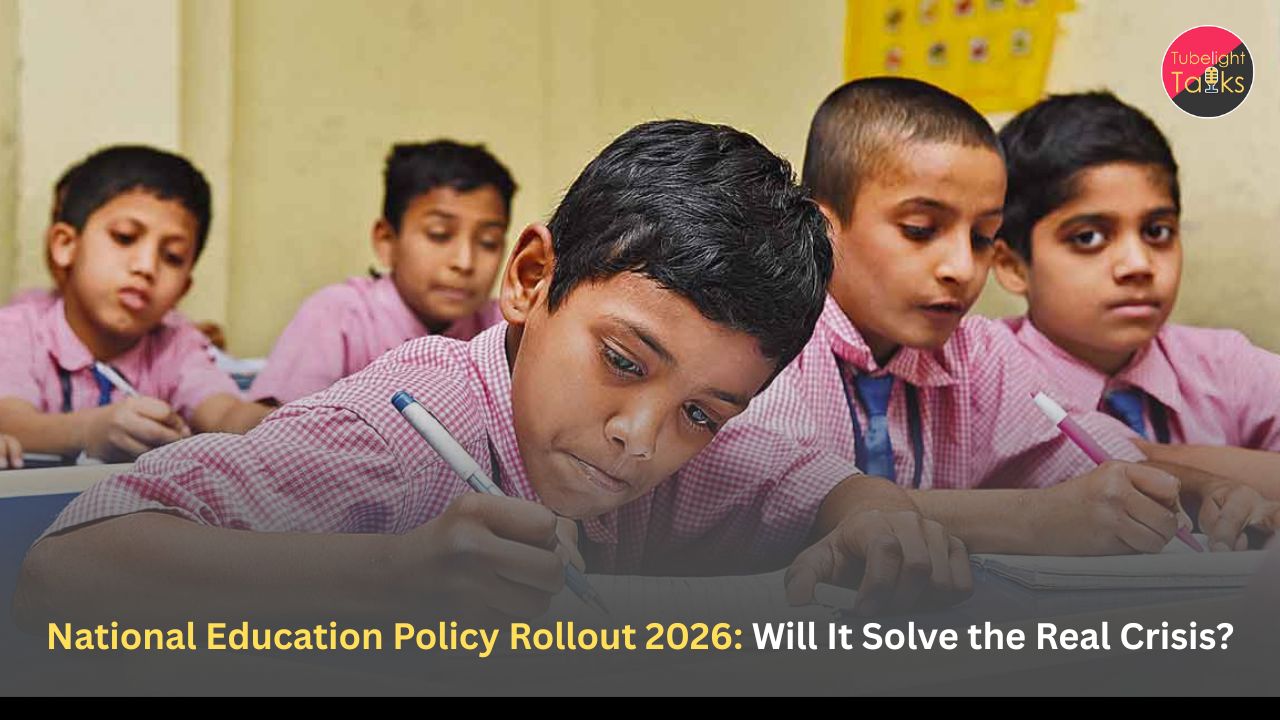
National Education Policy Rollout 2026: Will It Solve the Real Crisis?
National Education Policy Rollout 2026: In a nation where over 65% of the population is under 35, education is not just a policy issue—it’s a national lifeline. As of January 2026, India’s ambitious National Education Policy (NEP) enters its final stage of implementation. Promised as a transformational reform in learning, employability, and innovation, NEP 2026 is under scrutiny:
Is it fixing India’s education-to-employment gap, or just painting a broken system with new colors?
With joblessness rising even among degree-holders, and skills failing to meet market demand, India must urgently assess: What are we teaching, and what for?
What is NEP 2026? Key Highlights of the Rollout
NEP 2026 is the full-scale implementation phase of the 2020 National Education Policy, now expanded with modifications for the digital era and employment challenges.
Major Features of NEP 2026 Implementation:
- 5+3+3+4 curriculum structure fully active in all states
- Board exams twice a year with best-score selection
- Vocational training from Class 6 onward
- Multiple entry-exit system in colleges
- Integration of AI, coding, and skill-based courses
- National Credit Framework (NCrF) to allow transfer between degrees, diplomas, and skills
- Teachers’ training with tech-driven modules
- Regional language instruction up to Class 5 or more
Source: Ministry of Education, Govt of India, January 2026 briefing
Also Read: India’s Deep Tech Unicorns 2026: 10 Startups Changing the Global Game
The Core Crisis: Degree ≠ Job
Despite these reforms, India’s youth unemployment stands at 18.2% (CMIE, 2025). Over 2 crore graduates are either unemployed or underemployed.
“I have a Master’s degree but no job for the past two years,” says Renu, 24, from Kanpur.
“NEP taught me skills, but no company wants a fresher without experience,” adds Saurabh, a BCA student from Bhopal.
Key Disconnects:
- Curriculum still theory-heavy in many regions
- Skill programs lack industry alignment
- Rural and Tier-2 cities lack implementation infra
- Jobs created ≠ number of students graduating
Are We Teaching for Employment—or Just Exams?
NEP Vision:
Make education more holistic, flexible, multidisciplinary, and skills-integrated.
Reality in 2026:
- Focus remains on grading, not problem-solving
- Students still memorize, not analyze or innovate
- Many courses lack job market validation
India produces over 8 lakh engineers annually, but barely 20% are industry-ready (NASSCOM 2025).
Digital Divide Still Hurts the Poor
With heavy focus on online learning, coding, AI, and hybrid classrooms, students in rural areas are falling further behind.
Digital Inequity Stats (2025):
- Only 38% rural households have internet access
- Less than 25% rural teachers are trained for digital content delivery
The urban-rural education gap has widened, despite good intentions of the NEP.
The Hidden Pressure: Exams, Coaching & Stress
- Coaching culture is thriving despite NEP’s emphasis on joyful learning.
- Parents continue to spend lakhs on JEE/NEET prep.
- Students suffer from mental burnout, comparison anxiety, and directionless ambition.
Are Jobs the Only Goal?
Here lies the central question NEP doesn’t answer—Is education just a route to employment? Or should it build character, purpose, and wisdom?
Many students today feel they’re trained for an exam, not for life.
Spiritual Wisdom: What Real Education Looks Like
Teachings of Sant Rampal Ji Maharaj
According to Sant Rampal Ji Maharaj, the real aim of education is not just to earn a livelihood, but to discover the truth of life and our soul’s purpose.
“Degrees without true knowledge are like decorated lamps with no light inside.” – Sant Rampal Ji Maharaj
Real Knowledge = SatGyaan
SatGyaan or True Spiritual Knowledge teaches:
- Who we are as souls
- Why we were born
- What is our ultimate destination
- How to live with righteousness and fearlessness
Sant Rampal Ji Maharaj explains that a complete education combines worldly skills and spiritual insight. Only then can one achieve true success, both in this life and beyond.
Learn more: jagatgururampalji.org | YouTube Channel
Can NEP and Spirituality Work Together?
Yes. A balanced model of education must include:
- Vocational & critical thinking skills for employment
- Spiritual foundation for ethics, discipline, and peace
- Meditation and SatBhakti for emotional and mental stability
Countries like Finland have integrated values-based learning—India must go further by introducing scriptural truth (as per all holy books) in a neutral and universal way.
The Road Ahead
What’s Working:
- Skill-based modules introduced
- Flexibility in degree paths
- Some state boards reducing rote
What’s Not:
- No moral or spiritual education
- Job creation lags behind education output
- Rising mental health issues among students
- Digital divide deepening inequality
FAQs on National Education Policy Rollout 2026
Q1. What is NEP 2026?
It is the full-scale implementation of India’s new National Education Policy focused on flexibility, skills, and holistic learning.
Q2. Will NEP solve youth unemployment?
Not completely. Without parallel job creation and spiritual grounding, education alone cannot fix the employment crisis.
Q3. What are the drawbacks of NEP implementation so far?
Uneven rollout, poor digital access, lack of industry linkages, and minimal focus on ethical or emotional education.
Q4. How does spiritual knowledge improve education?
It builds clarity, purpose, self-discipline, and emotional strength—qualities critical for life success but missing in textbooks.
Related Stories








Discussion (0)