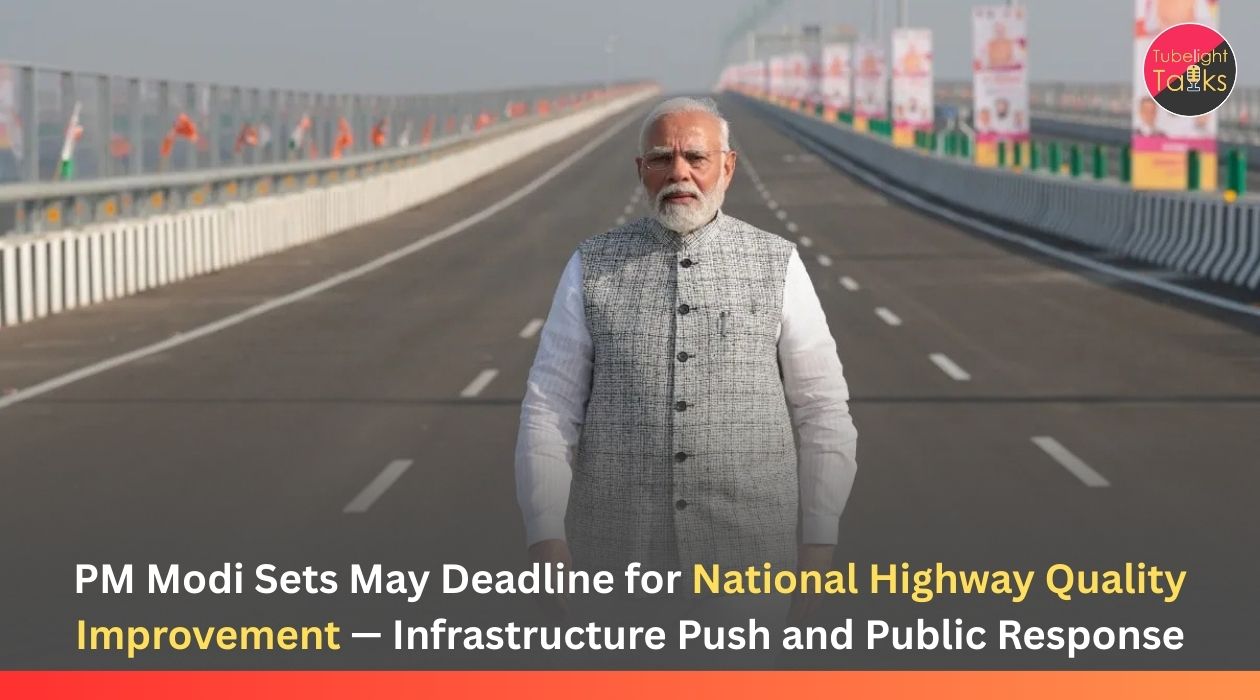
PM Modi Sets May Deadline for National Highway Quality Improvement — Infrastructure Push and Public Response
National Highway Quality Improvement: Prime Minister Narendra Modi has issued a clear directive to the Ministry of Road Transport and Highways to prioritise a significant quality uplift of India’s national highway network by May 2026. The move responds to widespread public and stakeholder complaints about uneven road conditions, premature road damage and construction concerns, especially visible after seasonal rains and monsoons.
The emphasis is on durable construction, improved maintenance, and consistent standards nationwide — shifting focus beyond just expanding the highway network to ensuring that the roads meet high performance and safety benchmarks.
Why the Quality Focus Now?
Growing Concerns Over Road Durability
India’s national highways have seen massive expansion over the past decade, with total highway length reaching around 1,46,572 km and significant investments under programs such as PM GatiShakti National Master Plan to improve connectivity and logistics.
Despite this expansion, concerns have grown among road users and local communities about:
- Potholes and cracks after seasonal changes
- Uneven road surfaces and premature wear
- Delays in repair and maintenance
- Safety issues for heavy transport and passenger vehicles
These issues prompted the Prime Minister’s office to set an urgent timeline for quality improvement and to ensure that construction and maintenance meet stricter benchmarks.
New Standards and Enforcement Measures
To achieve sustained improvement, the government is planning a set of quality‑focused reforms, including:
Stricter Standard Operating Procedures (SOPs)
The formation and implementation of clearer SOPs will hold contractors and agencies accountable for long‑term durability and consistent construction practices.
Contractor Qualification Norms
Proposals suggest tightening contractor eligibility criteria so that vehicles and contractors with poor past performance cannot bid on future highway work — improving accountability and workmanship.
Penalties for Poor Execution
Some reports indicate that contractors delivering substandard work could face bans from future bidding for up to two years — a strong deterrent aimed at quality compliance.
These steps represent a pivot towards rewarding quality, safety, and longevity over rapid completion alone.
Also Read: India’s Northeast to Get 40km Underground Rail Line: Boost to Security and Strategic Mobility
Public and Industry Feedback
Positive Reception from Commuters
Motorists and frequent travellers welcomed the move, pointing out that smooth, durable highways reduce travel time, fuel costs, and vehicle wear, while enhancing road safety. Local businesses and logistics companies also highlighted that better quality roads improve supply chain efficiency and reduce transport costs.
Developers Seek Balance on Deadlines
However, some in the infrastructure sector — particularly national highway developers — have flagged concerns that the stringent timelines could challenge operational execution without compromising safety and engineering standards. They have recommended reasonable flexibility in planning and construction schedules to maintain quality while meeting deadlines.
Authorities have indicated that the quality push will go hand‑in‑hand with process transparency and better contract management, helping the sector balance speed with excellence.
Strategic Impact on National Infrastructure Goals
Beyond Expansion to Quality and Efficiency
The government’s renewed emphasis on quality aligns with recent discussions in India’s Economic Survey 2025–26, which highlighted a shift from merely expanding the highway network to improving logistics efficiency and project delivery quality.
This approach not only enhances road durability but also complements broader national priorities such as:
- Boosting economic activity through improved logistics
- Enhancing regional connectivity
- Ensuring safety and resilience under diverse weather conditions
- Supporting multimodal transport integration
Challenges and Outlook
Implementation and Monitoring
The success of the May deadline will depend on effective monitoring, transparency and coordination among central and state authorities, contractors, and agencies like the National Highways Authority of India (NHAI).
Balancing Speed and Durable Work
While meeting aggressive timelines is critical, industry experts reiterate that quality should not be undermined for speed. A sustainable approach will likely involve staged implementation, periodic inspections and third‑party quality audits.
From Roads to Real Resilience — A Spiritual Perspective
Just as infrastructure must be built with strength, durability and resilience, life — too — requires a foundation of stable and lasting values.
According to Sant Rampal Ji Maharaj, while quality infrastructure enhances external journeys, true inner strength and peace arise from spiritual awakening. He teaches that worldly achievements — however durable they appear — remain impermanent. Real, unfailing resilience is found in divine knowledge and inner clarity. Seeking connection with the Supreme God, as Sant Rampal Ji Maharaj explains, equips the soul with inner steadiness far beyond material accomplishments.
In a world where both roads and relationships can wear down under pressure, spiritual insight offers lasting strength and purpose.
FAQs on National Highway Quality Improvement
1. Why has the government set a May deadline for highway quality improvement?
To address public concerns about road durability, improve safety standards, and ensure national highways are built to last.
2. What reforms are planned to boost quality?
Stricter SOPs, tighter contractor eligibility, potential bidding bans for substandard work, and enhanced monitoring systems.
3. How might this affect road users?
Better quality roads are expected to reduce accidents, travel time, vehicle wear and overall logistics costs.
4. What is the industry’s response?
Developers have acknowledged the need for quality but asked for reasonable timelines to ensure safety and workmanship.
5. Is this part of a wider infrastructure strategy?
Yes — in line with national goals to improve logistics efficiency, connectivity and sustainable development.
Related Stories










Discussion (0)