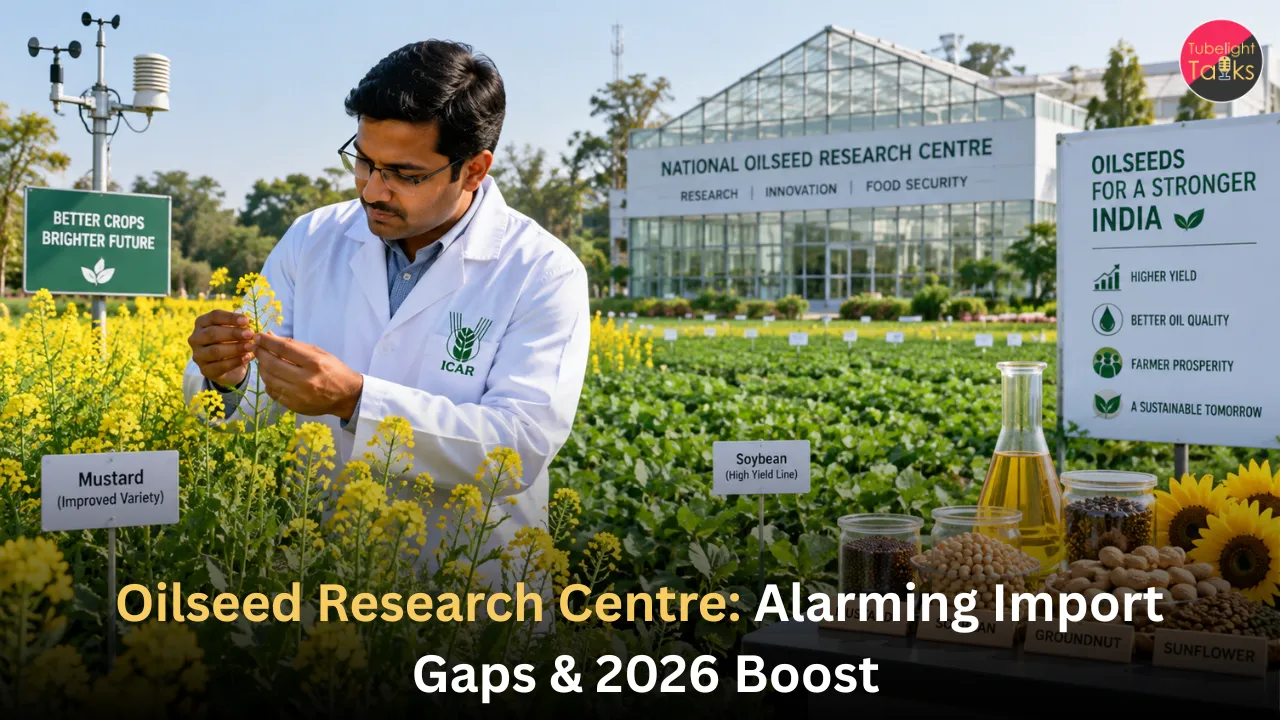
oilseed research centre: Alarming Import Gaps & 2026 Boost
Oilseed crops occupy an indispensable position in the agrarian architecture and economic framework of India. Cultivated across diverse agro-climatic zones, crops such as soybean, groundnut, rapeseed-mustard, sunflower, sesame, safflower, castor, linseed, and niger provide vital raw materials for edible oil processing, livestock feed formulations, industrial oleochemicals, and export commodities. However, meeting the escalating consumer demand requires high-efficiency interventions led by an advanced oilseed research centre. These specialized institutions address production bottlenecks, climate vulnerability, emerging pathogens, and farm profitability.
According to the Third Advance Estimates for 2025–26 released by the Department of Agriculture and Farmers Welfare, India’s total oilseed production reached an estimated 430.59 lakh tonnes (approximately 43.06 million tonnes). This represents consistent progress compared with 429.89 lakh tonnes in 2024–25 and 396.69 lakh tonnes in 2023–24. The sustained momentum underscores the practical value generated when a dedicated oilseed research centre translates laboratory genetics into high-yielding commercial varieties.
National Production Breakdown: Third Advance Estimates Analysis
The latest national data illustrates substantial regional performance across both kharif and rabi cropping seasons. The aggregated output reflects the dominant market share commanded by primary crops such as rapeseed-mustard, groundnut, and soybean.
| Oilseed Crop Variety | 2025–26 Output (Lakh Tonnes) | Primary Cultivating States | Key Industrial End-Use |
| Rapeseed & Mustard | 137.68 | Rajasthan, Madhya Pradesh, Haryana, UP | Domestic cooking oil, meal cake |
| Groundnut | 130.74 | Gujarat, Rajasthan, Tamil Nadu, Andhra Pradesh | Table consumption, edible oil, export |
| Soybean | 125.96 | Madhya Pradesh, Maharashtra, Rajasthan | Defatted soy flour, oil, poultry feed |
| Castor | 21.57 | Gujarat, Rajasthan, Telangana | Industrial lubricants, pharmaceutical wax |
| Sesame | 9.34 | West Bengal, Madhya Pradesh, Gujarat | Confectionery, culinary oil, export |
| Sunflower | 2.70 | Karnataka, Odisha, Bihar, Andhra Pradesh | Premium unsaturated culinary oil |
| Linseed | 1.61 | Madhya Pradesh, Jharkhand, Uttar Pradesh | Paints, varnishes, omega-3 supplements |
| Safflower | 0.66 | Maharashtra, Karnataka | High-oleic culinary oil, birdseed |
| Nigerseed | 0.32 | Madhya Pradesh, Chhattisgarh, Odisha | Value-added export feed, tribal cuisine |
These empirical figures show that rapeseed-mustard, groundnut, and soybean together constitute over 90 percent of India’s total domestic oilseed harvest. Secondary oilseeds require targeted breeding interventions from an apex oilseed research centre to prevent regional acreage shrinkage and sustain genetic biodiversity.
Macroeconomic Weight: Agricultural GVA and National Income Dynamics
When assessing the contribution of oilseeds to India’s national income, statistical parameters must be clearly delineated. The Central Statistics Office (CSO) does not isolate a standalone Gross Domestic Product (GDP) percentage metric exclusively for individual oilseeds. Instead, national accounts integrate these commodities under the broader Agriculture & Allied Sector.
Official National Accounts Statistics reveal that Agriculture & Allied activities represented approximately 18% of India’s total Gross Value Added (GVA) in FY 2024–25, generating ₹53.85 lakh crore at current prices. Within this agricultural domain, the crop sub-sector accounted for 54.39% of agricultural GVA. Oilseeds serve as an indispensable catalyst within this sub-sector, driving post-harvest solvent extraction, expeller crushing, freight logistics, rural employment, and protein meal exports.
Also Read: Paddy Procurement Target 2026: केंद्र सरकार का बड़ा फैसला, नया MSP
Alarming Import Dependency: Mandate of the Modern oilseed research centre
Despite contributing 5% to 6% of global oilseed production, India remains one of the largest buyers of edible oils internationally. Domestic production covers less than half of total consumer demand, requiring the import of approximately 55% to 60% of annual requirements, primarily palm oil from Southeast Asia and soybean or sunflower oil from South America and the Black Sea region.
This heavy exposure to foreign currency fluctuations, maritime disruptions, and international price shocks reinforces why every ICAR-affiliated oilseed research centre carries a vital national mandate. Premier institutions such as the ICAR-Indian Institute of Oilseeds Research (IIOR) in Hyderabad and the ICAR-Directorate of Rapeseed-Mustard Research (DRMR/IIRMR) in Bharatpur focus directly on raising per-hectare seed yield and total oil recovery percentages.
Breakthrough Innovations in Genetics, Agronomy, and Climate Resilience
A major constraint across the oilseed landscape is that over 60% of acreage remains rainfed, leaving crops exposed to erratic monsoon behavior, heat waves, and moisture stress. In response, research institutes are utilizing marker-assisted selection, genomics, and physiological profiling to protect yield baselines.
Agronomic teams at each oilseed research centre emphasize precise sulfur management. Because sulfur acts as an essential catalyst for lipid synthesis and nitrogen metabolism, soil application of customized bentonite sulfur or phosphogypsum delivers measurable increases in oil percentage. Concurrently, biological Integrated Pest Management (IPM) protocols restrict damaging infestations of mustard aphids (Lipaphis erysimi) and pod borers (Helicoverpa armigera) without degrading field ecology.
National Mission on Edible Oils (NMEO-OS) and Technology Transfer
The Union Cabinet’s rollout of the National Mission on Edible Oils – Oilseeds (NMEO-OS) has provided dedicated fiscal momentum to field research. The mission strengthens institutional seed production by establishing more than 100 dedicated high-yield seed hubs across verified agro-climatic clusters.
Krishi Vigyan Kendras (KVKs) collaborate directly with research institutions to execute Cluster Frontline Demonstrations (CFLDs). When farming communities observe localized performance gains—often between 20% and 35% higher yields compared to older seed stocks—adoption rates for certified breeder and foundation seeds rise significantly. Digital tools, including remote GIS sensing, drone-based fertilizer delivery, and automated agro-meteorological mobile alerts, help bridge the gap between scientific theory and practical field execution.
The Transience of Material Pursuits and the True Wealth
Scientific progress, agricultural optimization, and the expansion of national industries are meaningful endeavors for maintaining civic stability and societal sustenance. Farmers labor tirelessly to feed populations, while scientists dedicate their intellectual capacities to solve resource scarcity. Yet, amidst the intense human drive for economic growth, financial accumulation, and material achievement, human beings frequently overlook the fundamental purpose of earthly life. Physical existence in this transient realm (Kaal Lok) remains fundamentally unstable, vulnerable to sudden environmental disasters, age, disease, and inevitable physical demise.
Jagatguru Tatvdarshi Sant Rampal Ji Maharaj reveals through His profound spiritual discourses that the primary objective of the human birth is to engage in scripture-certified devotion and secure complete salvation. Sant Rampal Ji Maharaj refers to the holy Bhagavad Gita, specifically Chapter 16, Verse 23, which warns that those who abandon the authoritative injunctions of the sacred scriptures to act upon whimsical desires attain neither happiness, perfection, nor the supreme spiritual destination. Furthermore, Bhagavad Gita Chapter 18, Verse 62 commands seekers to take refuge with their whole being in the Supreme God, by Whose grace alone eternal peace and the imperishable supreme abode are attained.
Sant Rampal Ji Maharaj authenticates via the four Vedas, the Quran Majid, the Holy Bible, and the Sri Guru Granth Sahib that Supreme God Kabir (KavirDev) is the solitary Creator, Provider, and Everlasting Sustainer of the cosmos. By taking refuge in a true Tatvdarshi Saint and practicing righteous devotion within prescribed scriptural boundaries, an individual’s deep-rooted karmic debts and suffering are completely dissolved through divine grace. While carrying out household and worldly obligations with honesty, seeking the everlasting spiritual home, Satlok—a divine realm free from famine, decay, grief, and mortality—remains the highest human calling.
Watch Relevant Discourse: Why This Medical Student Believes in Miracles! Watch Now: God Is Superior
Click this link to order your completely free copy of the sacred book ‘Gyan Ganga’ by Sant Rampal Ji Maharaj.
Frequently Asked Questions (FAQs)
Q1: What is the primary role of a specialized oilseed research centre in India?
An oilseed research centre conducts advanced plant breeding, genetic characterization, pest management research, and seed certification to engineer climate-resilient, high-oil crop varieties that sustainably improve farmers’ yields.
Q2: How does an oilseed research centre help reduce national edible oil imports?
By engineering high-yielding seed lines and optimizing localized agronomic practices, an oilseed research centre drives higher per-hectare productivity. This expands aggregate domestic supply, closing the dependency gap that currently requires India to import over half of its edible oil requirements.
Q3: What was India’s total oilseed production figure for the 2025–26 agricultural year?
According to the Third Advance Estimates from the Ministry of Agriculture and Farmers Welfare, India’s total oilseed production reached an estimated 430.59 lakh tonnes in 2025–26, registering steady growth over the previous year’s 429.89 lakh tonnes.
Q4: Which oilseed crop accounts for the highest volume in domestic production?
Rapeseed and mustard hold the highest share among domestic oilseeds, recording an estimated production of 137.68 lakh tonnes in 2025–26, followed closely by groundnut at 130.74 lakh tonnes and soybean at 125.96 lakh tonnes.
Q5: What is the significance of sulfur nutrition in oilseed crop cultivation?
Sulfur is an essential secondary nutrient required for the biological synthesis of oil and sulfur-containing amino acids (cysteine and methionine). Balanced soil application of sulfur directly elevates oil percentage and overall grain weight.
Related Stories







Discussion (0)