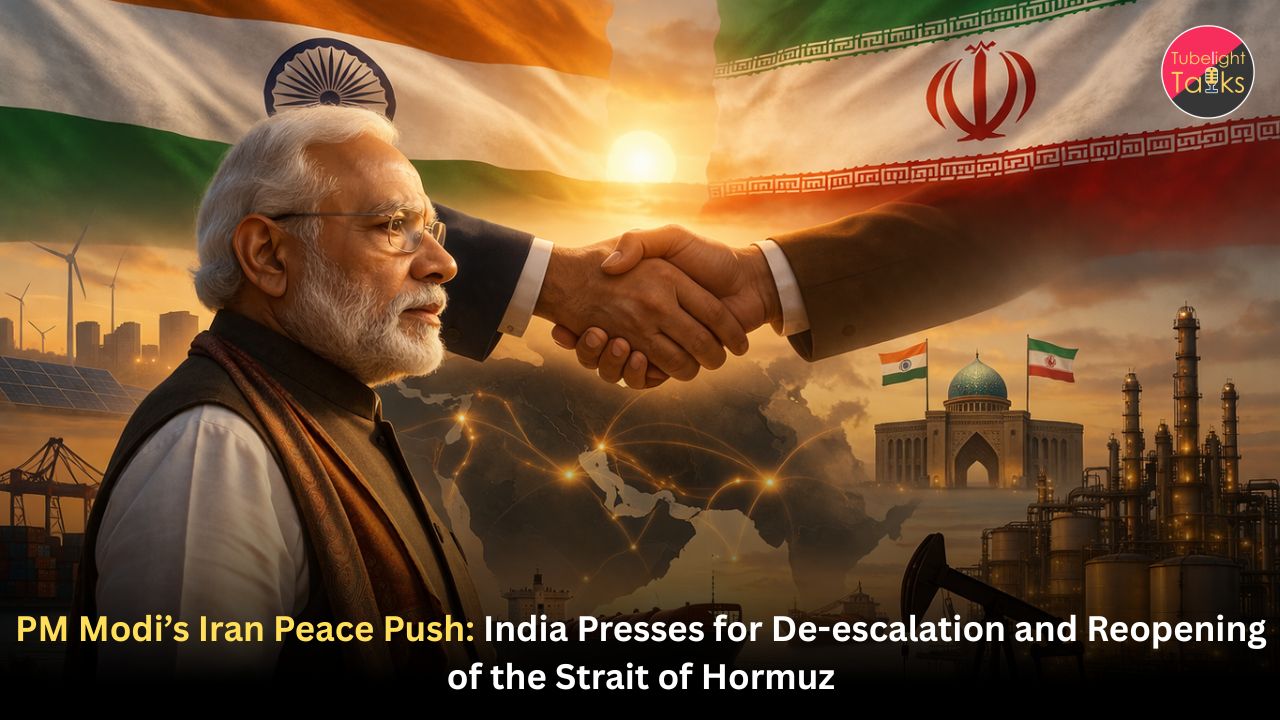
PM Modi’s Iran Peace Push: Why India Is Turning Diplomacy Into an Energy-Security Strategy
PM Modi’s Iran Peace Push: India’s diplomatic response to the West Asia war has entered a sharper and more public phase. Over the past several days, Prime Minister Narendra Modi has spoken directly with Iranian President Masoud Pezeshkian, stressed the need for “dialogue and diplomacy,” condemned attacks on critical infrastructure, and called for shipping lanes to remain open and secure.
Then, on March 24, 2026, Modi told the Rajya Sabha that India is in constant touch with Gulf countries as well as Iran, Israel and the United States, and that New Delhi has specifically discussed de-escalation and the reopening of the Strait of Hormuz. In parallel, India has pushed back against reports suggesting it paid or agreed to pay any fee for tanker safety in the waterway.
Taken together, these moves show that India is not handling the Hormuz crisis as routine foreign-policy messaging. It is treating it as a live national-security, energy-security, and citizen-protection challenge.
India’s message to Iran is clear but carefully framed
PM Modi’s direct call with President Pezeshkian set the tone
The most important bilateral signal came from PM Modi’s conversation with Iranian President Masoud Pezeshkian. According to the Prime Minister’s Office, Modi conveyed Eid and Nowruz greetings, expressed hope for peace and stability in West Asia, condemned attacks on critical infrastructure, and reiterated the importance of safeguarding freedom of navigation and keeping shipping lanes open and secure. He also appreciated Iran’s support for the safety and security of Indian nationals in Iran.
That official language is significant because it combines courtesy, concern, and strategic firmness in the same conversation. India did not publicly speak in the language of threat or alignment. It spoke in the language of stability, access and protection.
That matters because India needs to preserve working communication with Iran while still defending its core interests. The official readout does not present the call as symbolic outreach. It presents it as crisis diplomacy centered on infrastructure, sea-lane safety and Indian nationals.
In a conflict where public positions can quickly harden, India’s approach appears designed to keep channels open while still stating clear red lines around navigation and disruption. That is an inference from the PMO summary and India’s broader public messaging in Parliament.
The Rajya Sabha speech turned private diplomacy into public doctrine
On March 24, Modi made India’s position even more explicit in Parliament. In the official PIB release of his Rajya Sabha statement, he said India’s goal is to restore peace in the region through dialogue and diplomacy and that de-escalation and the reopening of the Strait of Hormuz have been specifically discussed with relevant countries.
He added that attacks on commercial ships and disruption of international waterways like Hormuz are unacceptable, and he said India has condemned attacks on civilians, civil infrastructure, and energy- and transport-related infrastructure.
This was a crucial step because it transformed India’s diplomatic effort from a series of closed-door conversations into a declared policy line. Modi also said he had conducted two rounds of phone conversations with heads of state of most West Asian nations and that India remains in touch with Gulf countries, Iran, Israel and the United States.
That broad contact map shows India is not trying to work only one channel. It is attempting a multi-directional diplomacy aimed at reducing escalation, reopening routes, and shielding Indian interests in a fast-changing war environment.
Why the Strait of Hormuz is central to this story
Hormuz is not a side issue for India
The Strait of Hormuz is the strategic core of India’s concern. Reuters reported on March 24 that the waterway channels about 40% of India’s crude oil imports. Reuters also reported that India imports about 60% of its LPG needs and that 90% of that imported LPG had been coming from the Middle East before the crisis.
These figures explain why India’s diplomacy is focused so heavily on reopening Hormuz and keeping maritime movement functional. When Hormuz slows or closes, India does not face a theoretical geopolitical problem. It faces a direct pressure point on fuel supply, import costs, inflation risk and industrial continuity.
The government’s own public messaging matches that concern. In Parliament, Modi said the war has created a serious energy crisis across the world and disrupted India’s trade routes and the routine supply of petrol, diesel, gas and fertilizers. He also said many ships from around the world are stranded in the Strait of Hormuz and that a large number of Indian crew members are among them.
That statement links economics and human security in one frame: India is worried not only about cargo but about people at sea.
Also Read: India Faces LPG Crisis in India as Supply Shock and Rupee Slide Raise Inflation Concerns
Reopening Hormuz is as much about inflation as diplomacy
There is also a domestic economic layer here. Reuters reported that India has ordered measures to strengthen natural-gas infrastructure because the war has produced supply constraints and because Hormuz remains a critical route for imported energy.
Reuters also reported that India’s private-sector growth slowed sharply in March under the weight of the war, rising energy costs, and broader disruption. That means India’s push to reopen Hormuz is not only about foreign-policy prestige. It is also about trying to prevent external war shocks from bleeding deeper into the domestic economy.
This is why India’s diplomacy sounds more urgent than usual. Every extra day of uncertainty in Hormuz affects oil buying, LPG planning, shipping costs, insurance, and the rupee. In such a context, “dialogue and diplomacy” is not a soft slogan. It is a hard economic necessity. That conclusion is an inference from the official parliamentary statement and the Reuters reporting on energy dependence and supply strain.
India is also protecting its position on maritime law
New Delhi has rejected the idea of paying for basic navigation rights
A major side controversy in the last 24 hours has been the claim that ships may have to pay for safe passage through Hormuz. India has publicly pushed back. Business Standard reported on March 24 that the Shipping Ministry rejected reports of any proposed toll or levy on vessels transiting the Strait of Hormuz, calling such claims “baseless” and reaffirming that the passage is governed by international conventions ensuring freedom of navigation.
That denial matters because once states begin accepting paid transit as the norm in a strategic chokepoint, the legal and diplomatic implications become much larger than one voyage.
India’s line here is consistent with its larger diplomatic position. If New Delhi is telling the world that freedom of navigation must be protected and commercial shipping cannot be obstructed, it cannot simultaneously normalize the idea that ships should pay ad hoc safety fees to cross an international waterway.
So the rejection of passage-fee reports is not just a technical correction. It is part of India’s attempt to defend a rule-based maritime principle. That is an inference from the ministry denial and Modi’s repeated emphasis on open, secure shipping lanes.
Earlier, India also denied any quid pro quo over seized tankers
This is not the first time India has pushed back against claims that Hormuz access is being negotiated through side deals. Reuters reported on March 17 that India denied holding talks with Iran about releasing three tankers seized in February in exchange for safe passage for Indian ships through the Strait of Hormuz.
That earlier denial matters because it establishes a pattern: India wants safe passage, but it does not want that push to be seen as a transactional bargain that undermines either Indian law enforcement or international maritime norms.
That does not mean India is refusing all practical engagement. On the contrary, Reuters has also reported that India has sought safe passage for dozens of its vessels and has been in active contact with Iran on shipping issues. The distinction India seems to be drawing is between diplomacy for safe navigation and bargaining away legal positions or accepting informal toll regimes. That is a crucial difference.
The shipping story shows why diplomacy has become so urgent
Indian-flagged tankers are moving, but the wider situation is still unstable
There have been some signs of operational relief. Reuters reported on March 23 that two India-bound tankers carrying more than 92,000 tonnes of LPG passed through the Strait of Hormuz. That was important because it showed that movement had not completely collapsed and that India was still finding ways to get essential supplies through. But the same Reuters reporting also made clear that most ships were still stuck and tanker traffic remained severely depressed compared with pre-war norms.
Reuters separately reported on March 24 that India has begun loading LPG onto some of its stranded empty ships in the Gulf because of the severity of the gas shortage. The report said 24 Indian-flagged vessels were stranded in the Gulf, including LPG carriers, crude carriers and LNG tankers, and that the supply disruption has already forced difficult domestic adjustments. That is why Modi’s peace push is not simply about future stability; it is about managing an ongoing logistical emergency.
Iran’s own position on Hormuz remains conditional
Another reason India is pressing so hard is that Iran’s current posture on Hormuz is not a full reopening. Reuters reported on March 24 that Iran told the United Nations and the International Maritime Organization that “non-hostile vessels” may transit the strait if they coordinate with Iranian authorities and do not engage in hostile acts.
That is not the same as normal, neutral, unrestricted commercial passage. It is a conditional regime shaped by war. For India, such uncertainty is unacceptable as a long-term operating condition because it leaves energy flows exposed to political interpretation.
This explains why India is calling not merely for technical ship movement but for de-escalation and reopening. A route that functions only under wartime permission is not the same as a stable sea lane. India wants restoration of predictability, not just selective access. That is an inference from Iran’s “non-hostile vessels” formulation and India’s official call for secure, open shipping lanes.
Modi’s Iran outreach is part of a wider India strategy
India is talking to all major players at once
Reuters reported on March 24 that Modi and Donald Trump also discussed the importance of keeping the Strait of Hormuz open, and that Modi stressed India’s support for de-escalation and peace restoration. This matters because it shows India’s diplomacy is not Iran-only. It is multi-vector: engage Tehran, signal priorities to Washington, speak to Gulf monarchies, and keep Parliament informed at home.
This broader approach fits India’s strategic position. It cannot afford to alienate energy suppliers, it cannot ignore U.S. influence, and it cannot let a Gulf war dictate India’s domestic economic stability. So the emerging diplomacy is practical rather than ideological. India is trying to maintain access, reduce escalation, protect citizens, and preserve maritime norms all at once. That is not an easy balance, but it is visible in the pattern of official outreach and statements.
This is also a message to Indian markets and citizens
Modi’s Rajya Sabha statement had another purpose: reassurance. He said India’s economic fundamentals remain strong, that the government is monitoring the rapidly changing situation, and that it is working with a short-, medium- and long-term strategy.
He also said ships carrying crude oil and LPG have arrived in India from many countries in recent days and that the effort to secure oil and gas from wherever possible will continue. That language was clearly aimed at calming domestic anxiety while acknowledging the seriousness of the crisis.
In other words, India’s peace push is not only external diplomacy. It is also internal crisis management. The government is trying to show that it has not lost control of the fuel-supply picture, even as it admits that the war has created a global energy emergency. That dual messaging matters because economic panic can deepen a geopolitical shock if not managed early. This is an inference based on the blend of warning and reassurance in Modi’s parliamentary remarks.
Deeper Meaning of Peace Through Dialogue
Teachings presented on the official platforms associated with Sant Rampal Ji Maharaj place repeated emphasis on peace, compassion, truthful conduct, and resolving conflict through wisdom rather than aggression. Those teachings describe violence and ego as forces that ultimately harm all sides, while true spiritual understanding encourages brotherhood and restraint.
Read in that light, India’s call for “dialogue and diplomacy” carries a deeper human truth: when conflict expands around energy, shipping and power, ordinary families, workers and nations bear the burden first. Sat Gyaan reminds humanity that durable peace cannot be built on fear and domination alone; it must rest on truth, compassion and righteous conduct.
Call to Action
Follow verified updates on Hormuz, energy and diplomacy
India’s response to the Iran crisis deserves close attention because it affects far more than one diplomatic relationship. It influences fuel prices, LPG availability, the rupee, shipping costs, and the safety of Indian seafarers and the wider diaspora.
Readers should track this issue through official government statements and credible reporting, not rumor-driven claims about secret deals or panic scenarios. In a crisis shaped by both war and misinformation, verified facts matter.
Choose calm, truth and responsibility in times of tension
Moments like this also test public character. Sant Rampal Ji Maharaj’s teachings emphasize truthfulness, restraint and compassionate thinking. Even when nations face conflict, individuals can reject panic, avoid spreading falsehoods, and stay anchored in responsible conduct. Peace in the world begins with peace in thought and action. That spiritual discipline is especially valuable when headlines are intense and uncertainty is high.
FAQs: PM Modi’s Iran Peace Push
1. What did PM Modi tell Iran’s President?
According to the Prime Minister’s Office, Modi condemned attacks on critical infrastructure, reiterated the need to safeguard freedom of navigation, and said shipping lanes must remain open and secure.
2. What did Modi say in Parliament about Hormuz?
In the Rajya Sabha on March 24, Modi said India’s goal is to restore peace through dialogue and diplomacy and that India has specifically discussed de-escalation and the reopening of the Strait of Hormuz with relevant countries.
3. Why is the Strait of Hormuz so important for India?
Reuters reported that about 40% of India’s crude oil imports pass through Hormuz, while India’s LPG supply has also been heavily exposed to disruptions in the region.
4. Has India denied reports of paying for tanker safety?
Yes. Business Standard reported that the Shipping Ministry rejected reports of any proposed toll or levy on vessels transiting Hormuz, calling such claims baseless. Earlier, Reuters also reported that India denied any quid-pro-quo talks over seized tankers in exchange for safe passage.
5. Are Indian ships still affected?
Yes. Reuters reported that Indian-flagged vessels, including LPG, crude and LNG carriers, have been stranded or delayed in the Gulf, even though some tankers have recently managed to pass through Hormuz.
6. What is India trying to achieve with this peace push?
India appears to be pursuing four linked goals: de-escalation of hostilities, reopening of Hormuz, protection of Indian ships and crew, and stabilization of energy supplies for the domestic economy. That is an inference from official statements and current shipping and energy reporting.
Related Stories






Discussion (0)