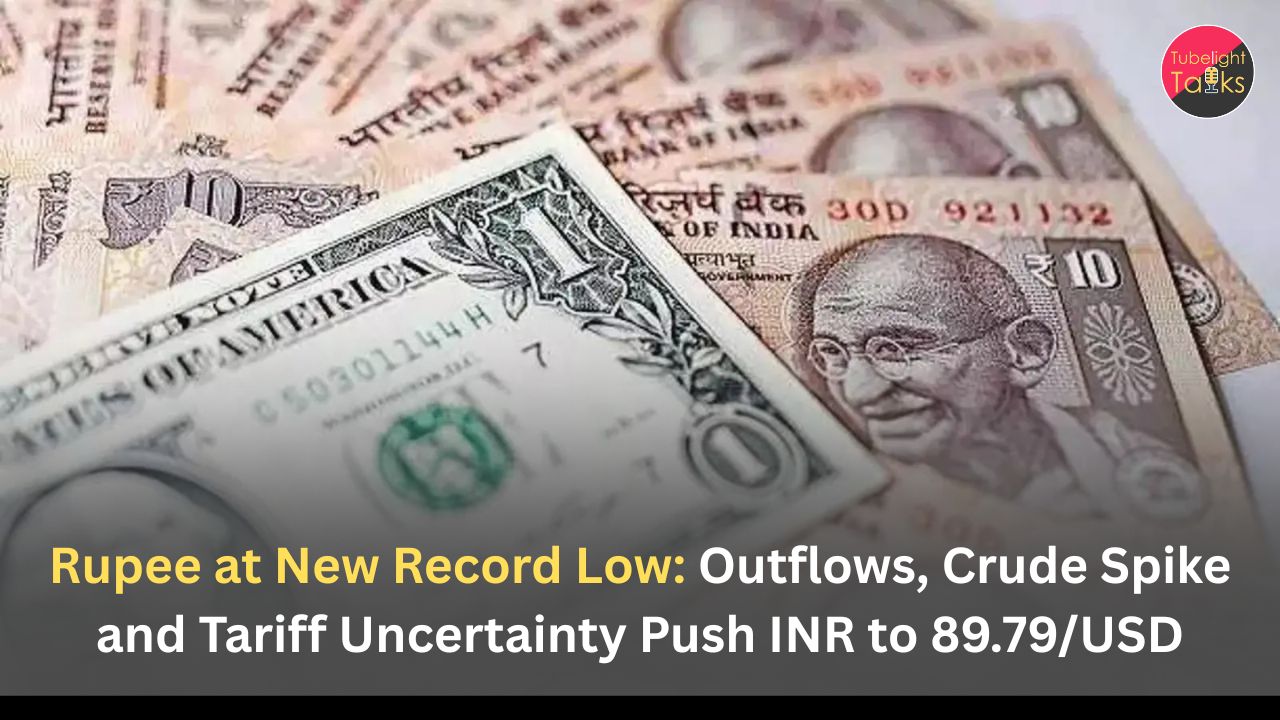
Rupee at New Record Low: Outflows, Crude Spike and Tariff Uncertainty Push INR to 89.79/USD
Rupee at New Record Low — The Indian currency plunged to a fresh lifetime low of 89.79 against the US dollar on December 1, despite India’s exceptionally strong GDP growth print. Persistent foreign fund outflows, heavy dollar demand from importers, rising crude oil prices, and the prolonged delay in the India–US trade deal created a perfect storm, driving the rupee sharply lower in intraday trade.
Even firm domestic equities and robust macroeconomic data failed to stem the currency’s deepening slide.
Key Takeaways: Rupee at New Record Low Amid FII Selloff and Stalled India–US Trade Deal
- Rupee hit an all-time low of 89.79/USD, breaking earlier lows of 89.66 and 89.49.
- FII outflows crossed ₹3,795 crore in a single day, with $16 billion pulled YTD.
- India posted a strong 8.2% GDP growth, the highest in over six quarters.
- Lack of progress on the India–US trade deal and ongoing 50% US tariffs weighed heavily.
- Rising crude oil prices and importer-driven dollar demand added pressure.
- Dollar index hovered around 99.40–99.50, maintaining global strength.
- Technical charts indicate the pair could test the 90–91 range soon.
Strong GDP Print Fails to Support the Rupee
The rupee opened at 89.45 at the interbank foreign exchange market but quickly lost momentum, sliding to 89.79 during the session. This came just days after India reported an impressive 8.2% GDP growth for the September quarter, surpassing expectations of 7.3% and marking the fastest expansion in six quarters.
Despite this robust economic performance, traders noted that the positive data failed to provide meaningful support as global and domestic flows remained heavily dollar-biased.
Foreign Outflows Intensify Pressure on the Indian Currency
Market participants pointed to significant foreign investor activity as a major driver of the rupee’s decline.
FIIs have turned net sellers for five straight months starting July, collectively unloading nearly ₹1.49 lakh crore from Indian equities. On Friday alone, FIIs sold ₹3,795.72 crore, while total yearly outflows crossed $16 billion, placing the rupee among the worst-performing global currencies of 2025 — ahead only of the Turkish lira and Argentine peso.
Anil Kumar Bhansali of Finrex Treasury Advisors highlighted that high valuations, corporate repayments, oil purchases, and gold buying have contributed to persistent dollar demand, leaving the rupee vulnerable.
Trade Deal Delays and Tariff Pressures Weigh on Sentiment
Uncertainty around the long-pending India–US trade deal further dampened market confidence.
Commerce Secretary Rajesh Agrawal recently said India is hopeful of finalizing a framework deal with the US this year, but officials acknowledge that steep 50% tariffs on Indian exports remain a major hurdle.
Economists at J.P. Morgan described the rupee’s depreciation as “inevitable and desirable” amid the current macro environment, noting that depreciation has become the only offset in the absence of tariff relief or improved trade flows.
Barclays strategist Mitul Kotecha said any credible trade-deal announcement could trigger a sharp rupee rebound, but for now, the lack of progress continues to overshadow the strong domestic economy.
Crude Oil Rise Adds Fresh Headwinds
Brent crude gained 1.57% to 1.96%, trading in the $63.35–$63.60 per barrel range. Rising crude prices directly increase India’s import bill, intensifying pressure on the currency and contributing to India’s record merchandise trade deficit in October.
The elevated energy bill has strengthened dollar demand among oil importers, adding to the rupee’s downward spiral.
Dollar Index Steady as Markets Eye US Fed Rate Cut
The dollar index stayed near 99.40–99.50 as investors awaited the US ISM Manufacturing PMI data.
Global markets are pricing in an 87.4% probability of a December US Fed rate cut, according to CME FedWatch, strengthening bets of softer monetary policy.
Also Read: Rupee Watch: Why USD/INR Is Anchored Near 88.6–88.8 in November 2025—and What Could Move It Next
Political developments added volatility as well. Reports suggested White House adviser Kevin Hassett may be considered as a replacement for Fed Chair Jerome Powell, a move analysts warn could increase uncertainty around US monetary independence and impact the dollar.
Technical Charts Point Toward Further Rupee Weakness
USD/INR technical indicators signal continued upward momentum.
With the spot pair trading above the 20-day EMA at 89.08 and the RSI near 68.85, analysts believe the rupee may breach the psychological 90-level.
Resistance remains firm around the 90-mark, but a breakout could push the pair toward 91.00.
On the downside, immediate support lies near the November 25 low of 89.14.
Equity Markets Hit Highs But Fail to Protect the Rupee
Despite the currency’s weakness, domestic equities saw strong buying early in the session, driving benchmarks to fresh highs.
- Sensex touched 86,022.54,
- Nifty reached 26,287.20.
However, gains later cooled as rupee volatility increased. Meanwhile, positions maturing in the non-deliverable forwards (NDF) market added additional pressure, with RBI data showing the central bank’s forward book expanding beyond $63 billion in October.
The Road Ahead: Can Policy Support Prevent a Break Below 90?
The rupee’s record decline underscores the widening gap between India’s strong economic performance and its weakening currency fundamentals. With FII outflows mounting, crude prices staying elevated, and no breakthrough yet on the India–US trade deal, the rupee remains vulnerable.
Market experts believe that unless capital flows stabilise or policy support strengthens, the 90-level may not hold for long. However, any positive development — a rate cut by the US Federal Reserve, progress on tariff reduction, or a shift in global risk sentiment — could temporarily ease pressure on the currency.
FAQs on Rupee at New Record Low
1. Why did the Indian rupee fall to 89.79 against the US dollar?
The rupee fell due to heavy FII outflows, importer-led dollar demand, rising crude prices, and delays in the India–US trade deal.
2. Will the rupee breach the psychological 90-mark soon?
Analysts warn it may breach 90 unless inflows improve or trade deal progress offers relief. Technical charts also indicate further upside toward 90–91.
3. How did India’s strong GDP growth impact the rupee?
Despite 8.2% GDP growth, the rupee weakened as outflows, crude prices, and tariff uncertainty overshadowed positive economic data.
4. What role do India–US trade tensions play in the rupee’s decline?
Stalled negotiations and steep 50% US tariffs on Indian exports are hurting trade flows and weakening investor sentiment, pressuring the rupee.
5. Why are FIIs selling Indian equities heavily in 2025?
FIIs are exiting due to high valuations, global uncertainty, importer hedging, and tariff concerns, resulting in over $16 billion outflows this year.
Related Stories










Discussion (0)