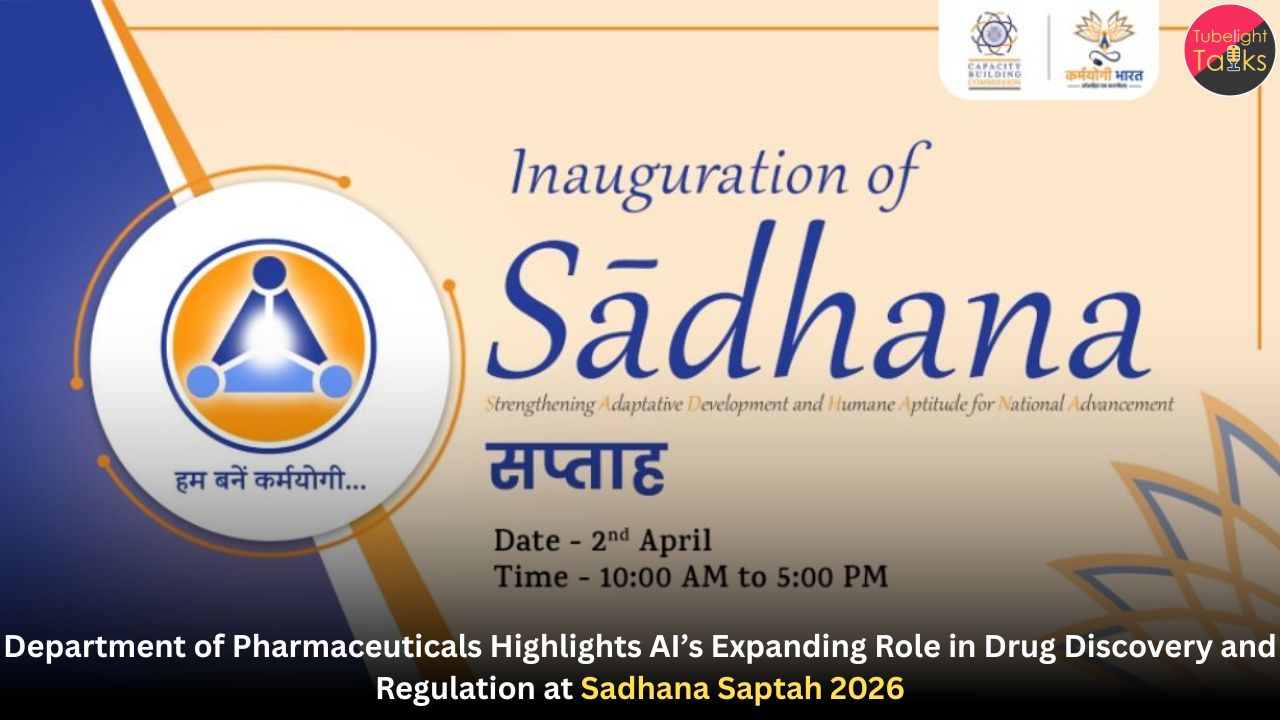
Health and Science: Department of Pharmaceuticals Highlights AI’s Transformative Role During Sadhana Saptah 2026
The Department of Pharmaceuticals has highlighted the growing role of AI in India’s pharmaceutical future during Sadhana Saptah 2026. An official PIB release said the department organised a webinar on April 4 on “AI and Emerging Technologies in Pharmaceuticals and Regulations,” and described the discussion as focusing on AI’s transformative role in drug discovery, development and regulation.
The webinar focused on AI as a sector-wide enabler
PIB said the session emphasized how AI and emerging technologies can strengthen India’s pharmaceutical ecosystem. The official release specifically highlighted the transformative role of AI in drug discovery, development and regulation.
That wording is important because it frames AI not as a narrow laboratory tool, but as something relevant across the sector’s value chain. The government is signaling that AI matters not only in research pipelines, but in how medicines are governed and monitored as well. This is an inference, but it is strongly supported by the official thematic scope of the webinar.
Regulation was a central part of the discussion
The PIB release lists several regulatory uses that were highlighted in the webinar. These included evidence-based regulatory decision-making, accelerated approval pathways, enhanced monitoring of drug safety and post-market surveillance.
This is significant because it suggests the conversation is moving beyond discovery science into governance modernization. AI in pharma is often discussed in relation to molecules and targets. Here, the Department of Pharmaceuticals is explicitly tying it to regulatory efficiency and oversight.
Also Read: PM Modi Addresses Karmayogi Sadhana Saptah, Says Capacity Building Will Shape Viksit Bharat 2047
The headline needs one important nuance
The user’s wording says the department highlighted the “successful integration” of AI. The strongest official source I reviewed does support the claim that AI is being actively promoted as transformative, but it does not prove that full-scale integration has already been completed across the pharmaceutical and regulatory system. The PIB language is aspirational and strategic rather than a declaration that the transformation is finished.
So the most accurate framing is that the department highlighted and advanced AI-driven transformation, not that the sector has already fully integrated AI in every relevant function.
Why this matters for India’s pharma ecosystem
The official release says the initiative reflects the department’s continued commitment to fostering innovation, strengthening regulatory frameworks and promoting the adoption of emerging technologies to improve efficiency and global competitiveness. That is a broad but important strategic statement.
If AI can genuinely improve approval quality, safety surveillance and drug-development speed without sacrificing scientific rigor, it could reshape both competitiveness and patient outcomes. That remains a work in progress, but the policy intent is now very clear. This is an inference, but it is grounded in the official objectives listed by PIB.
Sadhana Saptah is becoming a platform for sectoral modernization
PIB describes Sadhana Saptah 2026 as a large collaborative capacity-building initiative aimed at citizen-centric governance. Within that context, the pharmaceuticals webinar shows how ministries are using the platform not only for administrative training, but also for future-oriented sectoral thinking.
That is useful because it connects governance reform with technological modernization. In this case, AI is being discussed not in isolation, but as part of how public systems can become more responsive, data-driven and effective.
Science serves best when guided by wisdom
Technology is most useful when it improves human welfare with responsibility and clarity. In healthcare especially, progress matters only when it combines innovation with ethics, evidence and concern for people. AI may move quickly, but trust will still depend on how wisely it is used.
Call to Action
The next thing worth watching is whether these AI discussions turn into durable institutional tools, pilot programs and regulatory workflows that can be evaluated in practice. Policy attention is visible. The next test is implementation.
FAQs: Department of Pharmaceuticals Highlights AI’s Expanding Role in Drug Discovery and Regulation at Sadhana Saptah 2026.
1. What did the Department of Pharmaceuticals do during Sadhana Saptah 2026?
It organised a webinar on “AI and Emerging Technologies in Pharmaceuticals and Regulations.”
2. What areas of pharma did the webinar focus on?
Drug discovery, development and regulation.
3. What regulatory uses of AI were highlighted?
Evidence-based decision-making, accelerated approvals, drug-safety monitoring and post-market surveillance.
4. Did the government say AI will strengthen India’s pharma ecosystem?
Yes. The PIB release explicitly said AI and emerging technologies will strengthen the sector.
5. Does the official release prove AI has already fully transformed the system?
No. It strongly supports a policy push and a transformative direction, but not a claim of complete system-wide integration already being achieved.
6. Why was this discussed during Sadhana Saptah?
Because Sadhana Saptah is a capacity-building initiative focused on responsive, citizen-centric governance, and the department used it to highlight future-facing pharma innovation.
Related Stories









Discussion (0)