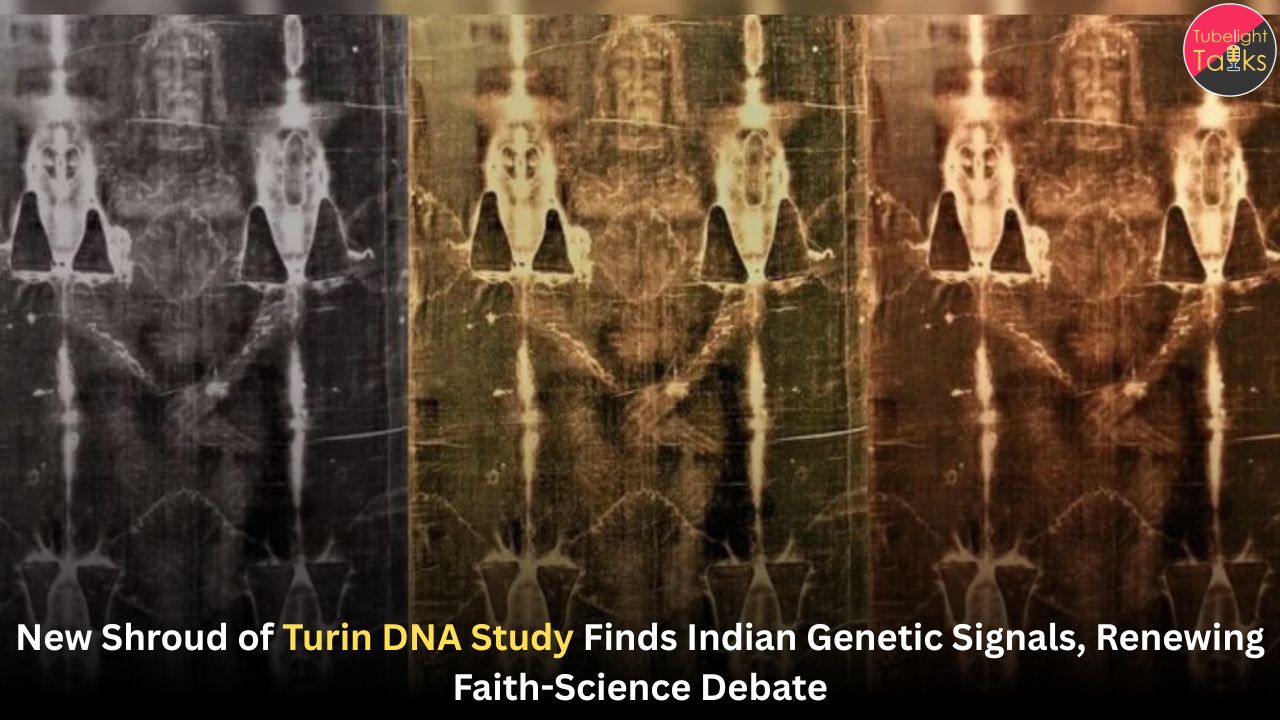
Scientific Breakthrough: New DNA Analysis Adds an Indian Link to the Shroud of Turin Debate
A new genomic preprint on the Shroud of Turin has reopened debate around one of Christianity’s most contested relics. The study, led by Gianni Barcaccia and published on bioRxiv, reported that about 38.7% of the human DNA contamination found on the cloth corresponds to Indian maternal lineages, while over 55.6% aligns with lineages from the Near East.
Indian Express reported that the authors interpret this as possible evidence of contact through textile trade or historical movement, while Vatican News highlighted the strong Near Eastern and saline-environment signals in the same body of research.
What the research found
The study did not isolate a single original DNA profile from the cloth. Instead, it found a mixture of human, animal, plant and microbial traces, which the researchers say reflect centuries of contact. Indian Express reported that the shroud carries biological evidence of long social, cultural and ecological exposure, including India-linked human lineages and broader Mediterranean-linked contamination. Vatican News also emphasized the detection of microorganisms associated with highly saline environments, which it said could be consistent with Middle Eastern exposure.
The Indian signal is the most eye-catching part of the story. According to Indian Express, the authors hypothesise that the DNA may have been picked up through linen or yarn linked to the Indus region, long known for textile trade. Vatican News quoted the paper’s suggestion that the Indian lineages could reflect historical interactions or the import of fine linen from regions near the Indus Valley.
Why the findings need caution
The strongest caution comes from the same scientific conversation around the paper. Live Science reported that the cloth also contains traces from many later contaminants, including species associated with the post-16th-century Old World, which indicates substantial contamination over time. It also cited experts saying the 1989 radiocarbon dating, which placed the cloth between 1260 and 1390 CE, still remains the strongest dating evidence and is not contradicted by the new DNA work.
That means the headline idea needs nuance. This research does not prove that the Shroud of Turin was made in India, nor does it prove authenticity as the burial cloth of Jesus. What it does provide is fresh empirical data showing a more globally mixed contamination history than many people assumed, including a notable Indian genetic signal that could reflect trade, contact or later handling.
Also Read: All About Happy Easter Sunday 2025
Why this matters for the faith-science dialogue
The real importance of the study is not that it settles the mystery, but that it changes the kind of conversation being had. Instead of relying only on visual analysis, devotional tradition or medieval-document arguments, the discussion now includes metagenomics, microbiomes and population-linked contamination signals. That makes the Shroud of Turin a stronger example of how faith-linked objects can be studied scientifically without pretending that science can answer every religious question.
In that sense, the study is meaningful even in its uncertainty. It shows how science can sharpen the questions even when it cannot fully close the case. For believers, historians and skeptics alike, that is valuable because it keeps the debate anchored in evidence rather than only assumption. This is an inference, but it is supported by the way the current reporting frames both the new data and its limits.
What truth-seeking really requires
The deeper lesson here is that honest inquiry should welcome both evidence and humility. Teachings associated with Sant Rampal Ji Maharaj repeatedly stress truth, clarity and freedom from blind assumption. A case like the Shroud of Turin reminds us that genuine understanding grows when people are willing to test claims carefully, accept uncertainty honestly, and keep seeking what is true rather than what is convenient to believe.
Call to Action
This study should be read as an important new data point, not as the final verdict. Readers interested in the Shroud of Turin should watch for peer review, independent replication, and expert response from genetics, archaeology and textile-history specialists before treating the Indian-origin hypothesis as established fact.
FAQs: New Shroud of Turin DNA Study Finds Indian Genetic Signals, Renewing Faith-Science Debate
1. Did the new Shroud of Turin study find Indian DNA?
Yes. The study reported that about 38.7% of the human DNA contamination on the cloth corresponds to Indian maternal lineages.
2. Does that prove the shroud came from India?
No. The researchers suggested that possibility, but experts cited by Live Science said centuries of contamination mean the finding cannot prove origin.
3. Is the study peer-reviewed?
No. Indian Express and Live Science both reported that it is currently a preprint on bioRxiv.
4. What did the study find besides Indian-linked DNA?
It also found strong Near East-linked human lineages and microbial traces associated with saline environments.
5. Does this overturn the medieval dating of the shroud?
No. Live Science reported that the strongest dating evidence remains the 1989 radiocarbon analysis placing the cloth between 1260 and 1390 CE.
6. Why is this study still important?
Because it adds new empirical genetic data to a long-running historical and religious debate, even if it does not settle the case.
Related Stories










Discussion (0)