
Smart Cities Around the World: Lessons for Developing Nations
Rapid urbanization has created new challenges such as traffic congestion, pollution, housing shortages, and pressure on public services. To address these issues, many countries are investing in smart cities that use digital technology, data, and sustainable infrastructure to improve urban living. Key models of Smart Cities Around the World-including Singapore, Barcelona, Copenhagen, Seoul, and Dubai-have demonstrated how innovation can enhance transportation, healthcare, energy efficiency, and citizen engagement. Developing nations are also exploring smart city initiatives to improve quality of life while supporting economic growth. This article examines successful global smart city examples, highlights valuable lessons, and explores how developing countries can build smarter, more sustainable, and inclusive cities.
What Is a Smart City?
A smart city uses technology, digital infrastructure, and data-driven decision-making to improve the quality of life for its residents. Smart cities integrate information technology with public services, transportation, healthcare, energy management, and governance to create efficient, sustainable, and citizen-friendly urban environments.
Rather than relying solely on traditional infrastructure, smart cities use real-time information to solve everyday urban problems. The ultimate objective is not merely technological advancement but creating safer, healthier, and more inclusive communities.
Key Features of Smart Cities
Top global urban models incorporate distinct features to streamline daily living:
- Intelligent traffic management
- Smart public transportation
- Digital government services
- Renewable energy integration
- Efficient waste management
- Smart water conservation systems
- Public safety through smart surveillance
- Digital healthcare services
- Green infrastructure
- Citizen participation through digital platforms
Why Smart Cities Matter
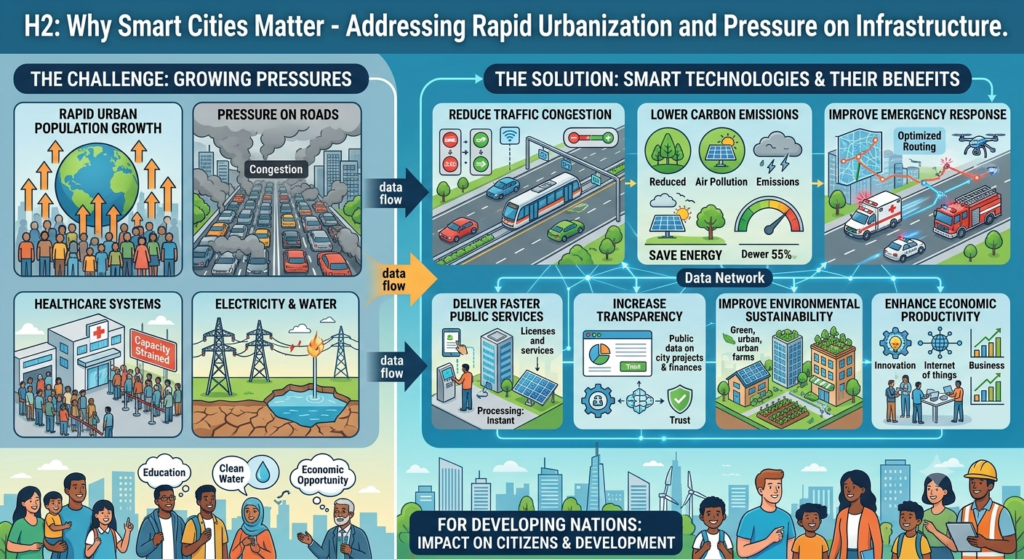
Urban populations continue to grow rapidly across the world. This growth places increasing pressure on roads, healthcare systems, electricity supply, water resources, and public administration.
According to reports by the [United Nations Sustainable Development Goals (SDG 11)](https://sdgs.un.org/goals/goal11), sustainable urban management is vital for global growth. Smart city technologies help governments:
- Reduce traffic congestion
- Lower carbon emissions
- Improve emergency response
- Save energy
- Deliver faster public services
- Increase transparency
- Improve environmental sustainability * Enhance economic productivity
For developing nations, these improvements can significantly enhance citizens’ daily lives while supporting long-term development.
Successful Smart Cities Around the World
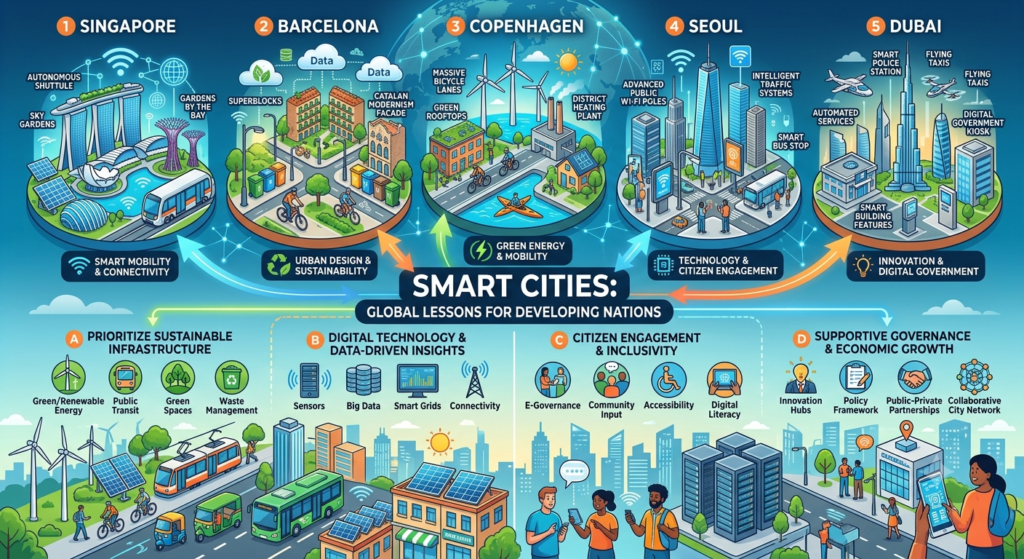
Singapore – The Global Leader
Singapore is widely regarded as one of the world’s smartest cities. Its government has invested heavily in digital services, artificial intelligence, smart transportation, and environmental monitoring.
Some major achievements documented by the IMD Smart City Observatory include:
- Cashless digital economy
- Smart traffic control systems
- Digital healthcare
- Water recycling technologies
- Efficient public transport
Singapore demonstrates how long-term planning and technology can work together for sustainable urban development.
Barcelona – Smart Urban Innovation
Barcelona transformed itself through digital infrastructure and citizen-focused planning. Its initiatives include:
- Smart street lighting
- Intelligent parking systems
- Digital waste collection
- Free public Wi-Fi
- Open government data
The city proves that technology can make daily life more convenient while reducing operational costs.
Copenhagen – Sustainability First
Copenhagen focuses on environmental sustainability. The city encourages:
- Cycling infrastructure
- Renewable energy
- Smart electricity grids
- Carbon reduction programs
- Energy-efficient buildings
Its vision is to become one of the world’s most climate-friendly cities.
### Seoul – A Digitally Connected City South Korea’s capital has embraced advanced digital governance. Residents can access numerous government services online, including transportation updates, public records, and emergency notifications.
Seoul’s smart initiatives include:
- High-speed internet connectivity
- AI-powered city management
- Smart public transportation
- Digital citizen services
Dubai – Innovation in the Desert
Dubai has rapidly adopted smart technologies to improve public administration. Its initiatives include:
- Paperless government services
- Smart police services
- AI-powered customer support
- Smart mobility projects
- Digital payment systems
Dubai showcases how ambitious planning and innovation can transform urban life.
Lessons for Developing Nations
Developing countries often face limited financial resources, growing populations, and infrastructure challenges. However, examining Smart Cities Around the World offers valuable lessons.
- Start with Citizens’ Needs: Technology should solve real problems rather than simply introducing advanced gadgets. Governments should prioritize better healthcare, clean water, reliable transportation, affordable housing, and efficient public services.
- Build Digital Infrastructure: Reliable internet access forms the backbone of smart cities. Expanding broadband networks enables online education, digital healthcare, e-governance, digital businesses, and remote work opportunities.
- Encourage Sustainable Development: Smart cities should balance economic growth with environmental protection. Governments can invest in solar energy, green buildings, electric public transport, rainwater harvesting, and urban forests.
- Promote Public Participation: Citizens should actively participate in city planning. Mobile apps and digital portals allow residents to report civic issues, share feedback, access government services, and participate in policy discussions.
- Use Data Responsibly: Smart cities generate enormous amounts of data. Governments must ensure strong cybersecurity, privacy protection, transparent data usage, and ethical AI implementation.
Challenges Developing Nations May Face
Despite the opportunities, implementing smart cities is not without obstacles. Common challenges cited in research by the World Bank Urban Development Program include:
- High infrastructure costs
- Digital divide
- Limited technical expertise
- Cybersecurity risks
- Rapid urban population growth
- Funding constraints
- Unequal access to technology
- Policy implementation delays
Addressing these issues requires collaboration between governments, private companies, educational institutions, and local communities.
The Future of Smart Cities
The future of smart cities will be shaped by technologies like Artificial Intelligence (AI), the Internet of Things (IoT), and 5G connectivity. These innovations will improve transportation, healthcare, energy management, and urban planning.
Climate-resilient infrastructure and renewable energy solutions will also play a key role. Developing nations can adopt these technologies while adapting them to local needs, ensuring cities remain inclusive, efficient, and sustainable for future generations.
Conclusion: Building Smart Cities with Spiritual Wisdom
Modern technology can undoubtedly improve transportation, healthcare, communication, and governance. However, true progress is achieved only when technological advancement is accompanied by moral values and spiritual awareness.
Spiritual Leader Sant Rampal Ji Maharaj explains that human life attains its highest purpose through true devotion to the Supreme God while living honestly, peacefully, and compassionately. A city may become technologically advanced like the leading Smart Cities Around the World, but if its people are affected by greed, corruption, violence, and discrimination, lasting happiness remains out of reach.
By following the spiritual teachings of Sant Rampal Ji Maharaj-promoting truthfulness, non-violence, equality, and devotion-society can nurture responsible citizens who contribute to cleaner, safer, and more harmonious communities. Such a balance of technological innovation and moral-spiritual wisdom creates not only smart cities, but compassionate and prosperous societies.
FAQs on Smart Cities Around the World
1. What is a smart city?
A smart city uses digital technology, data, and sustainable infrastructure to improve public services, transportation, healthcare, energy efficiency, and overall quality of life.
2. Which country has the best smart city?
Singapore is widely considered one of the leading Smart Cities Around the World due to its advanced digital governance, efficient transportation, and sustainable urban planning.
3. Why are smart cities important for developing nations?
Smart cities help developing nations improve infrastructure, reduce pollution, enhance public services, promote economic growth, and manage rapid urbanization more effectively.
4. What technologies are commonly used in smart cities?
Common technologies include Artificial Intelligence (AI), Internet of Things (IoT), 5G networks, smart sensors, cloud computing, digital governance platforms, and renewable energy systems.
5. What are the biggest challenges in building smart cities?
Major challenges include high implementation costs, cybersecurity concerns, digital inequality, funding limitations, lack of technical expertise, and ensuring equitable access to technology.
Related Stories









Discussion (0)