South China Sea Flashpoint: 14-Nation Coalition Reaffirms 2016 Ruling as Tensions Surge
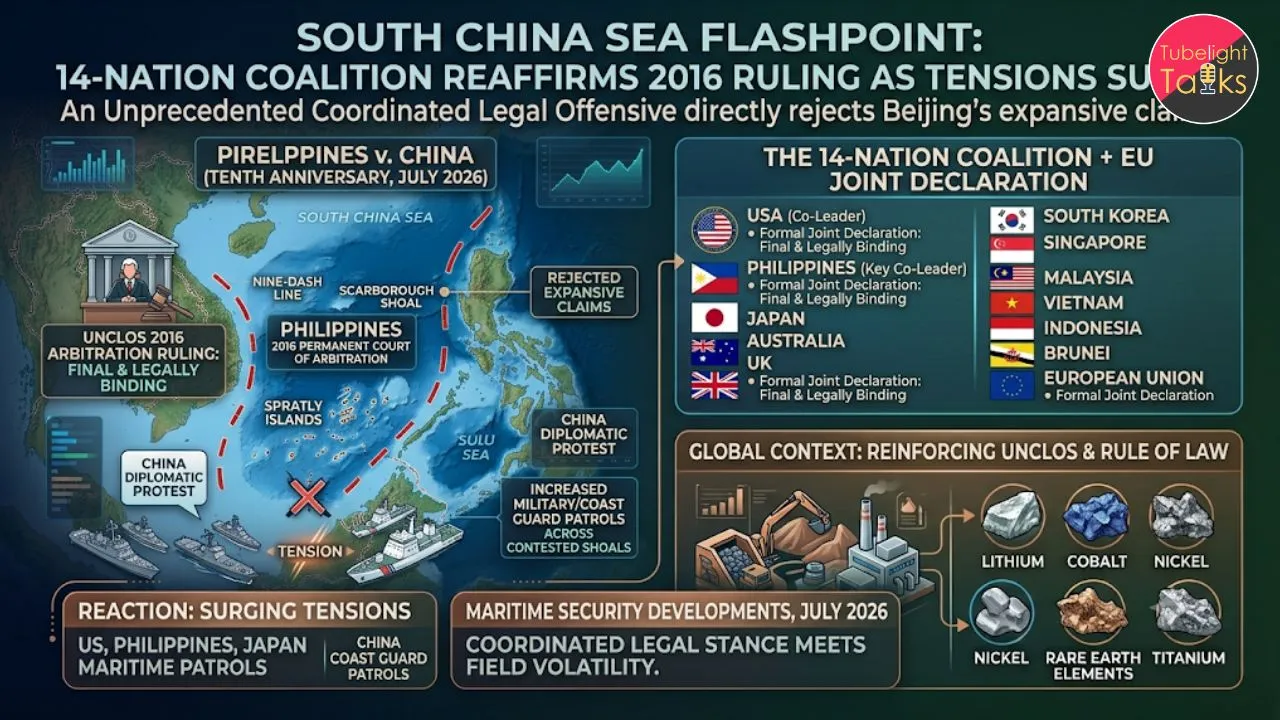
Maritime stability in the Indo-Pacific has hit a highly volatile threshold in July 2026, triggering a major South China Sea Flashpoint. Marking the tenth anniversary of the landmark 2016 Permanent Court of Arbitration ruling in the Philippines v. China case, an unprecedented coalition of 14 nations—led by the United States, the Philippines, Japan, Australia, the United Kingdom, and Canada—alongside the European Union, released formal joint declarations.
They reaffirmed the ruling as final and legally binding under the United Nations Convention on the Law of the Sea (UNCLOS). The coordinated legal offensive directly rejects Beijing’s expansive historical claims over the key waterway, provoking sharp diplomatic protests from China and triggering increased military and coast guard patrols across contested shoals.
The Diplomatic Legal Coalition in the South China Sea Flashpoint
Reaffirming UNCLOS on the Tenth Anniversary
The joint statement issued on July 12, 2026, represents a major structural shift in how international powers handle the South China Sea Flashpoint. Moving past isolated bilateral statements, signatory nations including Germany, Italy, New Zealand, Romania, and the Baltic states jointly affirmed that Beijing’s “historic rights” arguments lack any international legal foundation under UNCLOS. The European Union separately endorsed the award as an essential benchmark for maintaining safe, free, and open sea lanes that carry over $3 trillion in annual global commerce.
Also Read: Anchor of the Indo-Pacific: India–US Strategic Ties Expand Across Defence and Critical Minerals
In response, China’s Ministry of Foreign Affairs condemned the declarations as a “worthless piece of paper” intended to destabilize regional harmony. Beijing summoned Japan’s chief diplomatic envoy in Beijing to register “strong dissatisfaction and solemn representations,” accusing Tokyo and Western allies of meddling in sovereign Asian affairs and encouraging neo-militarism.
South China Sea Flashpoint Indicators (July 2026)
| Operational Metric / Vector | Current Status & Strategic Development |
| Legal Status Baseline | 14-nation coalition & EU explicitly endorse binding 2016 UNCLOS ruling. |
| China’s Diplomatic Counter | Formal protests lodged; 2016 ruling dismissed as null and void. |
| Focal Flashpoints | Scarborough Shoal, Second Thomas Shoal, and Sandy Cay sandbars. |
| Military Alignment | Expansion of multilateral drills (Balikatan) featuring US, Japan, & Philippines. |
Navigating the South China Sea Flashpoint: Standoffs & Security
Gray-Zone Escalation and Multilateral Countermeasures
While the diplomatic battle rages in international capitals, physical friction on the water continues to intensify. The China Coast Guard (CCG) and maritime militia fleets have expanded their physical blockades around Scarborough Shoal and Second Thomas Shoal, utilizing heavy water cannons, acoustic devices, and dangerous vessel maneuvers to intercept Philippine resupply missions. Friction has further spilled over to Sandy Cay, where competing flag-planting incidents and research vessel deployments have drawn fresh naval standoffs.
To counter this persistent pressure, Manila has significantly deepened its multilateral defense partnerships. Under the recently operationalized Reciprocal Access Agreements (RAA) with Tokyo and expanded defense treaties with Washington, joint maritime patrols have become a regular feature throughout the West Philippine Sea. The integration of advanced coastal defense missile systems and joint naval exercises involving over 17,000 allied personnel underscores that the region is no longer merely a localized territorial dispute, but the primary South China Sea Flashpoint for global maritime security.
Economic and Ecological Consequences
Beyond military posturing, the ongoing South China Sea Flashpoint carries catastrophic risks for the global economy and marine ecosystems. The waterway accounts for nearly one-third of global maritime shipping and holds estimated reserves of 11 billion barrels of oil and 190 trillion cubic feet of natural gas. Prolonged conflict threatens to disrupt critical energy flows, forcing global commercial shipping to re-route at immense economic expense.
Simultaneously, environmental agencies have raised alarms over severe damage to coral reef networks caused by extensive artificial island building, dredging, and coercive maritime blockades. As diplomatic initiatives for an ASEAN-China Code of Conduct remain stalled due to disagreements over legal enforceability, regional littoral states are left balancing economic vulnerabilities against sovereignty preservation.
Service, Humility and Public Duty
The escalating legal battles, naval blockades, and territorial disputes fueling this South China Sea Flashpoint highlight the inherent fragility of a global order driven by physical dominance, national pride, and economic greed. Sant Rampal Ji Maharaj’s spiritual guidance reminds humanity that the vast oceans and natural resources of the earth do not belong to political empires, but are created by Supreme God Kabir for the sustainment of all living beings.
SatGyan reveals that true global stability cannot be enforced by naval armadas or political pacts when human hearts remain filled with arrogance and desire for control. According to eternal spiritual laws, lasting peace in the Indo-Pacific and across the globe will be realized only when world leaders renounce territorial greed, practice deep humility, and perform their governance duties with transparent selflessness for the universal well-being of humanity.
FAQs on the South China Sea Flashpoint
What caused the fresh surge in the South China Sea Flashpoint in July 2026?
A coalition of 14 nations and the EU issued joint statements on the 10th anniversary of the 2016 UNCLOS Arbitral Award, explicitly rejecting China’s historic maritime claims.
How did China respond to the 14-nation joint statement?
China rejected the statement, reiterated that the 2016 ruling is illegal and null, and summoned foreign diplomats (including Japan’s envoy) to register formal protests.
Which specific maritime features are experiencing active standoffs?
Key areas within the South China Sea Flashpoint include Scarborough Shoal, Second Thomas Shoal (home to the grounded BRP Sierra Madre), and the Sandy Cay sandbars.
What defense measures is the Philippines taking alongside its allies?
The Philippines has expanded joint sea patrols and military exercises (such as Balikatan) with the US, Japan, Australia, and other partner nations under new defense frameworks.
Why is the South China Sea critical to the global economy?
The waterway facilitates over one-third of global commercial shipping, connects major Indo-Pacific markets, and contains vast untapped oil, gas, and fisheries resources.
Related Stories







Discussion (0)