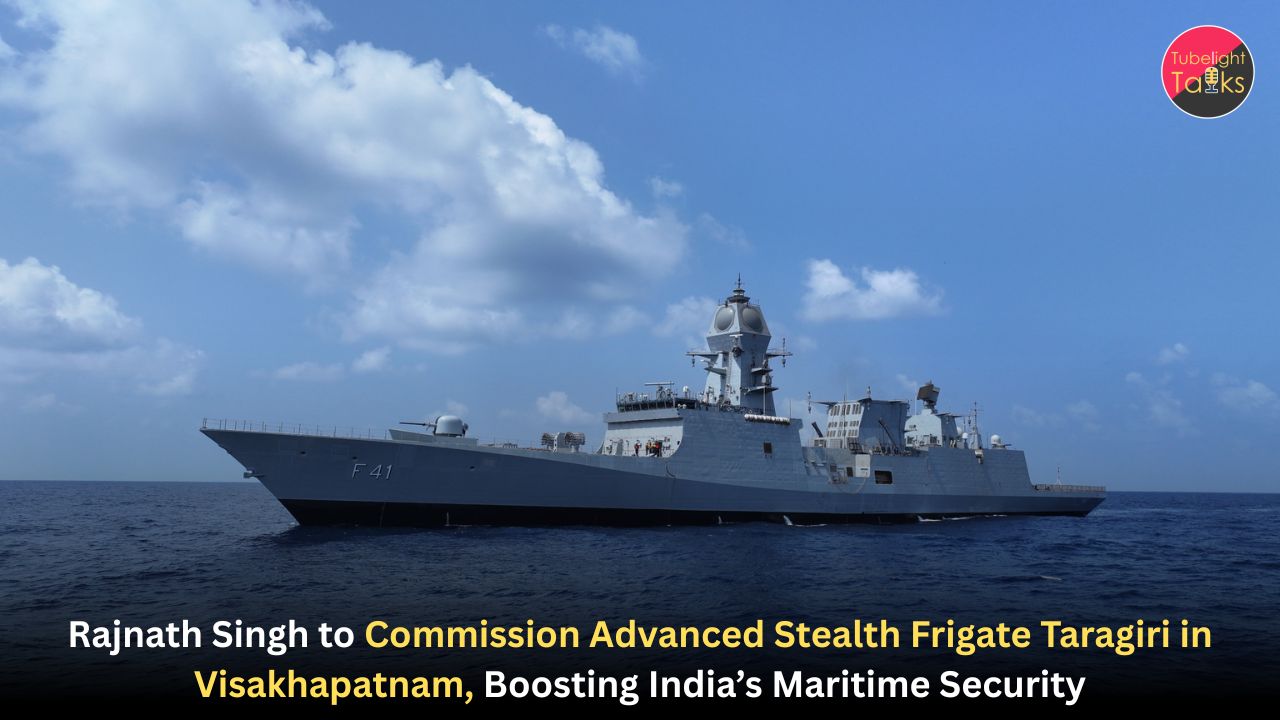
Naval Milestone: Rajnath Singh to Commission Advanced Stealth Frigate Taragiri in Visakhapatnam
India is set to mark an important naval milestone with the commissioning of Taragiri, the Indian Navy’s latest advanced stealth frigate, at Visakhapatnam on April 3. Official Ministry of Defence communication says the ceremony will be presided over by Defence Minister Rajnath Singh and describes the event as a defining moment for India’s maritime sovereignty and self-reliant naval power. The warship joins the fleet at a time when India is steadily sharpening its eastern seaboard posture and broader Indo-Pacific maritime readiness.
Taragiri is one of India’s newest frontline stealth warships
A Project 17A platform with advanced combat capability
The Ministry of Defence says Taragiri is the fourth platform of the Project 17A class and a 6,670-tonne frigate built by Mazagon Dock Shipbuilders Limited in Mumbai. Official material describes it as a major generational leap over earlier designs, with a sleeker form and reduced radar cross-section meant to enhance stealth during operations.
Its combat profile is substantial. The PIB release says Taragiri carries supersonic surface-to-surface missiles, medium-range surface-to-air missiles and a specialised anti-submarine warfare suite, all integrated through a modern combat management system. That gives the ship multi-dimensional operational capability across surface, air and undersea threats.
Built with a strong indigenous backbone
One of the ship’s most important features is its indigenous content. The Ministry of Defence says Taragiri has over 75% indigenous content and reflects a domestic industrial ecosystem involving more than 200 MSMEs. That makes the warship not only a naval asset, but also a strong symbol of India’s defence manufacturing ambitions under Aatmanirbhar Bharat.
This matters because India’s naval modernisation is increasingly being framed not just in terms of acquiring platforms, but in terms of designing, building and sustaining them domestically. Taragiri fits that model closely: Indian-designed, Indian-built and intended for Indian strategic priorities.
Also Read: India–France Defence Partnership Enters New Era with Focus on AI and Advanced Military Technology
Why Visakhapatnam matters in this commissioning
The eastern seaboard is central to India’s maritime posture
Official and government-linked reporting has stressed the significance of the location itself. News on Air said the commissioning highlights the strategic and maritime importance of India’s eastern seaboard, while Rajnath Singh also posted that the event reflects that importance. In current security terms, the Bay of Bengal and the wider eastern maritime arc are increasingly important for India’s operational preparedness, trade routes and Indo-Pacific partnerships.
Visakhapatnam is also a natural setting for such a milestone because it is one of India’s most important naval centres and home to the Eastern Naval Command. Commissioning Taragiri there reinforces the message that India is continuing to strengthen its eastern maritime capacity, not only its western seaboard focus. This is an inference, but it is strongly supported by the official emphasis on the eastern seaboard in the event messaging.
A warship designed for both combat and flexibility
High-speed endurance and multi-role operations
The Ministry of Defence says Taragiri uses a Combined Diesel or Gas propulsion plant, enabling high-speed and high-endurance performance across different mission conditions. That makes it suitable not only for combat tasks but for prolonged and varied maritime operations.
The same official note also says the ship is built for more than direct warfighting. Taragiri is described as capable of handling humanitarian assistance and disaster relief missions along with high-intensity combat operations. This matters because modern frigates are expected to do more than one job: deterrence, escort, presence, crisis response and diplomatic signalling are often all part of the same platform’s role.
What Taragiri adds to India’s naval strategy
A stronger surface fleet for a more contested maritime environment
India’s surface fleet is being modernised at a time of growing competition and uncertainty across the Indo-Pacific. Project 17A frigates like Taragiri are meant to improve survivability, strike power and operational flexibility in a more contested environment. The Ministry of Defence presents the ship as part of a combat-ready, credible and Aatmanirbhar naval force.
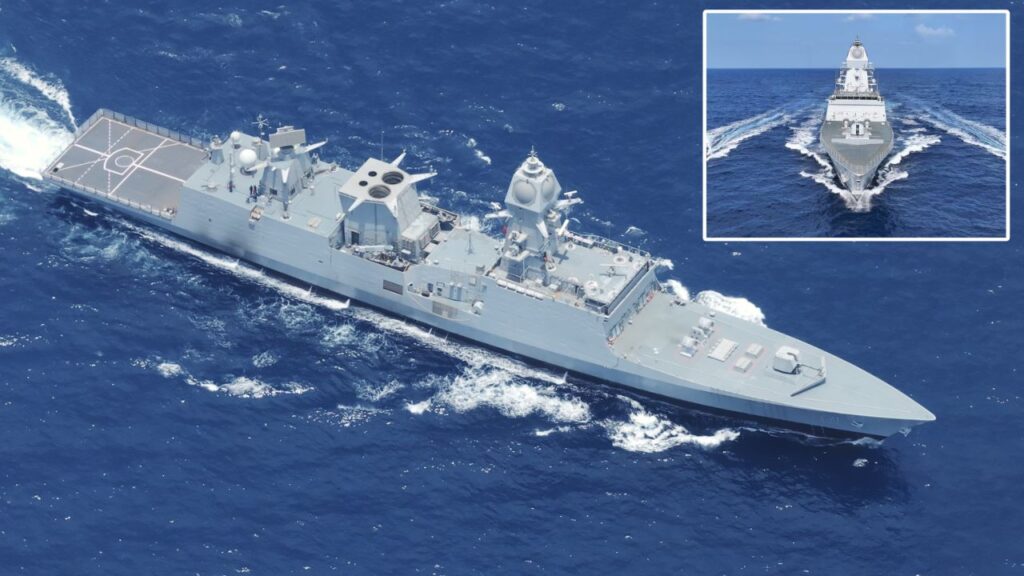
That means Taragiri is not just another hull entering service. It is part of a larger strategic pattern: newer stealthier platforms, more indigenous design, and more layered capability in surface, missile and anti-submarine warfare. In practical terms, that strengthens India’s ability to protect sea lanes, escort high-value assets and respond to evolving maritime threats. This is an inference based on the ship’s officially described capability set and the Navy’s broader modernisation direction.
Aatmanirbhar Bharat at sea
Defence manufacturing and national confidence
The commissioning is also being presented as an industrial achievement. Official messaging stresses that Taragiri is a product of Indian shipbuilding capability and a sign of the maturity of domestic design and manufacturing. With over 75% indigenous content and a broad supplier network, the ship stands as a visible outcome of India’s push for defence self-reliance.
That industrial dimension has a strategic value of its own. A country with stronger domestic shipbuilding capacity is better placed to maintain readiness, reduce dependence on foreign suppliers and scale future naval programmes with greater confidence. Taragiri therefore strengthens both India’s fleet and its defence-production ecosystem.
Strength with discipline is real security
A powerful warship can defend seas, but lasting security always depends on disciplined intent behind power. This connects naturally with the teachings of Sant Rampal Ji Maharaj, which emphasize responsibility, self-restraint and righteous conduct. National strength becomes meaningful when it is guided by protection, stability and duty rather than aggression for its own sake. In that sense, a maritime milestone is also a reminder that real power is strongest when joined with wisdom.
Call to Action
Taragiri’s commissioning should be seen as more than a ceremonial defence event. It is part of India’s long-term naval transition toward more capable, more indigenous and more strategically relevant frontline platforms. Citizens and observers should watch how ships like Taragiri fit into the Navy’s wider eastern seaboard readiness, anti-submarine posture and Indo-Pacific presence in the years ahead.
FAQs: Commission Advanced Stealth Frigate Taragiri in Visakhapatnam
1. What is Taragiri?
Taragiri is the Indian Navy’s latest advanced stealth frigate and the fourth platform of the Project 17A class. It is a 6,670-tonne warship built by Mazagon Dock Shipbuilders Limited.
2. Where is Taragiri being commissioned?
The commissioning ceremony is being held at Visakhapatnam. Government-linked reporting says it underscores the strategic importance of India’s eastern seaboard.
3. Who is presiding over the commissioning?
The ceremony is scheduled to be presided over by Defence Minister Rajnath Singh.
4. What weapons and systems does Taragiri carry?
Official information says it has supersonic surface-to-surface missiles, medium-range surface-to-air missiles and a specialised anti-submarine warfare suite integrated through a modern combat management system.
5. How much of Taragiri is indigenous?
The Ministry of Defence says the ship has more than 75% indigenous content.
6. Why is Taragiri important for India’s maritime security?
It adds stealth, strike capability, air defence, anti-submarine capability and high-endurance operational flexibility to the fleet, strengthening India’s eastern maritime posture and overall naval readiness.
Related Stories










Discussion (0)