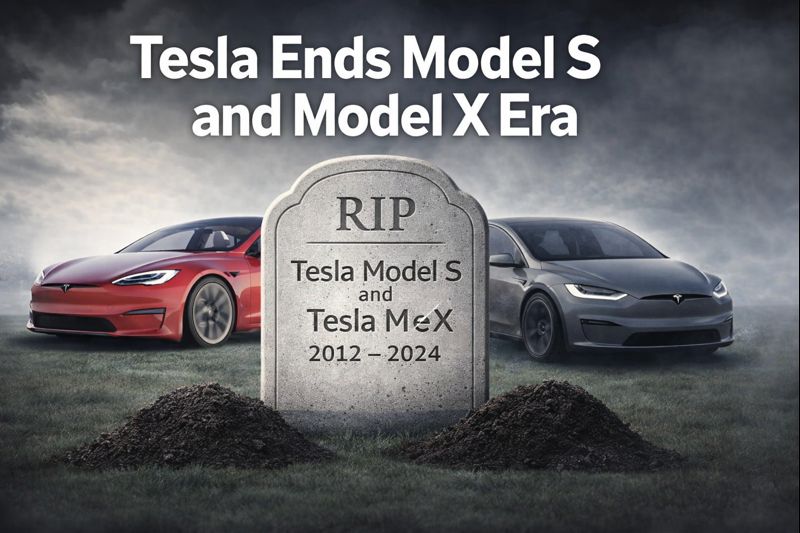
Tesla Ends Model S and Model X Era as Elon Musk Reorients the Company Toward Autonomy, AI and Humanoid Robots
Tesla has confirmed it will discontinue production of its Model S sedan and Model X SUV by the end of the second quarter of 2026, closing the chapter on the vehicles that helped establish the company as a global electric vehicle leader. CEO Elon Musk announced the decision during Tesla’s latest earnings call, framing it as part of a decisive pivot away from premium, low-volume electric cars toward autonomy, artificial intelligence, robotaxis and humanoid robots.
The Fremont, California factory that currently builds the Model S and X will be converted to produce Tesla’s Optimus robot, underscoring a fundamental shift in the company’s long-term strategy.
Key Takeaways: Tesla Discontinues Model S and Model X to Accelerate Its Autonomous and Robotics Vision
- Tesla will end Model S and Model X production by Q2 2026
- Fremont factory lines will be repurposed for Optimus humanoid robots
- Elon Musk says Tesla’s future is based on autonomy and AI, not premium EVs
- Sales of Model S and X have fallen sharply for several years
- Tesla plans to produce up to one million Optimus robots annually
- The company is investing $2 billion in xAI to support AI development
- Robotaxis, Cybercab and humanoid robots are now central to Tesla’s strategy
- Existing Model S and X vehicles will continue to receive long-term support
The Official Announcement That Ends Tesla’s Flagship Era
Tesla confirmed that production of the Model S and Model X will be wound down next quarter, with final production ending by the close of Q2 2026. Musk described the move as “slightly sad” but necessary, repeatedly stating that Tesla is “moving into a future that is based on autonomy.”
Both vehicles are manufactured at Tesla’s Fremont factory, which has built the Model S since 2012 and the Model X since 2015. Once production ends, Tesla will convert this space into a dedicated Optimus robot factory. Musk said the long-term goal is to reach annual production of one million robots from the site.
Tesla also confirmed it will continue to support Model S and Model X vehicles for as long as owners keep them.
Also Read: Elon Musk’s $1 Trillion Tesla Deal Faces Global Pushback from Norway Fund and CalPERS
Financial Pressure Behind the Strategic Shift
The decision comes amid clear signs of financial and sales pressure in Tesla’s automotive business. The company reported its first-ever annual revenue decline, with total revenue falling 3% year-over-year. Fourth-quarter revenue came in at $24.9 billion, slightly above Wall Street expectations, while earnings per share were $0.50, exceeding analyst forecasts.
Despite beating expectations, Tesla’s automotive revenue declined 11% year-over-year, and profits fell sharply, with a 61% drop in Q4 profits, highlighting the strain on the company’s core vehicle business.
Vehicle deliveries also weakened. Tesla reported a 16% year-over-year decline in fourth-quarter deliveries, with demand particularly weak in Europe.
A Long and Visible Decline in Model S and Model X Sales
Tesla stopped reporting Model S and Model X sales separately in 2023, grouping them with Cybertruck and Semi deliveries under an “other models” category. This made it harder to track performance, but the decline was significant.
In 2025, Tesla delivered 50,850 vehicles in this combined category, a 40.2% year-over-year drop. Quarterly figures showed the deterioration clearly:
| Period | “Other Models” Deliveries |
| Q4 2024 | 23,640 |
| Q1 2025 | 12,881 |
| Q2 2025 | 10,394 |
| Q3 2025 | 15,933 |
| Q4 2025 | 11,642 |
| FY 2025 | 50,850 |
These figures include Cybertruck and Semi deliveries, meaning actual Model S and X sales were significantly lower, likely around 30,000 units globally in 2025, despite Fremont having the capacity to build about 100,000 units annually.
The Refresh That Quietly Signaled the End
In mid-2025, Tesla introduced a mild refresh to the Model S and Model X. The updates included a new paint option, a front bumper camera, modest range improvements, improved noise cancellation, smoother suspension and ambient lighting features already available in cheaper models.
The most notable change was a price increase of roughly $4,500 to $5,000, pushing the vehicles close to or above the $90,000 mark. The refresh did not include major innovations seen in newer Tesla projects, reinforcing the perception that the vehicles were no longer central to Tesla’s plans.
Rising Competition and Market Headwinds
Tesla’s premium EVs have also faced growing competition. Rivals such as Lucid Motors and Rivian have increasingly challenged the Model S and Model X, while global competition — particularly from China — has intensified.
Chinese automaker BYD overtook Tesla as the world’s largest EV manufacturer, with sales growing 28% in 2025, driven by lower-priced alternatives. These pressures have further reduced demand for Tesla’s high-end vehicles.
Cybertruck Struggles Add to the Pressure
Tesla’s Cybertruck, which Musk once called the company’s best vehicle, has struggled since launch. According to industry data cited in the chunks, Cybertruck sales declined 48% year-over-year, and early promises of a $40,000 base price and millions of reservations failed to materialize.
The Cybertruck was grouped with the Model S and X under the “other models” category, masking the scale of its underperformance and adding to the justification for reallocating factory capacity.
Fremont’s Future: Optimus, Not Cars
Musk confirmed that Fremont’s Model S and X production lines will be replaced with Optimus robot manufacturing. Tesla plans to begin Optimus production before the end of 2026, with public sales targeted for 2027.
Tesla also revealed that it will unveil the third generation of Optimus this quarter, describing it as the first design intended for mass production. Musk said the Optimus supply chain is entirely new, meaning early production will ramp up gradually.
Also Read: Elon Musk Proposes Tesla’s Optimus Robots to Eliminate Global Poverty via Universal Basic Income
Autonomy, Robotaxis and AI at the Core
Tesla’s pivot goes beyond robotics. Musk said Tesla is already operating around 500 robotaxis across Austin and San Francisco and has begun conducting paid rides without safety drivers in Austin.
Tesla disclosed that Full Self-Driving subscriptions reached 1.1 million in 2025, up from 800,000 the year before. CFO Vaibhav Taneja cautioned that robotaxi revenue metrics are not yet meaningful, as the company remains in an early validation phase.
Tesla also confirmed a $2 billion investment in xAI, Musk’s AI company. Executives said this would avoid duplicative AI spending, and Taneja revealed that Grok, xAI’s chatbot, is already being used inside Tesla vehicles.
Global Impact and Market Exits
Since 2012, Tesla has delivered an estimated 730,000 Model S and Model X vehicles globally, including around 15,000 units in Australia. Production of right-hand-drive versions was discontinued, and order books were closed in markets such as Australia, the UK and Japan between 2023 and early 2025.
With the end of Model S and X, Tesla’s consumer lineup will largely consist of the Model 3, Model Y and Cybertruck, alongside future autonomous vehicles like Cybercab.
A Defining Turning Point for Tesla’s Identity
The retirement of the Model S and Model X marks one of the most significant shifts in Tesla’s history. These vehicles proved electric cars could be desirable, high-performance and commercially viable, funding Tesla’s rise from a startup into a global automaker.
By replacing them with robots at Fremont, Tesla is making a clear statement: its future lies not in premium electric cars, but in autonomy, artificial intelligence and robotics. Whether that bet delivers the growth Musk promises remains to be seen, but the era that defined Tesla’s early success has now officially come to an end.
FAQs on Tesla Ends Model S and Model X
1. Why is Tesla discontinuing the Model S and Model X?
Tesla is ending Model S and X production to reallocate resources toward autonomy, artificial intelligence, robotaxis, and Optimus humanoid robots, which Elon Musk says represent the company’s future.
2. When will Tesla stop producing the Model S and Model X?
Tesla will wind down Model S and Model X production by the end of the second quarter, with final units built before Fremont factory lines are fully repurposed.
3. What will replace Model S and Model X production at Tesla’s Fremont factory?
The Fremont factory will be converted to manufacture Tesla’s Optimus humanoid robots, with a long-term production target of up to one million robots annually.
4. Will Tesla continue to support existing Model S and Model X vehicles?
Yes, Tesla has confirmed it will provide service, software updates, and parts support for Model S and Model X vehicles for as long as owners have them.
5. How does discontinuing Model S and X fit into Elon Musk’s broader strategy?
According to Elon Musk, ending Model S and X supports Tesla’s transition from a carmaker into a company focused on autonomy, AI-driven transport services, and robotics.
Related Stories









Discussion (0)