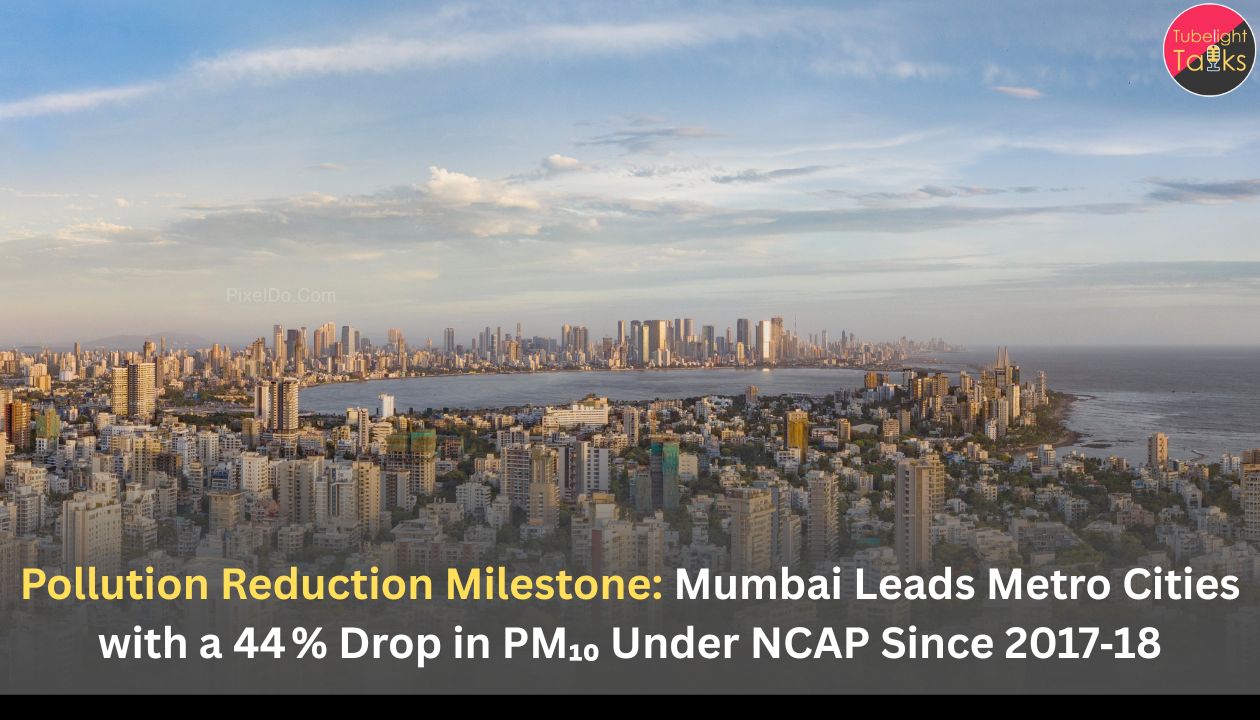
Pollution Reduction Milestone: Mumbai Leads Metro Cities with a 44 % Drop in PM₁₀ Under NCAP Since 2017‑18
Pollution Reduction Milestone: According to data tabled in the Lok Sabha, Mumbai has achieved a 44 % reduction in annual average PM₁₀ levels between 2017‑18 and 2024‑25, marking the highest improvement among India’s major metro cities under the National Clean Air Programme (NCAP).
The Numbers & Context
- Mumbai’s average PM₁₀ level dropped from 161 µg/m³ in 2017‑18 to 90 µg/m³ in 2024‑25.
- Among metro cities under NCAP:
- Kolkata saw a 37 % reduction.
- Delhi achieved about 15 % reduction.
- Chennai recorded around 12 % drop.
- Kolkata saw a 37 % reduction.
- Nationally, out of 130 cities under NCAP, 103 showed improvement in PM₁₀ levels.
What Is the National Clean Air Programme (NCAP)?
Launched in January 2019 by the Ministry of Environment, Forest & Climate Change (MoEFCC), NCAP aims to reduce PM₁₀ concentrations by 40 % by 2025‑26 (or attain the national ambient standard) in 131 non‑attainment cities. The programme supports cities via Clean Air Action Plans, performance‑linked grants and monitoring of particulate matter.
Why Mumbai’s Improvement Matters
- A 44 % reduction in PM₁₀ signals that concerted policy, managerial and infrastructure efforts are yielding results in one of India’s largest and most polluted metros.
- PM₁₀ (particulate matter with diameter ≤10 µm) is known to contribute to respiratory illnesses, cardiovascular problems and reduced life expectancy.
- Improved air quality may lower public‑health burden, reduce healthcare costs and enhance quality of life.
- Globally and nationally, metros often struggle with air pollution due to traffic, industry, construction and population density—Mumbai’s result may serve as a model.
What Likely Contributed to the Decline
Although city‑specific breakdowns are not detailed in the data disclosed, possible contributing factors include:
- Stricter vehicular emission norms, fuel quality improvements, phasing out older vehicles.
- Dust control measures: road‑sweeping, covering construction sites, reducing open burning.
- Industrial emission controls, regulatory enforcement and relocation of polluting units.
- Regional winds and coastal location may aid dispersion—but human‑driven interventions are key since improvement is much larger than natural variation.
- Targeted interventions under NCAP, city action plans and resource allocation to air‑quality improvement.
Challenges & Caveats
- Even after the 44 % reduction, Mumbai’s PM₁₀ level (90 µg/m³) remains well above the National Ambient Air Quality Standard (NAAQS) of 60 µg/m³ annual average.
- Localised hotspots persist: some monitoring stations in Mumbai reported elevated PM₁₀ levels despite city‑wide averages improving.
- Improvement rates in many other cities remain much lower—suggesting uneven progress across India.
- Reducing PM₂.₅ (finer particles with greater health risk) remains a bigger challenge; the data highlighted is for PM₁₀.
- Long‑term sustainability of improvement requires continuous enforcement, infrastructure investment and urban planning.
Also Read: India’s air crisis and the search for solutions
Clean Air and Inner Purity
According to Sant Rampal Ji Maharaj, just as external air needs to be clean for health and vitality, our inner “air” — the mind and heart — must also be kept pure through Sat Gyaan (true knowledge) and righteous living.
“When we clear the dust of ego, selfishness and wrongdoing from the heart, we breathe the breeze of peace. Just as the city must clear its physical dust for clean air, the soul must clear its inner impurities for true well‑being.”
Mumbai’s progress shows that large‑scale change is possible when collective resolve, policy action and community engagement align—not only externally but also with inner awareness.
Call to Action: For Cities, Citizens & Policymakers
For City Authorities
- Continue strengthening air‑quality monitoring and public‑data transparency.
- Invest in dust‑control, construction‑site regulation, clean public transport and tree cover.
- Ensure resources from NCAP and other schemes are fully utilised and directed to high‑impact interventions.
For Citizens
- Reduce personal contribution to PM₁₀: avoid open burning, use public transport, maintain vehicles, support green spaces.
- Advocate for better local enforcement of construction and traffic norms.
- Monitor local air‑quality data and respond accordingly (use masks/air purifiers when needed).
For Policymakers
- Replicate best‑practices observed in cities like Mumbai in other metros and smaller cities.
- Expand focus beyond PM₁₀ to PM₂.₅ and other pollutants with stricter targets.
- Align air‑quality improvement efforts with health, urban‑planning, transport and climate policies for holistic impact.
FAQs: Pollution Reduction Milestone
Q1. What does a 44 % drop in PM₁₀ mean for Mumbai?
It means the average annual concentration of PM₁₀ in Mumbai has fallen by 44 % since the baseline year 2017‑18, improving air quality significantly though levels are still above safe limits.
Q2. What is the target under NCAP for cities?
Cities under NCAP aim for a 40 % reduction (or attaining NAAQS) in PM₁₀ by 2025‑26 compared with 2017‑18.
Q3. Are other major cities improving at similar rates?
No—among major metros, Kolkata recorded 37 % reduction, Delhi about 15 % and Chennai only ~12 %.
Q4. Does this improvement mean Mumbai’s air is safe now?
Not fully. While the improvement is substantial, average PM₁₀ still exceeds the NAAQS of 60 µg/m³, and PM₂.₅ (which is more harmful) remains a challenge.
Related Stories







Discussion (0)