India–EU FTA: Inside the New Delhi Round (Nov 3–7, 2025) and the Final Push to a Balanced Deal
India EU FTA: India and the European Union completed an intensive round of Free Trade Agreement (FTA) talks in New Delhi from November 3 to 7, 2025, including a senior-level stock-take on November 5–6. Officials said discussions spanned goods, services, investment, sustainable development, rules of origin and technical barriers, and that both sides would accelerate efforts toward a “balanced and mutually beneficial” pact.
We decode what actually moved in Delhi, the contentious files that still need political calls, and how issues like autos, dairy and the EU’s Carbon Border Adjustment Mechanism (CBAM) intersect with India’s manufacturing and export ambitions.
What Just Happened in New Delhi (Nov 3–7)
India hosted EU negotiators for a week-long round capped by two days of senior-level “stock-take” meetings on November 5–6. The Ministry of Commerce & Industry noted wide coverage across chapters—goods, services, investment, trade and sustainable development, rules of origin and technical barriers—signalling consolidation rather than chapter-by-chapter sprints. The public phrasing—“accelerate efforts towards a balanced agreement”—is diplomatic, but important: it indicates both sides think the landing zone is visible, pending political trade-offs.
Official line: “Both sides agreed to further accelerate efforts towards achieving a balanced trade agreement.” (PIB press note, Nov 7, 2025).
Why This Round Matters
The New Delhi sequence came after an October acceleration—ministerial engagements and the EU Council’s new strategic agenda urging deeper EU–India trade ties—keeping the year-end target in play. With the technical groundwork largely laid since 2022, the remaining chapters are the difficult ones where India’s industrial policy and the EU’s single-market disciplines meet.
The State of Play: What’s Done vs. What’s Pending
While neither side publishes a running “scorecard,” public briefings and press reports suggest roughly half the FTA chapters are either closed or close to closure (customs/trade facilitation, parts of IP, some regulatory cooperation), while market-access and sustainability chapters remain hard.
Chapters Closer to Closure (Indicative)
- Customs & Trade Facilitation: Streamlining procedures to reduce delays and costs for exporters—important for MSMEs.
- Regulatory Cooperation / TBT elements: Alignment or recognition steps to avoid duplicate conformity assessments. (Inferred from typical EU FTAs and press briefings.)
- Parts of IPR and Services Disciplines: Non-market-access disciplines reportedly advanced, though final balances depend on horizontal trades elsewhere.
Sticking Points
- Automobiles: EU seeks lower tariffs and meaningful tariff-reduction schedules; India calibrates to protect domestic manufacturing and value chains.
- Agriculture & Dairy: Sensitive due to farm livelihoods and price volatility; the EU pushes for access while India seeks safeguards.
- Wines & Spirits: Long-running WTO-era divergences make this a high-visibility tariff issue.
- CBAM & Sustainability: India wants relief or accommodation for carbon-intensive exports, plus transition support and recognition of domestic decarbonisation pathways.
- GIs (Geographical Indications): Technical but politically sensitive—impacts food/agri branding and legacy products.
- Digital Trade / Data: Guardrails for cross-border data and privacy alignment post-DPDP Act will need careful drafting. (Context from EU-India FTA scope.)
- Investment Protection: Final architecture (investor–state dispute settlement style, domestic courts, or reformed model) can be a late-stage pivot.
Autos, Dairy and the ‘Political Economy’ Files
Automobiles: Timing, Tariffs and Transition
Europe wants a credible path to lower tariffs for cars and components; India is cautious on headline cuts but may consider phased reductions, local value-addition incentives, and TRQs (tariff-rate quotas) to smooth impacts. The balance must preserve Make in India while easing EU market-access anxiety. In public commentary, automotives have consistently featured as “sticky,” underscoring that any breakthrough likely requires top-level intervention.
Agriculture & Dairy: Safeguards and Sensitivities
India’s dairy ecosystem—smallholders, cooperatives, and price supports—shapes its defensive stance. Expect calibrated TRQs, safeguard clauses and longer staging timelines rather than sweeping liberalisation. EU asks will continue to be strong—but New Delhi’s political calculus is clear.
CBAM: The Carbon Question Hanging Over Tariff Talks
From October 2023 to end-2025, CBAM is in a transitional reporting phase; the full compliance regime starts in 2026. India’s steel, cement and aluminium shipments into the EU will face embedded-carbon reporting and, later, certificate purchases—effectively a carbon price at the EU border. Negotiators are exploring how the FTA can recognise India’s decarbonisation pathways, avoid double-pricing and support industry upgrades, while the EU safeguards its climate policy.
What to watch next: India may seek flexible methodologies, de-minimis carve-outs, or cooperation funds for cleaner tech. Meanwhile, Brussels has fine-tuned CBAM rules ahead of 2026, hinting at some administrative pragmatism.
Services, Mobility, and the People Angle
The EU is India’s largest partner in services trade outside the U.S., and India wants better access for IT, professional services, and intra-corporate transferees. Expect modern commitments on temporary movement (Mode 4), recognition of qualifications, and fast-track visas in specific categories—though a full “liberalisation of the visa regime” is beyond a trade pact’s scope.
GIs and the Brand Battles Ahead
The EU champions GIs; India has iconic names too (Darjeeling Tea, Basmati, Alphonso). Expect detailed annexes and carve-outs, plus procedures for future additions. While technical, GI outcomes affect rural incomes and export branding—hence the attention.
Investment Protection: Designing Certainty Without Handcuffs
The EU prefers a reformed investment-court system; India has revised its model BIT to narrow obligations. Compromise options include stronger due-process guarantees, transparency, and domestic-remedy first approaches—preserving policy space while assuring investors. The EU’s public “documents” page shows this file running in parallel to the FTA.
Where the Numbers Stand
Public reporting through 2025 indicates “roughly half” of chapters are closed or near-closed, with more in-principle agreements. But market-access tables—tariff lines, staging periods and TRQs—will ultimately determine the deal’s value. In recent months, both sides have intensified contact (three rounds in ~35 days at one point), underscoring urgency.
Official Signals: The Year-End Target
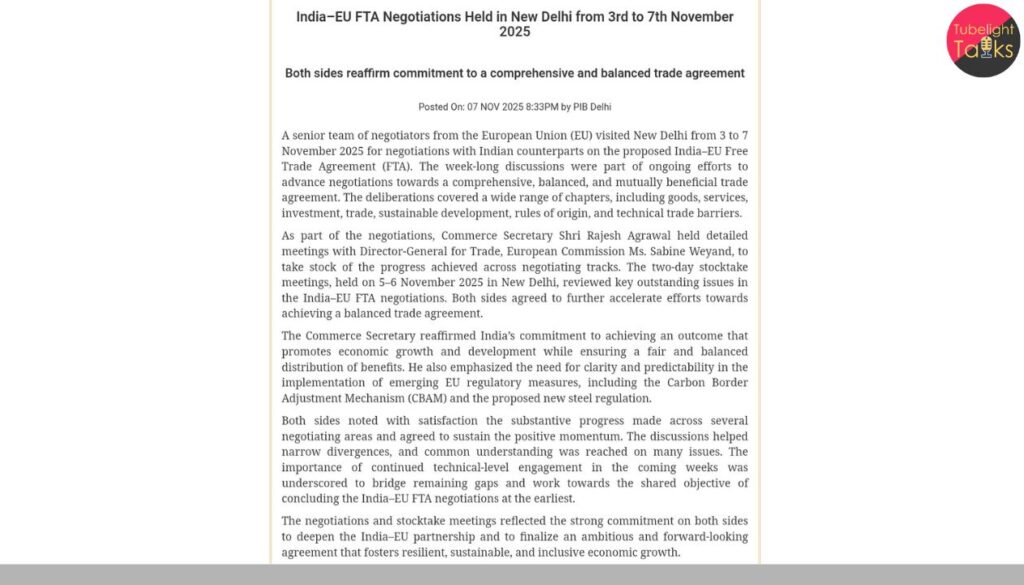
New Delhi’s briefing after the November round keeps the “this year” ambition on the table, even if slippage into early 2026 remains possible depending on political calendars. The fact that Delhi hosted a concentrated week with a senior stock-take suggests negotiators have narrowed the landing zone.
What a Balanced Deal Could Look Like
Possible Elements
- Gradual tariff cuts on selected autos with localisation incentives.
- TRQs for dairy and spirits, with safeguard triggers.
- CBAM cooperation annex recognising India’s decarbonisation measures and capacity-building support.
- Services mobility improvements for ICT and professionals.
- GI annexes with staged recognition and dispute procedures.
- Investment protection with strong due-process and limited ISDS footprint.
Why It Matters for Businesses
For auto and component makers, a predictable tariff glide path and clear rules of origin could unlock EU sourcing and Indian assembly plans. For food and beverage firms, TRQs plus labelling clarity can reduce uncertainty. For steel/aluminium exporters, CBAM alignment and emissions accounting support are critical to preserve EU market share post-2026.
India’s Broader Trade Strategy Context
The Delhi round sat against two important backdrops: (1) India’s EFTA pact took effect October 1, 2025, showcasing comfort with advanced-economy partners; and (2) a strong political push from Brussels to write a fresh EU–India agenda. Both raise the stakes for an India–EU FTA that actually lands.
The Road to Signature: A Realistic Sequence
- Technical clean-up in November: scrub texts, translate “in-principles” into legal language. 2) Political call on autos/dairy/CBAM levers. 3) Final legal scrub and initialling. 4) Public-facing factsheets to explain consumer and MSME gains. Even if a December handshake slips, an early-2026 landing with substantive Delhi progress this month would still be viewed as mission-aligned.
Practical Guide for Exporters and MSMEs
What to Do Now
- Audit your HS codes for likely tariff staging.
- Map CBAM exposure (steel, cement, aluminium): start emissions accounting systems now; learn the EU registry/reporting processes.
- Check GI risks (packaging, brand names) if you export food/agri.
- Plan for rules-of-origin: source components to meet thresholds under likely cumulation rules. (General FTA practice.)
What Would Success Look Like for Households?
- Lower prices over time on EU autos/spirits where tariff cuts are staged and competition increases.
- Better job prospects in services and high-tech manufacturing as EU buyers integrate Indian suppliers.
- Cleaner industry as CBAM drives decarbonisation investments, provided transition support lands.
Balanced Trade, Shared Values
The EU frames CBAM as a fight against carbon leakage; India frames policy space as essential for development and jobs. A successful deal accepts both truths: Europe needs to uphold climate ambition and a level playing field; India needs time and tools to climb the value chain without a shock to livelihoods. That’s the space negotiators are testing now.
From New Delhi to the Finish Line
The Delhi round’s weight lies in its focus: hard files, senior-level reviews, and public recommitment to speed. As winter calendars crowd, officials will triage a few core swaps—autos staging for dairy TRQs, CBAM flexibilities for services mobility, GI lists for investment protection contours. The next fortnight determines whether 2025 ends with an initialled text or a short glide into early 2026.
Ethics in Trade: A Human-Centric Lens
Modern trade deals are more than tariff tables; they are compacts about fairness, responsibility and the welfare of ordinary people on both sides. When negotiation teams talk about “balanced outcomes,” the ideal is reciprocity—not squeezing the other party, but securing gains that don’t inflict harm downstream. In Sant Rampal Ji Maharaj spiritual discourses on righteous conduct, emphasis is placed on truthfulness, fair exchange and compassion for those affected by our decisions—the farmer, the factory worker, the small merchant.
Bringing that ethic to trade means pacing liberalisation where livelihoods are fragile, financing cleaner technology where emissions are high, and writing rules that protect consumers without stifling entrepreneurship. Readers who wish to dive deeper into this perspective can explore discourses that foreground compassion and equitable conduct as practical guides to complex worldly choices.
What Businesses, Policymakers and Citizens Can Do Next
Prepare, Participate, and Hold the Benchmark of Balance
- Exporters & MSMEs: Start CBAM readiness, reassess EU pricing, and engage industry bodies to feed granular tariff data into negotiators now.
- State governments & clusters: Identify sectors likely to benefit (textiles, chemicals, engineering) and plan skill programs tied to EU demand. (Context: EU is a top partner for manufactured goods.)
- Consumers & professionals: Watch for consultation notes and factsheets; informed feedback helps shape fairer, more pro-consumer outcomes.
- Negotiators: Anchor the final swaps in reciprocity—credible auto staging, realistic dairy TRQs, CBAM cooperation with transition support, and meaningful services mobility.
Read Also: India-EU Relations Strengthen: A New Era of Strategic Cooperation
FAQs: EU India FTA
Q1. What exactly was negotiated in New Delhi (Nov 3–7, 2025)?
Meetings covered goods, services, investment, sustainable development, rules of origin, and technical barriers. A senior stock-take on Nov 5–6 reviewed “key outstanding issues.”
Q2. Is a 2025 conclusion still realistic?
Officials publicly maintain a “this year” ambition after the Delhi round, but the remaining political calls could push final initialling into early 2026.
Q3. What are the hardest files?
Automobiles, dairy and spirits market-access; CBAM treatment; and the final contours of investment protection and GIs.
Q4. What is CBAM and why does it matter to India?
The EU’s Carbon Border Adjustment Mechanism imposes a carbon cost on imports post-2026; 2023–25 is a transitional reporting phase. Indian steel/aluminium exporters must prepare.
Q5. What tangible benefits can Indian businesses expect?
Faster customs, clearer standards recognition, and more predictable tariffs—plus potential mobility improvements for services professionals. Details depend on final schedules.
Q6. Where can I read official updates?
See the Government of India’s PIB releases on the New Delhi round and the EU’s official India page for negotiation architecture and documents.
Related Stories





Discussion (0)