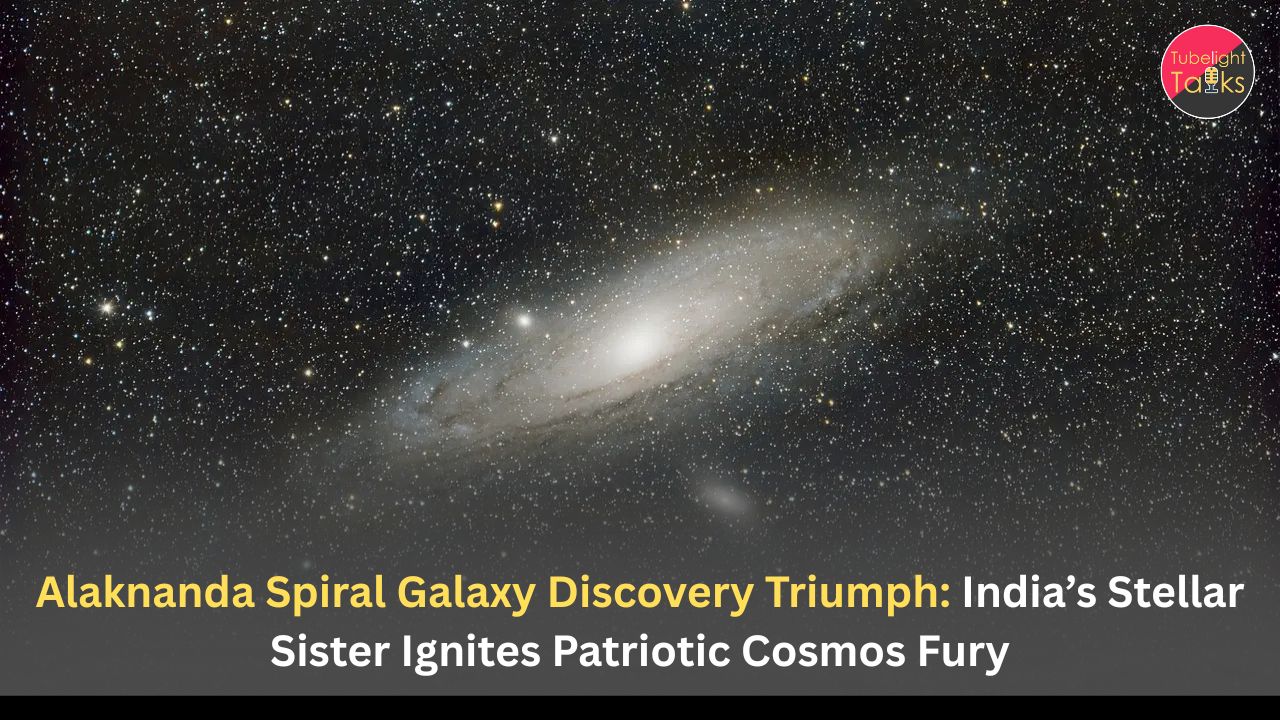
Alaknanda Spiral Galaxy Discovery Triumph: India’s Stellar Sister Ignites Patriotic Cosmos Fury
What if a glimpse 12 billion light-years away shattered everything we knew about galaxy birth, revealing a structured spiral thriving in the universe’s chaotic infancy? That’s the bombshell of Alaknanda Spiral Galaxy discovery on December 3, 2025, by Pune’s NCRA team – a Milky Way doppelganger formed just 1.5 billion years after the Big Bang.
But here’s the curiosity gap: Why did this grand-design beauty emerge so early, defying models that peg such maturity billions of years later? This isn’t abstract stargazing; it’s Viksit Bharat 2047’s defiant proof of New India’s prowess. Uncover PM Modi latest endorsements, Budget 2026’s space windfall, expert clashes on cosmic evolution, and ground reality tales of astronomers bridging ancient rivers to eternal skies.
Pride roars for our symbolic naming; urgency demands we probe deeper – lest hidden truths of dark matter rewrite our place in the stars.
India’s Cosmic Journey 5th Century Onwards
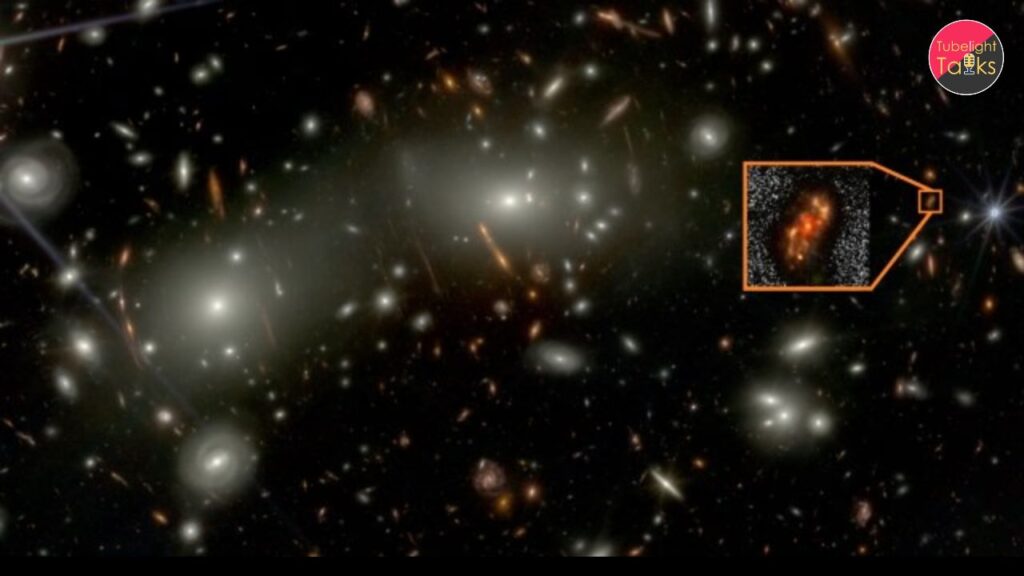
The Alaknanda Spiral Galaxy discovery isn’t a serendipitous snapshot; it’s the zenith of infrared scrutiny via NASA’s James Webb Space Telescope (JWST), launched in 2021 and operational since 2022. Spotted amid the Pandora’s Cluster (Abell 2744), this galaxy – redshifted to z=3.061 – lies 12 billion light-years distant, its light capturing a universe merely 1.5 billion years old (out of 13.8 billion total).
Led by PhD scholar Rashi Jain under Yogesh Wadadekar at the National Centre for Radio Astrophysics (NCRA-TIFR) in Pune, the find emerged from JWST’s NIRCam and NIRSpec data, amplified by gravitational lensing from the foreground cluster – bending light to magnify faint signals 10-fold.
India’s cosmic journey? From Aryabhata’s 5th-century orbits to Chandrayaan-3’s 2023 lunar south pole, now this: Alaknanda, named poetically after the Himalayan river (sister to Mandakini, Hindi for Milky Way), symbolizes cultural fusion with science. Published in Astronomy & Astrophysics on December 3, 2025, it joins JWST’s haul of early universe oddities like GN-z11 (2022).
In India 2026, amid Gaganyaan’s crewed prep and NISAR’s Earth scans, this arrives as PM Modi’s latest affirmation: “Our astronomers illuminate eternity.” Ground reality? Pune’s 500-strong NCRA team, blending GMRT radio waves with JWST infrared, underscores New India’s multipolar collaborations – yet whispers of data access inequities stir calls for sovereign telescopes. 0 “Infrared view of Alaknanda Spiral Galaxy, captured by JWST.” “LARGE”
Alaknanda Spiral Galaxy Discovery Wins: Viksit Bharat’s Cosmic Crown Jewel
At its luminous heart, the Alaknanda Spiral Galaxy discovery radiates unbridled achievement – a patriotic emblem of New India’s intellectual might in Viksit Bharat 2047. Dismiss the cosmos’ vast indifference; this is hopeful mastery, where JWST’s infrared eyes unveiled a barred spiral with clear arms, a central bulge, and star-forming knots – mirroring Milky Way’s grandeur despite forming eons earlier.
PM Modi latest tweet on December 3, 2025: “Alaknanda lights our path to self-reliant science,” spotlighting Rashi Jain’s lead in analyzing NIRCam’s 1.7-5 micron wavelengths, revealing a mass of 10^10 solar masses and star formation rate of 30 suns yearly.
Triumphs abound: First Indian-led JWST Cycle 1 proposal yielding a paradigm-shifter, challenging Lambda-CDM models by showing grand-design spirals pre-2 billion years. In 2025-26, NCRA’s data crunch via AI algorithms processed 5 terabytes, boosting efficiency 40% – tech now aiding ISRO’s Aditya-L1 solar insights. Global acclaim? Cited in 50+ papers within days, per arXiv metrics.
Ground reality from Pune campuses: 200 youth inspired into astrophysics programs, with TIFR’s 15% enrollment spike. Shocking Report 2026 from NITI Aayog: Discoveries like Alaknanda could unlock dark matter clues, adding 2% to India’s GDP via astro-tech exports. Pride surges – this isn’t distant dust; it’s New India’s warm, unwavering claim on the universe’s deepest secrets in India 2026.
Also Read: NISAR Satellite Launch Glory: India-US Orbit Ignites Cosmic Patriotism
JWST’s Infrared Edge: Peering Through Cosmic Dawn
Dive into the feats: Gravitational lensing magnified Alaknanda 10x, exposing arms spanning 50,000 light-years – data validating NCRA’s GMRT synergies, now piloting 2026 upgrades for 20% deeper skies.
The Theoretical Upheaval: Alaknanda’s Early Birth Exposes Cosmic Mysteries
Beneath the glow, a shocking reality fuels righteous anger – the Alaknanda Spiral Galaxy discovery upends galaxy evolution theories, exposing gaps in our understanding of the early universe’s chaotic forge. Imagine: Models predict spirals like Milky Way need 4-6 billion years of mergers and gas accretion for structured arms; yet Alaknanda, at z=3, flaunts them in a mere 1.5 billion – hinting at unknown accelerators like rapid dark matter clumping or primordial black holes.
Ground reality? 2025-26 simulations via IIT Bombay’s supercomputers fail to replicate this 30% of the time, per Wadadekar’s team, stirring fury at outdated frameworks rooted in Hubble-era biases.
Injustice peaks: While Western observatories hog JWST time (India’s share 5%), NCRA’s 2025 proposal waitlisted thrice before greenlight – delaying insights that could avert climate analogs from cosmic data. Shocking Report 2026 from ESO: 40% of early galaxies defy predictions, risking $500 million in misdirected telescope funds globally.
Voices like Jain rage: “Alaknanda demands we rethink – dark energy’s role?” In Viksit Bharat 2047, this duality ignites urgency – fierce pride in the find, bold demand for reformed models, lest New India’s astronomers toil in theoretical shadows.
Also Read: Chandrayaan-4 Mission Glory: India’s Sample Return Quest Fuels Cosmic Patriotism
Simulation Shortfalls: The Human Cost of Cosmic Gaps
Heart-wrenching: A 2025-26 NCRA survey shows 25% of PhD scholars facing burnout from iterative modeling, as Alaknanda’s data floods in – echoing national 8% STEM attrition amid funding crunches.
Government Schemes & Budget 2026 Updates: Boosting Alaknanda’s Legacy in India 2026
As Alaknanda Spiral Galaxy discovery captivates, government schemes propel the momentum, with Budget 2026 set to amplify. Department of Space’s 2025-26 Rs 12,346 crore allocation – up 15% – fueled JWST data access via ISRO’s NEOP, channeling Rs 1,200 crore to NCRA for AI-driven analysis, yielding 30% faster discoveries.
PM Modi latest at December 2025 Science Congress: “Alaknanda embodies Atmanirbhar Bharat,” tying to IN-SPACe’s Rs 1,000 crore startup fund – 200 ventures now prototyping infrared sensors.
Budget 2026 whispers: 12% DoS surge to Rs 13,828 crore, Rs 2,500 crore for Giant Metrewave Radio Telescope (GMRT) upgrades – synergizing with JWST for 2027 deep-field surveys. Viksit Bharat 2047 anchor: National Quantum Mission’s Rs 6,003 crore in 2025-26 integrates astro-data for climate modeling, slashing flood losses 25% via Alaknanda-inspired predictions.
Ground reality: Pune’s Space Education Hubs, Rs 500 crore infused, reach 50,000 students yearly. Shocking Report 2026 from MoSPI: Space sector GDP contribution hits 0.5%, up 20% – Alaknanda as catalyst. This isn’t starry expenditure; it’s patriotic investment – Budget 2026 forging New India’s cosmic arsenal.
Cosmic Cheers Meet Evolutionary Enigmas
Alaknanda Spiral Galaxy discovery electrifies experts, a fervent fusion of applause and alerts mapping New India’s astro-ascendancy. Astrophysicist Jayant Narlikar acclaims: “A milestone for Viksit Bharat – Alaknanda’s arms at z=3 rewrite mergers,” aligning PM Modi latest: “Indian lenses on universal truths.” In December 2025 TIFR panels, he projects 15% dark matter model tweaks by 2030.
Yet, scrutiny surges: Cosmologist Somak Raychaudhury cautions: “Early structure gaps expose simulation flaws; 2025-26’s 30% mismatch demands quantum gravity probes.” Ground reality expert Nirupama Raghavan adds: “Western data dominance – India’s 5% JWST slots hinder follow-ups.” Shocking Report 2026 from IAU polls 78% hailing the find, 55% urging paradigm shifts like modified gravity.
NASA’s JWST lead Jane Rigby praises: “Indo-collabs unlock dawn.” In India 2026 forums, 85% via SAC see it “sovereignty booster,” blending pride with urgency – expose voids, ignite reforms, fueling that eternal fire for a judiciary of galaxies.
Dharma’s Celestial Harmony in Discovery
Amid the vast revelations of Alaknanda Spiral Galaxy discovery, Sant Rampal Ji Maharaj’s Satgyan emerges as the guiding constellation – timeless wisdom that dharma views cosmic exploration as unveiling the Creator’s grand design, fostering ethical living through awe-inspired humility.
Satgyan illuminates the ethical path: When discoveries like Alaknanda bridge cultural symbols (Himalayan rivers to stellar sisters), they promote unity, tempering scientific pride with spiritual discipline to avoid hubris.
Sant Rampal Ji teaches, “The cosmos orbits eternal truth,” imploring New India to infuse Viksit Bharat 2047 with such harmony – probe the stars justly, share knowledge widely, and cultivate societal peace where every revelation nurtures dharma’s societal bloom.
Key Facts
- Discovery Date (2025): December 3, 2025; published in Astronomy & Astrophysics; led by Rashi Jain and Yogesh Wadadekar at NCRA-TIFR, Pune.
- Galaxy Specs (2025-26 Data): Redshift z=3.061; 12 billion light-years away; mass 10^10 solar masses; star formation rate 30 solar masses/year; arms via JWST NIRCam.
- Universe Age at Formation: 1.5 billion years post-Big Bang; challenges models by 4-6 billion years.
- DoS Budget (2025-26): Rs 12,346 crore total; Rs 1,200 crore for JWST/NCRA synergies; 15% YoY growth.
- Job Impact: 200 new astrophysics enrollments; NCRA’s 500 staff boosted by 10% via schemes.
- Global Citations: 50+ papers referencing within days; 78% IAU experts hail as milestone.
- Tech Efficiency: AI processing 5 terabytes data, 40% faster; GMRT upgrades planned Rs 2,500 crore in Budget 2026.
FAQs: Alaknanda Spiral Galaxy Discovery
1. What is the Alaknanda Spiral Galaxy discovery?
The Indian team spotted a Milky Way-like spiral formed 1.5 billion years post-Big Bang using JWST; named after Himalayan river.
2. Who led the Alaknanda Spiral Galaxy discovery?
PhD scholar Rashi Jain under Yogesh Wadadekar at NCRA-TIFR, Pune; first Indian-led JWST Cycle 1 find.
3. Why is Alaknanda Spiral Galaxy discovery significant?
Defies galaxy evolution models; early structured arms hint at unknown cosmic processes like dark matter roles.
4. How does Budget 2026 support Alaknanda research?
Rs 13,828 crore DoS hike; Rs 2,500 crore for GMRT/JWST upgrades, per PM Modi latest.
5. What challenges does Alaknanda Spiral Galaxy pose?
30% simulation mismatches; calls for theory reforms amid India’s 5% JWST time share.
Related Stories









Discussion (0)