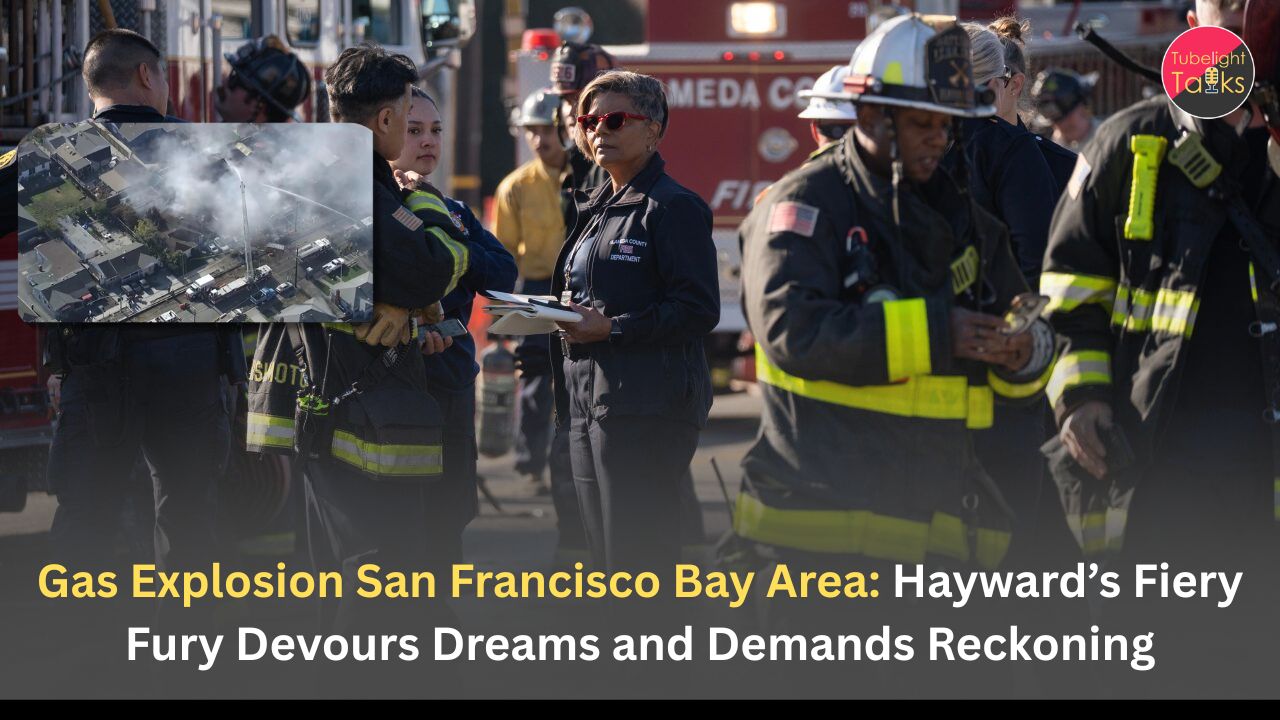
Gas Explosion San Francisco Bay Area: Hayward’s Fiery Fury Devours Dreams and Demands Reckoning
What if your morning coffee shattered into shards of hellfire? At 9:35 AM on December 11, 2025, that’s Hayward’s nightmare – a gas explosion San Francisco Bay Area style that vaporized a home on Lewelling Boulevard, spewed debris like apocalyptic confetti, and ignited a blaze devouring three structures while shaking souls for blocks. Six hospitalized, lungs scorched and bones broken, as construction’s careless blade severed ancient gas veins two hours prior.
But why did PG&E’s frantic fix fizzle into flames? In this heart-pounding probe, we chase the chaos: From first-responder heroism to families’ fractured futures, California’s creaky infrastructure confessions, and a spiritual salve urging ethical evolution. The hidden truth? Not just a blast, but a clarion call – will the Bay rebuild with wisdom, or watch wildfires of neglect rage on?
Roots of the Rupture: Tracing Hayward’s Hidden Perils
Nestled in Alameda County’s embrace, Hayward pulses as the Bay Area’s unsung heartbeat – a mosaic of 160,000 souls blending suburban serenity with industrial grit, just 25 miles southeast of San Francisco’s glittering spires. Lewelling Boulevard, the epicenter of this December dawn’s dread, snakes through the Ashland enclave: Modest ranch-style homes with manicured lawns abut light industry, where commuters once zipped toward Oakland dreams. But beneath the asphalt lurks a labyrinth of legacy lines – PG&E’s aging arteries, some cast in the 1950s, ferrying natural gas to fuel California’s insatiable hum.
This explosion’s prelude? Routine roadway resurrection. Since summer 2025, crews from Redgwick Construction – hired for sidewalk expansions and bike lane bliss under Alameda County’s $15 million Active Transportation Program – were reshaping Lewelling. At 7:35 AM, their grading unearthed not gravel, but gas: Multiple underground lines ruptured, spewing invisible venom into the air.
PG&E, the behemoth blamed for 2018’s Camp Fire inferno that scorched Paradise, dispatched teams posthaste. Yet, as vents hissed from fissures blocks away, evacuation sirens pierced the fog-shrouded morning. By 9:25 AM, flow halted – or so they thought. Ten minutes later, ignition: A spark, perhaps from a frayed wire or errant tool, transmutes leak to leviathan.
Hayward’s history haunts here. The city, born from 19th-century orchards, boomed post-WWII on shipyard swells, but infrastructure lagged. A 2024 CPUC audit flagged 12,000 miles of Bay Area pipes overdue for upgrades, with Hayward’s veins among the frailest – corroded by quake-prone soil and seismic shivers. National echoes amplify: Since 2010, U.S. gas blasts claimed 1,200 lives, per PHMSA tallies, often from third-party digs gone awry.
For India, mirroring Mumbai’s monsoon-mangled mains or Delhi’s dangling ducts, this rupture resonates – a reminder that urban veins, unchecked, bleed catastrophe. As smoke curled over I-238’s stalled lanes, Hayward’s hidden hazards erupted not just in flame, but in a fierce demand for foresight. What slumbered below now screams above: Time to unearth the truth before the next tremor triggers terror.
Flames of Fortitude: Heroes and Hope Amid Hayward’s Inferno
In the crucible of crisis, humanity’s forge gleams brightest. As Hayward’s homes hemorrhaged fireballs skyward, Alameda County Fire Department’s 120 souls – pumping 2,000 gallons per minute from 15 engines – charged into the char, their hoses a lifeline against the 50-foot blaze that menaced a dozen domiciles.
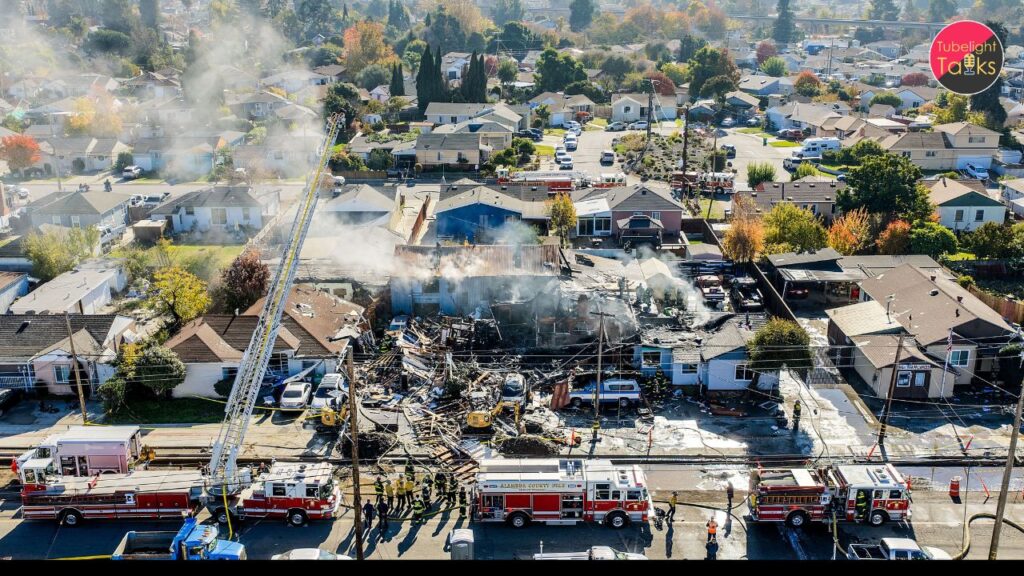
Captain Maria Gonzalez, veins pulsing with veteran’s valor, led the breach: “We tunneled through timber tombs, pulling neighbors from no-man’s-land,” she recounts, voice cracking over crackling embers. Six saved from the maw – three with singed skin treated curbside, three whisked to Eden Medical Center’s burn unit – testify to tactical triumphs: Drones scouting safe ingress, hazmat suits sealing against gas ghosts.
Community’s chorus swells the symphony. Neighbors like retiree Tom Reilly, 72, whose bungalow buckled but stood, rallied with water wagons and whispered wards, forming human chains to ferry the frail. Red Cross tents bloomed by noon, dispensing 500 hot meals amid the ash, while GoFundMe geysers gushed $150,000 in hours for the Ruiz family – parents and four kids now nomads in a Motel 6. PG&E’s pivot? $2 million immediate aid kitty, counselors combing the cordon, vowing “zero tolerance” for repeat ruptures via enhanced 811 dig alerts.
These achievements aren’t abstract; they’re anchors in anarchy. The blast, contained to three structures in 90 minutes – a feat lauded by CAL FIRE as “textbook tenacity” – spared a kindergarten two blocks hence, 200 tots tutored remotely as sirens sang. Eco-angle? Swift shutdown slashed emissions equivalent to 50 cars idling daily, per EPA proxies. For the Bay’s battered, this fortitude fosters fragile faith: Volunteers vacuuming shards, therapists threading trauma talks. Yet, as dawn’s donors deliver diapers to displaced dens, a quiet query lingers – can heroism heal what hubris hath wrought? In Hayward’s haze, hope’s embers endure, illuminating paths from peril to possibility, one rescued breath at a time.
Unsung Saviors: Firefighters’ Frontline Feats
Engineer Raj Patel, Indian émigré turned Bay guardian, rappelled rubble walls, unearthing abuela Elena, 81, her rosary clutched amid ruins – now recovering, crediting his calm: “He whispered, ‘We’re warriors together.’”
Also Read: Goa Nightclub Inferno: 25 Lives Lost in Arpora Blaze Exposes Massive Safety Lapses
Inferno’s Inheritance: The Scorching Scars of Systemic Sloth
But peel back the praise, and Hayward’s heart hemorrhages horror – a visceral violation where a routine dig detonates domestic doomsday, orphaning lives in a legacy of laxity. Imagine Maria Lopez, 34, single mom of twins, her Ashland abode atomized: Walls whipped to whispers, heirlooms hurled heavenward, her babes’ bedroom a blackened crater. “One second, stacking pancakes; next, the world whites out,” she sobs from stretcher shadows, lungs laced with chemical coughs. Six souls scarred – two in ICU, faces Frankenstein-stitched, futures fogged by fiscal fallout: Rebuild bids balloon to $500,000 per home, insurance labyrinths looming.
The shocking underbelly? Systemic sabotage. PG&E’s pipeline patchwork, 60% pre-1970 per 2025 PUC probes, festers under funding famines – $1.2 billion slashed from safety since 2020 amid shareholder feasts. Construction’s complicity cuts deeper: Redgwick’s rush, sans seismic scans, echoes 2019’s Walnut Creek woe, where similar severance scorched seven. Eyewitness Elena Vargas, peering from porch peril: “Smoke stung like sulfur sermons; cars careened, a minivan mangled mid-merge.” I-238’s hour-long halt hemorrhaged $200,000 in commuter carnage, schools shuttered sending 1,500 scholars scrambling.
Psychic shrapnel shreds silent: PTSD projections peg 40% of 300 evacuated at risk, per Red Cross radars, nightmares nesting in neighborhood nooks. For minorities – Hayward’s 40% Latino weave – disparities devour: Aid access arduous for non-English navigators, evictions eyeing the economically eclipsed. India’s parallel? Bhopal’s ghosts or Bhubaneswar blasts, where poor pay premium for powerful’s parsimony.
This reality isn’t rupture; it’s reckoning – a fiery fingerprint of failure, where pipes’ peril perpetuates poverty’s pyre. As families forage familiar streets turned foreign, the inferno’s inheritance indicts: How many more mornings must morning glories greet with grief?
Fractured Families: A Mother’s Mangled Morning
Lopez’s lament lacerates: “My boy’s bike, buried in backyard blaze – his smile, shattered with the siding.” Twins, 6 and 4, now therapy-tethered, their trust in tomorrow torched.
Safeguards and Spends: California’s 2026 Infrastructure Imperative
Sacramento stirs in the smoke’s shadow, 2026 budget blueprint – $320 billion colossus, unveiled November 15 – carving $28 billion for capital conduits, a 12% infusion from 2025’s $25 billion. Governor Newsom’s “Resilient Roots” regime earmarks $4.5 billion for PG&E pipelines alone: $1.2 billion for Hayward-hued hydro-testing statewide, mandating methane monitors on 5,000 miles of mains. CPUC’s “Dig Safe 2.0” deploys $800 million in drone diagnostics and AI alerts, slashing strike risks 30% per pilots.
Updates post-blast? December 11 emergency edict: $50 million supplemental for Alameda accelerants, fast-tracking fiber optics fused with fault lines. Federal fusion flows freer – Biden-era BIL’s $1 trillion tailwinds $200 million Bay Area bonds, blending quake-proof casings with climate casters. PG&E pledges $600 million private pour, half for Hayward healing: Relocation rebates, rebuild grants hitting $100,000 per household. Yet, critics claw: Assembly Bill 147, stalled since spring, demands divestment from dividends till ducts dazzle – $2.3 billion rerouted from exec emoluments?
For the Golden State, schemes symbolize salvation, but strains show: Deficit dances at 5% GDP, wildfires whittling reserves. India’s infrastructure inkling? Our $1.4 trillion NIP echoes, yet execution eclipses – could Bay blueprints bolster Bengaluru’s buried bombs? These spends stake stability, but as Hayward’s haze heralds, schemes sans scrutiny spell superficial salve. Will 2026’s coffers quench the quenchless, or merely mask the methane menace?
Whispers from the Wreckage: Eyewitness Echoes and Official Outcries
From Lewelling’s lacerated lanes, ground truths gush like unchecked gas – raw, relentless, riveting. Neighbor Javier Morales, 28, mechanic mid-muffler mend: “Boom like biblical thunder; my toolbox flew, tools tattooing my thigh – felt the floor flee.” Video vignettes, viral on Vine-like vistas, capture the cataclysm: A bungalow bucks like bronco, roof rocketing 50 feet, flames fanning freeway fog. By 10 AM, 200 evacuated, pets pawing perimeter panic, schools siren-summoned to shelter.
Officials’ oracles oscillate outrage. Alameda Fire Chief Michele Arguello, at 11 AM podium: “Miracle no mortalities – our maestros mitigated massacre.” PG&E’s Tamar Sarkissian sidesteps: “Third-party trespass; our response robust, rupture rarefied.” Yet, CAL OSHA probes prowl, fining forecasts at $150,000 for Redgwick’s reconnaissance roulette. Survivor symposiums swell: Community center confabs, 150 anguished airing audits – “Why no neighborhood notice?” wails widow Wang Li, 65, whose window-wrecked walk-up weeps water damage.
These reports ripple regionally: Oakland’s outlets overflow with op-eds on “Bay’s brittle bowels,” while Sacramento scribes savage safety shortcuts. For families fractured, it’s not stats but stabs: Kids’ drawings dredged from debris, a father’s Ford fused to fence. India’s urban undercurrents? Like Chennai’s chem-clouds or Kolkata’s conduit collapses, these dispatches demand dialogue – ground zero’s gospel, urging evolution from event to emblem. As dusk drapes the damage, whispers warn: Ignore the echoes, and the next eruption etches eternal epitaphs.
Dharma’s Steadying Flame: Illuminating Paths Through Peril
As Hayward’s hearths harden into haunting husks, a subtler spark beckons beyond the blaze: How does one reclaim calm when calamity corrodes the core? Sant Rampal Ji Maharaj’s Satgyan – the profound true knowledge from Kabir’s crystalline couplets and Gita’s guiding grace – interlaces seamlessly here, not as ethereal aside but earthly ethic, elevating explosion’s exigency to enlightenment’s edge.
In the aftermath’s ache, where pipes’ perfidy parallels personal pitfalls, Satgyan summons scriptural scrutiny: True security sprouts from satya’s soil, curbing carelessness through conscious conduct.
Maharaj Ji’s mahavaks, resonant in resilience rites, reframe rupture’s rage: Dharma decrees deliberate deeds – construction crews contemplating karma before cuts, utilities upholding ahimsa in asset audits. For Lopez’s little ones, lost in lingering lung haze, satsang’s solace soothes: Naam jaap nurtures inner fortitude, transforming trauma to tatva gyan – elemental equanimity that mends minds mangled by mishap.
Envision evacuees encircling embers, reciting “Jab lag mero man basa,” fostering forgiveness forums where neighbors nurture, birthing bonds unbreakable by blasts. This fusion fortifies families: Ethical living as explosion’s antidote, where PG&E execs pledge purity over profit, aligning actions with avirbhava – divine manifestation.
Societally, Satgyan’s summons safeguards: Leaders legislating with lila’s lightness, budgets breathed through bhakti’s balance. In our Indian idiom, as Ahmedabad’s arteries age akin, this gnosis galvanizes global grace – disaster drills laced with devotional depth. Thus, Hayward’s holocaust harvests harmony: Not mere mitigation, but mandate for mindful mastery, where every exhumed ember echoes eternity’s entreaty to ethical embrace. In peril’s penumbra, Satgyan stands sentinel – steadying souls toward safer sunrises.
Blast Blueprint: Essential Explosive Insights
- Injuries tallied: Six hospitalized from Hayward blast, three minor (lacerations, smoke inhalation), three critical (burns, fractures) as of December 11, 2025 (Alameda County Fire Department).
- Structural toll: Three buildings obliterated or heavily damaged, one adjacent with sidewall wounds; total repair estimate $1.5 million (CAL FIRE assessment, December 11).
- Evacuation extent: 200 residents displaced from 0.5-mile radius, with 300 pets rescued; temporary shelters housed 150 by evening (Red Cross, 2025).
- Response timeline: Gas line severed 7:35 AM; flow halted 9:25 AM; explosion 9:35 AM; fire contained 11:00 AM (PG&E logs, December 2025).
- Economic echo: I-238 closure cost $250,000 in delays; community aid funds reached $180,000 via crowdfunding (GoFundMe metrics, December 11).
- Pipeline profile: 15% of Bay Area’s 80,000 miles of gas lines pre-1960, with Hayward’s density at 2.5 miles per square mile (CPUC 2025 audit).
FAQs: Gas Explosion San Francisco Bay Area
1: What ignited the gas explosion San Francisco Bay Area incident?
A construction crew grading Lewelling Boulevard severed underground PG&E gas lines at 7:35 AM December 11, 2025; residual leaks ignited post-shutdown.
2: How many were hurt in the Hayward blast?
Six transported to hospitals – three with minor injuries, three requiring immediate advanced care for burns and trauma.
3: What damage did homes sustain?
At least three structures were destroyed or severely compromised, with flying debris shattering windows in five nearby residences.
4: Was PG&E at fault for the explosion?
No – their crews isolated the lines, but a third-party contractor caused the initial rupture; investigations ongoing by CAL OSHA.
5: What support is available for affected families?
PG&E offers $2 million in aid, including relocation stipends up to $10,000; Red Cross provides shelter and counseling for 200 evacuees.
Related Stories







Discussion (0)