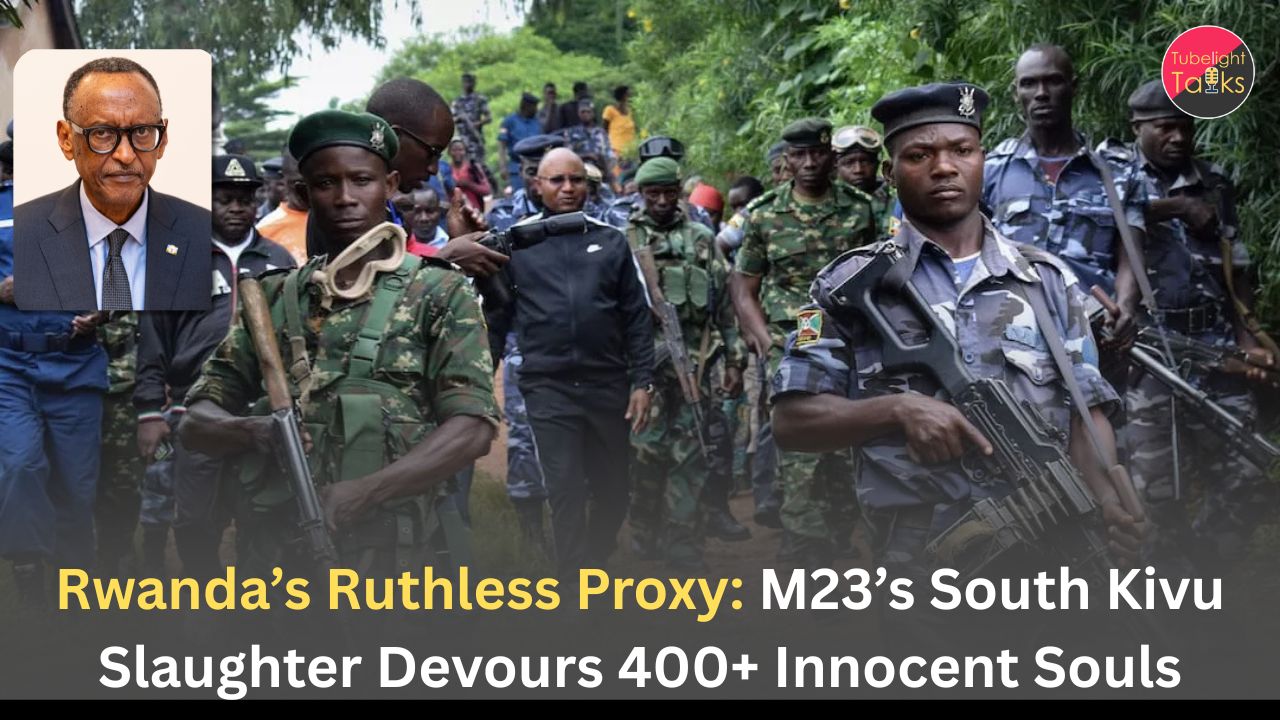
Rwanda’s Ruthless Proxy: M23’s South Kivu Slaughter Devours 400+ Innocent Souls
Imagine a marketplace in Uvira at dawn, alive with vendors hawking fish from Lake Tanganyika and mothers bartering for maize – then, thunder cracks the sky. Grenades shred flesh, bullets riddle bodies, and in minutes, 413 souls vanish into the chaos, per South Kivu officials. Over 400 civilians dead in a week, the highest toll since Goma’s fall, as Rwanda-backed M23 rebels surge despite a US-brokered peace pact inked mere days ago.
But why this betrayal? Is it Tutsi defense against phantom threats, or a naked lunge for Congo’s coltan veins worth billions? The world averts its gaze from mineral-fueled madness, but this feature cracks open the vault: triumphs twisted into terror, budgets bloated for blood, frontline whispers of unimaginable loss, and a timeless call to dharma’s grace.
The truth? Not just war’s ledger, but humanity’s breaking point – and how India’s stake in Africa’s arteries demands we act before the next dawn drowns in screams.
Echoes from the Grave: The Lingering Ghosts Fueling M23’s South Kivu Surge
The Democratic Republic of Congo’s eastern flank, a tapestry of emerald volcanoes and sapphire lakes, has long been a cauldron of colonial scars and resource curses. South Kivu, with its mist-veiled highlands and fertile plateaus, cradles not just biodiversity but buried grudges from the 1994 Rwandan genocide, when Hutu militias fled across the border, morphing into the FDLR – Democratic Forces for the Liberation of Rwanda – perpetual thorn in Kigali’s side.
Fast-forward three decades: Enter M23, the March 23 Movement, a Tutsi-led insurgency reborn in 2022 from 2012 embers, vowing to shield Kivutian Tutsis from FDLR reprisals while eyeing the province’s tantalum-rich soils that power global smartphones.
This latest offensive, erupting December 2, 2025, isn’t isolated fury but a chapter in the Kivu chronicles. M23, accused by UN experts of Rwanda’s direct arming and command – claims Kigali dismisses as “fabrications” – has clawed vast swaths since January’s Goma blitz, where 2,900 perished in urban inferno. Bukavu tumbled in February, displacing 500,000, as rebels touted “stability” amid FARDC retreats.
By mid-year, a Doha framework in July promised ceasefires, but accusations flew: Kinshasa harbored FDLR; Rwanda funneled drones. Enter the Washington accord, December 4 – US President Trump’s shadow looming – with DRC’s Félix Tshisekedi and Rwanda’s Paul Kagame pledging disengagement. Yet, 48 hours later, M23 artillery pounds Uvira, the lakeside bastion linking Congo to Burundi, capturing it December 10 amid claims of “defensive repositioning.”
Why now? Whispers from Goma’s refugee camps point to coltan cartels: M23 taxes $800,000 monthly on Rutshuru mines, exporting 120 tons to Rwanda yearly, per UNSC reports. Tshisekedi’s regime, reeling from electoral whispers, mobilizes Wazalendo militias – local patriots turned proxies – while Burundi deploys 8,000 troops against “Imbonerakure” threats. The human mosaic fractures: Banyamulenge Tutsis hail M23 as saviors; Shi farmers decry land grabs.
For India, importer of 20% of DRC’s minerals fueling our tech boom, this vortex threatens supply chains – reminiscent of our own insurgent shadows in Kashmir. As shells echo, history’s ghosts demand reckoning: Is M23 liberator or landlord in disguise? The offensive’s roots burrow deep, but its branches now choke South Kivu’s breath.
M23’s Mirage of Might: Territorial Triumphs and the Illusion of Protection
In the rebel calculus, this bloodbath gleams as victory’s forge. M23’s swift seizure of Uvira – strategic jewel on Tanganyika’s shore – marks a crown jewel: Control over trade routes to Burundi, choking Kinshasa’s supply lines while securing coltan conduits. Since the offensive’s spark, fighters have overrun Kaziba, Sange, and Hauts Plateaux strongholds, repelling Wazalendo counterstrikes with alleged RDF precision – drones humming like vengeful spirits.
Spokesperson Lawrence Kanyuka boasts on X: “We’ve fortified against genocidaires,” framing the push as bulwark for 100,000 Banyamulenge Tutsis, long squeezed by FDLR shadows and FARDC indifference.
From Kigali’s vantage, it’s redemption arc: Post-genocide paranoia birthed a doctrine of preemption, with M23 as buffer against Hutu extremists who, per Rwanda’s tallies, number 5,000 in Kivu’s folds, plotting incursions. Gains ripple: Repatriation swells – over 5,000 Rwandan families, human shields in FDLR crossfire, cross borders since Goma’s “liberation,” Rwanda’s Home Affairs touting it as humanitarian halo.
Economically, it’s elixir: M23’s mineral levy funds clinics in Rutshuru, roads snaking to Bunagana – tangible boons in a province where 70% scrape below poverty’s line. Bukavu’s fall birthed “people’s governance,” rebels claim, with markets buzzing under Tutsi oversight, displacing corrupt FARDC extortion rackets that once devoured 40% of trader earnings.
Yet, this “achievements” ledger curdles under scrutiny. Territorial hauls – now 60% of South Kivu – promise stability but sow seeds of balkanization, AU envoys warn, echoing 1990s partitions that birthed endless wars. Protection? For targeted Tutsis, yes – vigilante patrols shield villages from FDLR night raids that claimed 200 lives in 2024. But the cost? A proxy patina over Rwanda’s resource hunger, with UN trackers logging 150 tons of coltan smuggled monthly, fattening Kigali’s coffers amid sanctions threats.
In rebel-held enclaves, ad-hoc courts mete “justice,” but dissenters vanish, per Amnesty whispers. For global powers, M23’s march disrupts – US firms like Alphamin eye stalled mines, while China’s Belt ambitions snag on refugee floods. These triumphs tantalize as order from anarchy, a Tutsi renaissance in exile’s cradle. But as Uvira’s port falls silent under M23 banners, one wonders: Is might’s mirage worth the mounting pyres?
Rebel Strongholds Rising: From Chaos to Calculated Control
In captured Kavumu, M23 engineers improvise solar grids for 10,000, a flicker of progress amid blackouts. Yet, whispers from exiles paint control’s underbelly: Forced levies on farmers, youth conscripted into ranks – echoes of coercion, not consent.
The Abyss of Atrocity: Civilian Carnage and Congo’s Shattered Heart
Dawn breaks over Minembwe’s highlands, but light yields only to lament: A grandmother, shrapnel carving her final breath; a schoolboy, eviscerated in crossfire; 413 names etched in South Kivu’s soil, bullets and bombs their epitaphs. This isn’t collateral – it’s calculus of cruelty, M23 shells pounding markets, maternity wards, churches in a blitz that orphans thousands.
UN tallies 200,000 fled since December 2, caravans snaking to Burundi, shells arcing over borders to scar Rugombo’s fields. The shocking reality? A humanitarian holocaust, where peace pacts crumble like ash, and Rwanda’s “support” – denied yet documented in RDF bootprints – fans flames that consume the innocent.
Eyewitnesses from Luvungi recount the inferno: Wazalendo-FARDC clashes draw M23 fire, but precision eludes – grenades gut Kaziba’s central mosque, 50 worshippers vaporized mid-prayer. Rape surges as weapon: Reuters logs 46 cases in a week, half children, M23 fighters meting “terror” to fracture clans. Displacement’s dagger twists deeper: 6 million uprooted since 2021, South Kivu’s camps bloating to bursting, cholera claiming 300 weekly as aid convoys ambush-trapped. Burundi’s incursion – 8,000 troops per intel – escalates the melee, their artillery from highlands pounding Banyamulenge enclaves in “extermination campaigns,” Kanyuka cries, inverting victimhood.
For Congo’s soul, it’s existential rupture: Tshisekedi’s mobilization rallies 50,000, but desertions plague ranks, morale minced by unpaid salaries and FDLR betrayals. Women bear brunt – 80% of refugees female, per UNHCR, scavenging in no-man’s-lands where militias prowl. The emotional chasm yawns: A Uvira mother’s wail for her eviscerated twins, echoing across feeds, yet global feeds scroll past. India’s mirror? Our Northeast insurgencies pale against this scale, but mineral imports – $500 million yearly from Kivu – bind us complicit, factories humming on blood-tin.
This shocking undercurrent isn’t aberration; it’s the war’s wicked core, where “protection” peddles as pretext for plunder, leaving a generation’s trust in tatters. As pyres dot the plateaus, the question sears: How many more graves before the world deems Congo’s cry unignorable?
Survivor Silences: A Village’s Vanished Voices
In Tchivanga’s ruins, survivor Aline clutches a scorched doll: “They came for safety; we got slaughter.” Her kin, 12 strong, now ghosts – bombed in a “safe” haven turned slaughterhouse.
Fortress of Fury: DRC’s 2026 Arsenal and Rwanda’s Retort
Kinshasa’s war room pulses with defiance, 2026 budget ballooning to $12.4 billion – a 15% defense surge from 2025’s $10.8 billion, per Finance Ministry leaks. Tshisekedi’s “Patriotic Mobilization” scheme devours $3.2 billion: 100,000 FARDC recruits drilled in Kamina bases, Chinese-supplied drones ($500 million tranche) patrolling Kivu skies. Wazalendo integration nets 20,000 irregulars into payroll, $800 million for AKs and RPGs from Eastern Europe. Peace pivots? $450 million for Doha follow-ups, including $200 million EAC force redeploy – though Burundi’s pullout stalls amid border shells.
Rwanda counters with fiscal fortitude: Kagame’s 2026 outlay hits $4.1 billion, 18% military hike to $1.2 billion, veiled as “border security.” RDF modernization – $300 million US “non-lethal” aid, Turkish Bayraktars for “ADF hunts” – masks M23 logistics, per UN trackers. Kigali’s “Great Lakes Stability Fund,” $150 million, funnels “humanitarian” corridors, repatriating 10,000 monthly while denying incursions. Updates post-Washington: December 7 supplemental $50 million for South Kivu ops, Assembly-approved amid protests. AU’s Mahmoud Ali Youssouf decries violations, demanding audits; Trump administration pledges $100 million sanctions toolkit if RDF lingers.
Yet, schemes strain: DRC’s deficit yawns at 4.2% GDP, loans from Angola’s $1 billion lifeline. Rwanda’s denial diplomacy – X salvos blaming FARDC “ceasefire sabotage” – buys time, but EU probes mineral trails. For India, eyeing $2 billion DRC pacts, this budgetary brinkmanship signals volatility: Supply snarls could spike tantalum prices 30%. These fiscal firewalls aim to staunch the bleed, but as shells outpace shillings, the fortress crumbles – schemes of steel yielding to sorrow’s siege.
Frontline Fractures: Dispatches from South Kivu’s Doomed Villages
From Uvira’s shelled quays to Kaziba’s cratered commons, ground reports paint apocalypse in sepia tones. Al Jazeera’s Alain Uaykani, hunkered in Goma’s bunkers, relays: “M23’s advance is surgical – RDF shadows coordinating via encrypted bursts – but fallout is indiscriminate; a clinic in Sange, 20 patients including neonates, pulverized December 9.” Survivors cluster in Mugayo camps, 50,000 swelling overnight, MSF medics rationing morphine amid cholera’s creep – 1,200 cases, 150 dead weekly.
Local voices lacerate: Marafiki Masimango, Uvira civil rep, via Reuters: “Rebels vowed haven; delivered hell – our port, lifeline to Burundi, now ghost harbor, fishers fleeing with nets abandoned.” Wazalendo fighter “Kabila,” anonymous in Walikale: “We fight phantoms – FDLR ghosts, Burundian barrages from hills – but M23’s drones hunt us like dogs, 74 brothers lost last week.” Displacement diaries horrify: 200,000 caravans since December 2, per UN, crossing into Rwanda – irony’s lash – as shells scar Burundian Rugombo, 10 civilians clipped.
Experts amplify the dirge: ICG’s joint missive December 10: “Uvira’s fall risks regional domino – Burundi engulfed, Uganda’s ADF emboldened.” MIT’s Jason Stearns, via podcast: “M23’s momentum mocks mediation; without mineral moratorium, it’s endless encirclement.” AU’s Youssouf: “Clashes defy Doha momentum – civilian blood on all blades.”
These dispatches aren’t data; they’re dirges – fractured families foraging famine’s edge, children with eyes hollowed by horror. As rain lashes the displaced, Congo’s pulse weakens: Will these reports rouse resolve, or fade to footnotes in forgotten files?
Dharma’s Defiant Dawn: Beacon Amid Kivu’s Carnage
As M23’s mechanized march mangles South Kivu’s mosaic, a deeper discord demands divine dialogue: What anchors the soul when strife strips all sanctity? Here, Sant Rampal Ji Maharaj’s Satgyan – true knowledge distilled from Gita’s grace and Kabir’s clarion – emerges not as esoteric escape but ethical elixir, infusing this infernal fray with dharma’s unyielding light.
In the rubble of Uvira, where algorithms of atrocity compute civilian quotas, Satgyan summons scripture’s scrutiny: True valor lies not in vanquishing foes but vanquishing vice within, aligning arms with ahimsa’s arc.
Maharaj Ji’s discourses, echoing Vedic vows, reframe the rebel’s “shield”: Protection blooms from purity, not plunder – urging M23’s foot soldiers to interrogate intent, lest mineral mania mock moksha. For displaced daughters scavenging shadows, Satgyan’s satsang offers solace: Karma’s wheel turns on compassion, transforming trauma into tatva darshan – elemental insight that heals divides.
Imagine Kaziba’s kin, amid pyres, reciting Kabir’s dohas: “The thread of love binds what hate rends,” fostering forgiveness forums where Tutsi and Shi share suppers, birthing bridges over bitterness. This isn’t interruption; it’s integration – dharma as diplomacy’s depth charge, curbing cycles where FDLR phantoms perpetuate pain.
Societally, Satgyan’s summons societal sutra: Ethical living as insurgency’s antidote, where leaders like Tshisekedi pledge parliaments of peace, audited for avarice. In India’s echo, as we navigate Naxal nexuses, embracing this gnosis could galvanize global goods – mineral pacts laced with living wage, tech tempered by truth.
Thus, Kivu’s kaleidoscope of killing finds counterpoint in Satgyan’s spectrum: Not mere mantra, but mandate for mindful might, where every query to the divine disarms the devil within, paving paths to prosperity profound. In war’s whirlwind, this wisdom whispers: Dharma dawns eternal, if we dare its dance.
The Reckoning in Figures
- Over 413 civilians slain by M23 artillery and clashes in Uvira-Bukavu corridor since December 2, 2025, including 150 women and children (South Kivu Government, December 11).
- 200,000 displaced across South Kivu since offensive launch, swelling to 6.5 million total Kivu refugees since 2021 (UNHCR, December 10).
- M23 territorial haul: 60% of South Kivu under control post-Uvira capture, up from 40% in November (ACLED estimates, December 2025).
- Mineral revenue: $800,000 monthly M23 taxes on coltan, with 120 tons exported to Rwanda in 2025 (UNSC Group of Experts, November).
- FARDC mobilization: 50,000 troops deployed to Kivu, backed by $3.2 billion 2026 defense allocation (DRC Finance Ministry, October).
- International toll: 74 confirmed deaths in initial Uvira push, plus 10 Burundian spillover casualties (UN partners, December 10).
FAQs: Rwanda-Backed M23 Offensive Kills 400+
1: What sparked the December 2025 M23 offensive in South Kivu?
It ignited December 2 amid ceasefire violations, with M23 advancing on Uvira despite the US-mediated Washington pact, citing FDLR threats as pretext.
2: How many civilians have died in this surge?
At least 413, per regional officials, from bullets, grenades, and bombs – many women and children in densely populated areas.
3: Is Rwanda directly involved in M23’s actions?
UN and US reports affirm RDF support via troops and arms, though Kigali denies, blaming DRC provocations.
4: What is the humanitarian fallout?
200,000 newly displaced, aid blockades fueling cholera outbreaks; total Kivu refugees exceed 6 million since 2021.
5: Can the Washington peace deal salvage the crisis?
Unlikely without M23 inclusion; ICG urges RDF withdrawal and Doha commitments enforcement to avert regional war.
Related Stories



Discussion (0)