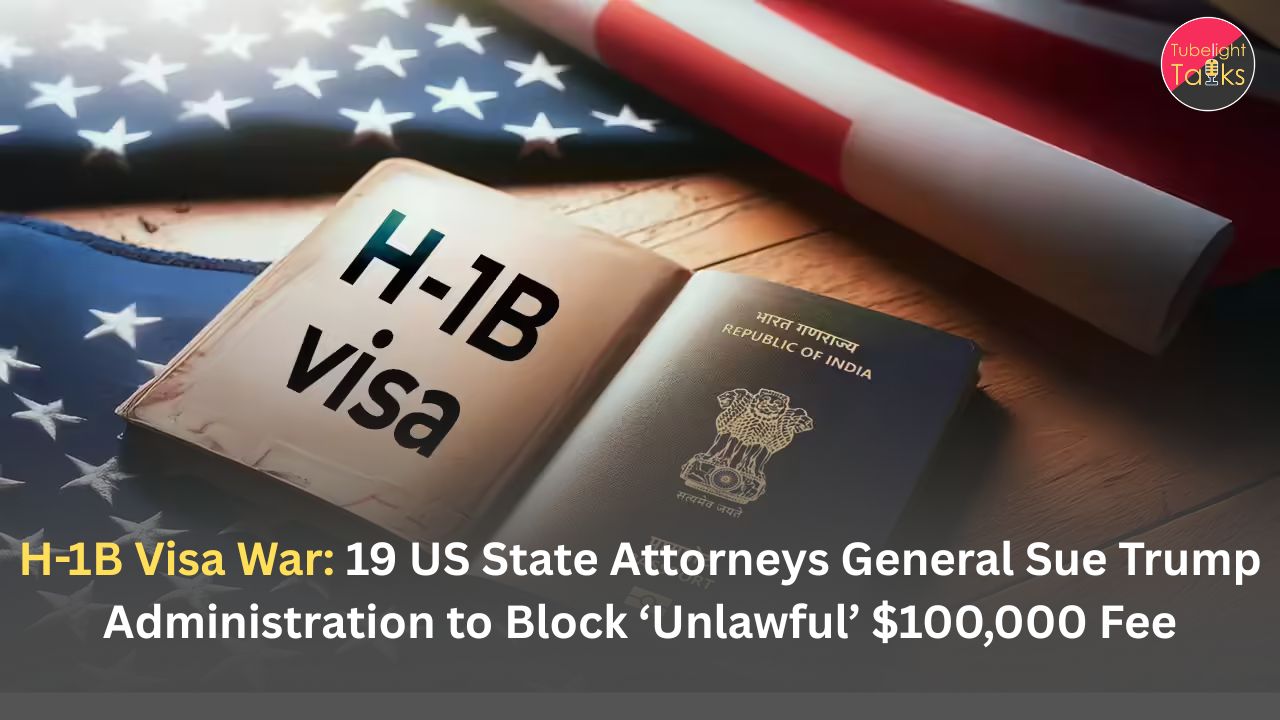
H-1B Visa War: 19 US State Attorneys General Sue Trump Administration to Block ‘Unlawful’ $100,000 Fee
H-1B Visa War: Has the Trump administration overstepped its legal boundaries in a direct move to throttle the US’s primary skilled worker program? In a significant institutional challenge, a coalition of 19 US State Attorneys General (AGs), led by New York and California, has filed a federal lawsuit seeking to block the administration’s controversial decision to impose a massive, one-time $100,000 fee on all new H-1B visa petitions.
The lawsuit, filed in the US District Court for the District of Massachusetts, argues that the fee is “unlawful,” imposed without legal authority, due process, or congressional approval, and warns it will severely exacerbate existing labor shortages in critical fields like healthcare, education, and technology across the nation.
For India 2026, which supplies over 70% of H-1B holders, this legal battle is of paramount importance. The $100,000 fee—a colossal increase over the existing fees that typically range between $2,000 and $5,000—threatens to sever the talent pipeline that has fueled the IT and technology sectors for decades, directly impacting the aspirations of skilled professionals aiming to contribute to both New India and the global economy.
The Sudden $100,000 Fee Shock
The crisis stems from a presidential proclamation issued in September 2025, which introduced the $100,000 charge for most new H-1B applications. The administration defended the fee as a necessary measure to curb alleged abuses of the H-1B program, encourage companies to hire US workers, and ensure that only the highest-skilled, highest-paid foreign talent are hired.
Also Read: US Department of Labor Launches 175 Investigations into Alleged H‑1B Visa Abuse
However, the imposition was immediate and unilateral, bypassing the mandatory Administrative Procedure Act (APA) requirement for public notice and comment rulemaking. The coalition of AGs—including those from major tech hubs and states with severe healthcare shortages such as California, New York, Massachusetts, and New Jersey—argues that the fee is punitive, not administrative, as immigration law only permits fees necessary to cover the cost of administering the visa program.
This dramatic increase, they contend, transforms the H-1B program into a costly “pay-to-play” system that fundamentally alters its legislative intent.
Healthcare and Education Face Collapse
The most devastating effect, highlighted in the Shocking Report 2026 detailed by the state AGs, is the disproportionate harm the fee will inflict on public sector employers.
Exclusion of Essential Services: While large, profitable tech corporations might be able to absorb the $100,000 fee, government, non-profit, university, and hospital employers often operate on razor-thin margins. These entities rely on H-1B workers to fill critical specialty positions, such as doctors, specialized nurses, and research faculty, particularly in underserved communities.
The fee makes the H-1B program effectively inaccessible for them, deepening the crisis of labor shortages in healthcare and education across the US.
Indian Talent Lockout: For highly skilled Indian professionals, the fee makes the prospect of job sponsorship almost impossible outside of the largest, highest-paying firms. This threatens to cripple the STEM talent pipeline from India—a major source of innovation for Silicon Valley and Research Triangle Park—and forces prospective Indian graduates from US universities to look elsewhere for opportunities, directly impacting the long-term competitiveness of Viksit Bharat 2047 professionals.
Judicial Oversight and Legal Defense of Talent
The lawsuit represents a powerful assertion of judicial oversight against executive overreach and a defense of the skilled immigrant workforce.
Constitutional Challenge: The legal action argues that the administration acted outside the bounds of Congressional authority, which alone has the power to set the parameters and fees of the H-1B program. This is the third major legal challenge to the fee (following separate lawsuits by the US Chamber of Commerce and a coalition of universities/employers), demonstrating a unified front against the policy.
Defense of the Economy: By challenging the fee, the 19 states are defending their local economies. California Attorney General Rob Bonta emphasized that the fee creates “illegal financial burdens on California public employers… exacerbating labor shortages.”
The AGs are effectively arguing that the H-1B worker is essential for maintaining and growing their state services and economy, a validation of the contribution made by skilled Indian professionals. This judicial action offers a glimmer of hope that the Ground Reality of economic necessity will overcome political rhetoric.
India’s Strategic Pivot
Recognizing the escalating US visa uncertainties, the Government of India, informed by Budget 2026 priorities, has been strategically pivoting.
The PM Modi Latest initiatives focus on enhancing India’s domestic technology ecosystem to attract and retain high-skilled talent. Budget 2026 provided significant incentives for Global Capability Centres (GCCs)—the Indian subsidiaries of global MNCs—to expand their operations in India, hiring local talent who would otherwise seek H-1B visas.
Furthermore, increased funding for the National Research Foundation (NRF) aims to elevate the prestige and career opportunities within Indian academia and R&D, making India a viable long-term home for its STEM professionals and countering the economic disruption caused by the US fee hike.
The Ethical Value of Labour
The spiritual wisdom (Satgyan) of Sant Rampal Ji Maharaj stresses that all honest labor, especially high-skilled labor, must be valued and compensated ethically, without imposing arbitrary and unjust financial barriers. The $100,000 fee is not based on the ethical value of the work performed but on a political motive, making it a clear violation of Dharma (righteous conduct) in global commerce.
The principles of Satgyan support the free movement of skilled talent for the benefit of humanity, so long as the process is transparent and fair. The legal fight led by the State AGs to ensure that the H-1B program operates within the bounds of law and fairness, allowing essential workers like doctors and teachers to fill critical needs, is aligned with the ethical imperative to prioritize service (seva) and the welfare of society over punitive policy.
This upholds the vision of a morally just and globally connected Viksit Bharat 2047.
Key Facts: H-1B Fee Lawsuit (December 2025)
Plaintiffs: 19 US State Attorneys General (led by California and New York).
Defendant: Trump Administration (specifically the Department of Homeland Security/DHS).
Fee Challenged: One-time $100,000 fee on all new H-1B visa petitions (effective Sept 21, 2025).
Legal Grounds: Violates the Administrative Procedure Act (APA) and the Immigration and Nationality Act (claiming the fee is not related to administrative costs).
Impact Warning: Will worsen labor shortages in healthcare, education, and technology sectors.
Status: Lawsuit filed in the US District Court for the District of Massachusetts.
FAQs: H-1B Visa War
Q1: Does the $100,000 fee apply to current H-1B holders and renewals?
No. The administration clarified that the fee is a one-time charge for new H-1B petitions and does not apply to existing visa holders or renewal applications filed before the September 21, 2025 deadline.
Q2: Why are US States suing instead of just companies?
The states are suing because the fee directly harms their state-run institutions (public universities, hospitals, and schools) that rely on H-1B workers to provide essential public services to their residents.
Q3: What is the main legal argument against the fee?
The main legal argument is that the administration bypassed the mandatory notice-and-comment rulemaking process (APA violation) and that the fee amount far exceeds the legal limit, which is the cost of processing the application.
Q4: How does this fee impact Indian IT firms?
The fee is expected to sharply erode the profit margins of Indian IT firms, forcing them to accelerate the shift of work offshore or increase local US hiring, making new H-1B sponsorships economically unviable for all but the highest-paid positions.
Q5: How soon can the courts block this fee?
Legal challenges have been expedited. A federal judge is expected to hold a hearing soon on a separate but related lawsuit filed by business groups, potentially leading to a preliminary injunction that could temporarily block the fee’s enforcement.
Comment Your Experience Below Share If This Is Your Reality Too
If you are an H-1B applicant, a US employer, or an Indian tech professional, how has the $100,000 fee impacted your future plans? Do you think the courts will succeed in stopping this massive increase?
Drop your state/city name in comments | Tag a friend who needs to see the biggest legal fight for Indian tech talent!
Related Stories





Discussion (0)