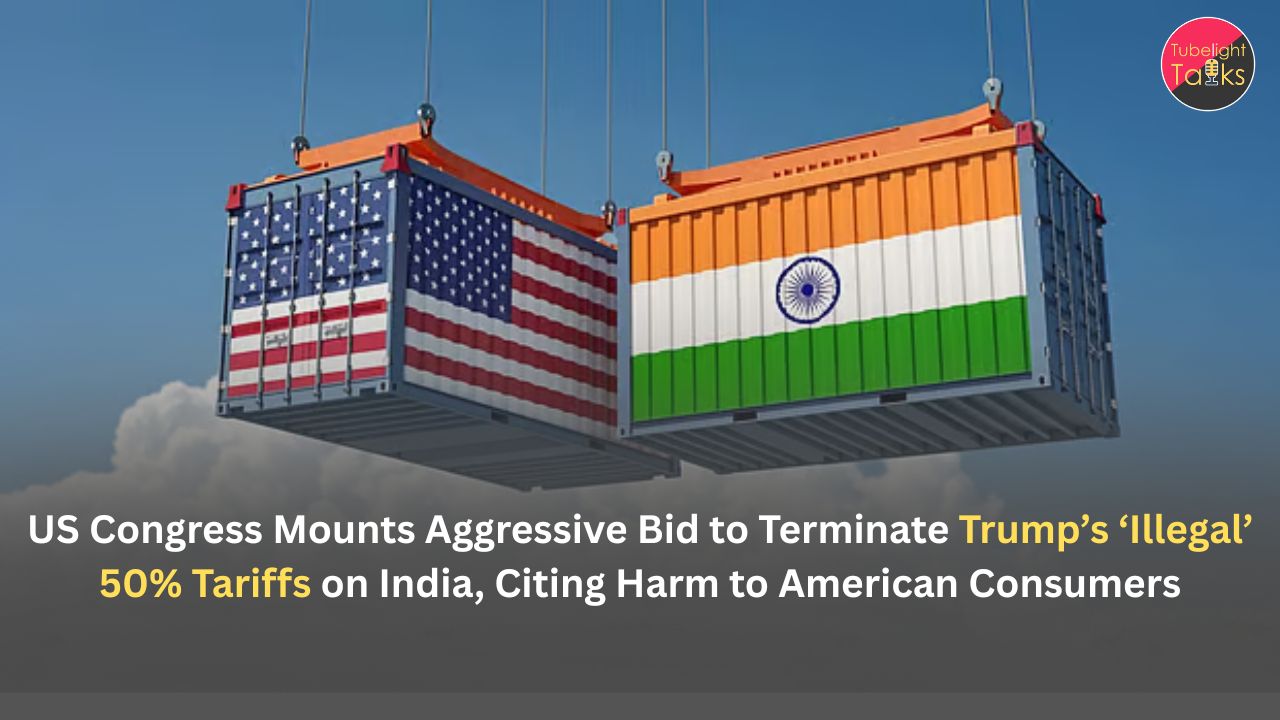
US Congress Mounts Aggressive Bid to Terminate Trump’s ‘Illegal’ 50% Tariffs on India, Citing Harm to American Consumers
Trump’s 50% India Tariffs: Is the United States Congress finally drawing a firm line against the unilateral weaponization of trade policy? A significant legislative challenge was mounted in the US House of Representatives on Friday as three influential lawmakers introduced a resolution aimed at immediately terminating President Donald Trump’s national emergency declaration that resulted in tariffs as high as 50 per cent on imports from India.
Spearheaded by Representatives Deborah Ross, Marc Veasey, and Raja Krishnamoorthi, the resolution explicitly labels the measures “illegal” and damaging to American workers, consumers, and the crucial bilateral strategic partnership. The move, which follows a parallel bipartisan push in the Senate, represents a full-scale institutional revolt against the executive’s unprecedented use of emergency powers under the International Emergency Economic Powers Act (IEEPA) to impose trade barriers.
The Shocking Report 2026 is that these tariffs have primarily served as a regressive tax on the American public, destabilizing the economic foundation of the Viksit Bharat 2047 partnership.
The IEEPA Emergency and the 50% Tariff Shock
The tariff crisis began with the Trump administration’s decision in early 2025 to impose reciprocal tariffs on numerous countries, including India, citing structural trade imbalances. This was escalated by the controversial imposition of an additional 25 per cent “secondary” duty on Indian-origin products on August 27, 2025.
This secondary tariff, stacked on top of existing duties, raised the total tariff rate on many goods to a crushing 50 per cent, the highest in the world against a major trading partner. The administration justified the move by citing India’s continued purchases of Russian oil and defense equipment, claiming it undermined US foreign policy objectives—a clear conflation of security and trade policy.
This unprecedented use of the IEEPA to address trade disputes has been the flashpoint, as Congress believes the President has usurped its constitutional authority over trade. The resolution introduced by the three lawmakers seeks to rescind this national emergency declaration, thereby ending the duties and restoring the constitutional balance of power. This is a crucial fight for the future of democratic checks and balances in New India’s principal strategic partner.
Tariffs Are a Tax on American Consumers and Workers
The resolution’s sponsors were forceful in arguing that the tariffs have backfired, hurting American interests far more than Indian exporters.
Consumer Tax: Representative Marc Veasey (Texas) stated, “These illegal tariffs are a tax on everyday North Texans who are already struggling with rising costs.” Economic analysis, which forms part of the Shocking Report 2026, confirms that Indian exporters are redirecting shipments to other markets or maintaining pricing, passing the majority of the 50% tariff burden directly onto US importers and, ultimately, American households through higher retail prices for products like Basmati rice, textiles, and leather goods.
Also Read: Trump Indian Rice Dumping 2025 Fury: Exporters Slam “Political Posturing” as Tariff Storm Looms
Supply Chain Disruption: Representative Raja Krishnamoorthi (Illinois) emphasized that the duties “disrupt supply chains, harm American workers, and drive up costs for consumers.” This destabilization undermines the US push for resilient supply chains by making a key strategic partner like India an unreliable source.
Job Losses: The tariffs disproportionately target labor-intensive sectors in India, including Textiles, Gems & Jewellery, and Leather. While these sectors in India are suffering, US companies relying on these inputs for manufacturing and retail are facing plummeting profit margins and reduced investment, jeopardizing thousands of American jobs linked to the US-India trade relationship.
Restoring a Critical Strategic Partnership
The resolution is being framed not just as a trade policy correction but as a necessary measure to strengthen the US-India strategic relationship, a key pillar of global stability and the vision of Viksit Bharat 2047.
Diplomatic Repair: Lawmakers argue that imposing the world’s highest tariffs on a critical strategic partner undermines years of diplomatic effort to foster closer ties. Terminating the emergency declaration is viewed as the most direct path to repair the damage and re-establish trust, allowing the US to engage with India on shared security and economic needs.
Constitutional Reassertion: The House resolution is part of a broader, bipartisan push in Congress to reclaim its constitutional authority over trade from the Executive branch. This move against the unilateral use of emergency trade powers is a win for institutional integrity, regardless of the tariffs’ target.
Future-Proofing Trade: Ending the volatility caused by these tariffs will provide stability and predictability, encouraging US firms to invest further in India and strengthen the bilateral trade volume—a necessity for achieving PM Modi Latest goal of becoming a global manufacturing powerhouse.
Indian Resilience
While India has faced a massive trade shock, the government has responded by leveraging Budget 2026 allocations and existing schemes. The government’s main response has been encouraging exporters in affected sectors to immediately diversify away from the US market towards Europe, the Gulf (GCC), and ASEAN nations.
The Budget 2026 provided enhanced subsidies under the Remission of Duties and Taxes on Exported Products (RoDTEP) scheme for labor-intensive sectors, offering a cushion to exporters facing the 50% tariff squeeze.
Furthermore, the PM Modi Latest push for manufacturing hubs has accelerated talks for comprehensive Free Trade Agreements (FTAs) with the UK and the EU, creating long-term, stable markets to offset the uncertainty of the US trade policy. This strategic diversification reinforces India’s commitment to self-reliance and global trade resilience.
The Burden of Unilateralism
The resolution is receiving strong support from trade bodies and think tanks who see the tariffs as counterproductive economic warfare.
Raja Krishnamoorthi, U.S. Representative (Co-Sponsor): “The President’s irresponsible tariff strategy toward India is a counterproductive approach that weakens a critical partnership… Ending these damaging tariffs will allow the United States to engage with India to advance our shared economic and security needs.”
Ajay Srivastava, Founder, Global Trade Research Initiative (GTRI): “The analysis is clear: the tariff burden has been passed onto US consumers. Indian exporters in the worst-hit sectors like textiles and gems & jewelry could see exports plunge by over 70% if the tariffs remain. This is a massive hit to the ‘Make in India’ ecosystem. The House resolution is an essential step toward restoring sanity and ensuring that the economic ties of India 2026 can flourish without political interference.”
Honesty in Global Commerce
The wisdom (Satgyan) of Sant Rampal Ji Maharaj stresses that international commerce must be rooted in Satya (truth) and Dharma (righteousness), not unilateral aggression or coercion. The use of emergency powers to impose tariffs for political reasons, particularly when the economic burden falls on one’s own citizens (consumers) and disrupts the livelihoods of laborers in a partner country, is an act of adharma.
The principle of righteous trade dictates that agreements should be fair and mutually beneficial (parhit). The actions of the US lawmakers who are fighting to restore constitutional order and end these “illegal” tariffs are upholding this higher moral duty. Only through adherence to ethical principles, ensuring that trade policy supports the welfare of all people—American consumers and Indian workers alike—can the strategic partnership truly advance the shared vision of peace and prosperity for Viksit Bharat 2047.
Key Facts: US Tariff Resolution (December 2025)
Resolution Introduced By: Representatives Deborah Ross, Marc Veasey, and Raja Krishnamoorthi.
Target: Termination of President Donald Trump’s national emergency declaration used to impose tariffs.
Tariff Rate: Up to 50 per cent on many Indian imports (earlier reciprocal duty + 25% secondary duty).
Authority Used by President: International Emergency Economic Powers Act (IEEPA).
Congressional Goal: Reclaim constitutional authority over trade; strengthen US-India ties.
Affected Indian Sectors: Textiles, Gems & Jewellery, Leather, and Marine Products (affecting roughly $60 billion in exports).
FAQs: The Battle to End India Tariffs
Q1: Why were the tariffs raised to 50 per cent in August 2025?
The 50% rate is a combination of earlier reciprocal tariffs plus an additional 25% “secondary” duty imposed under the emergency declaration, which the Trump administration cited as a response to India’s continued purchases of Russian energy and defense equipment.
Q2: What is the main argument by US lawmakers that the tariffs are ‘illegal’?
The lawmakers argue that the President is misusing the IEEPA, which is meant for true national security emergencies, to pursue broad, punitive trade policy—a power that constitutionally belongs to Congress.
Q3: How is this related to the Senate measure mentioned in the news?
The House resolution is part of a broader, bipartisan effort by the US Congress to curb the President’s use of emergency powers to impose unilateral trade barriers on multiple countries, including similar tariffs on Brazil.
Q4: What happens if the House resolution passes?
If the resolution passes both the House and the Senate, it would terminate the national emergency declaration, forcing the removal of the additional 25% secondary tariffs and significantly lowering the total duties on Indian goods.
Q5: Which Indian export sectors are most affected by the 50% duty?
Labor-intensive sectors like textiles, apparel, leather, and gems and jewelry are the worst affected, facing significant economic pressure and threats of job losses.
Related Stories








Discussion (0)