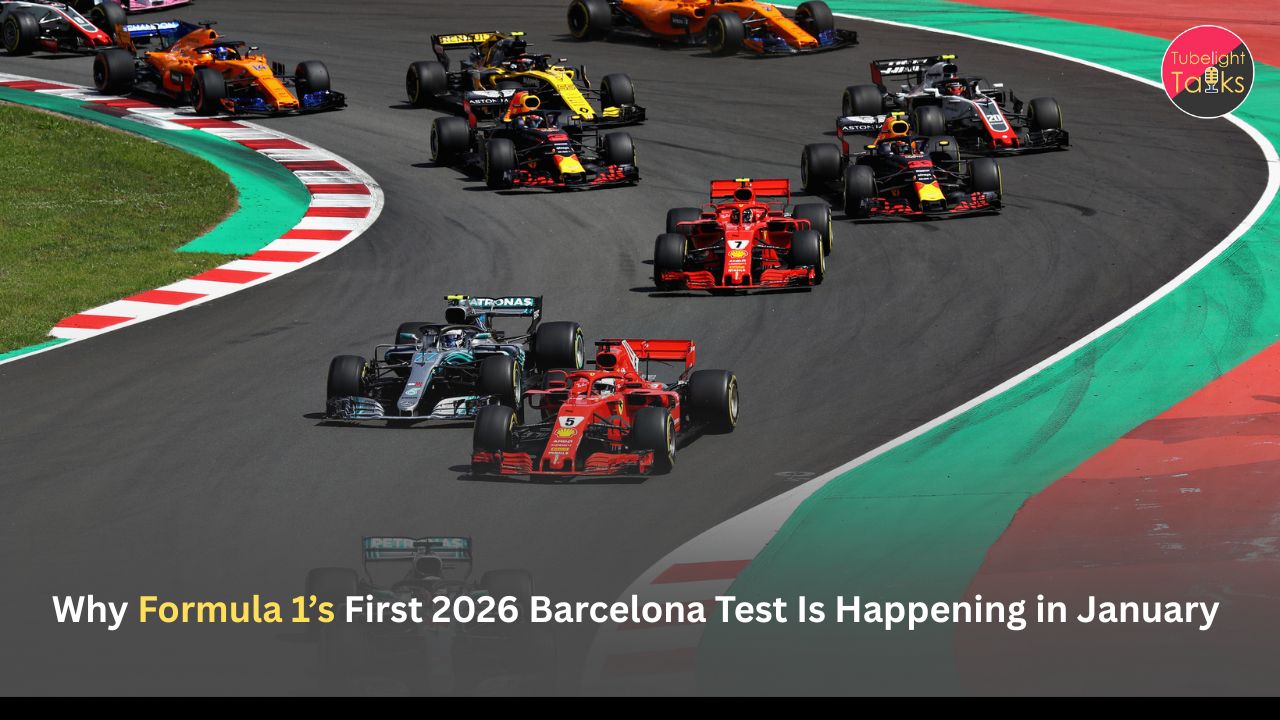
Why Formula 1’s First 2026 Barcelona Test Is Happening in January — And Why the Entire Shakedown Is Being Held in Secrecy
F1’s First 2026 Barcelona Test: Formula 1 has officially taken its first step into the 2026 era, but in an unusual and tightly controlled manner. The sport’s first 2026 on-track running is taking place in January at the Circuit de Barcelona-Catalunya, behind closed doors, without fans, independent media, or live timing. Officially labelled a “shakedown,” the five-day private test marks the beginning of the biggest technical overhaul in F1 history.
With radically new power units, aerodynamics, fuels, and car dimensions, teams are prioritising reliability, data gathering, and system validation over performance — even if that means keeping the spotlight firmly switched off.
Key Takeaways: Why F1’s First 2026 Barcelona Test Is Private and So Important
- The Barcelona event is the first collective on-track running of the 2026 Formula 1 cars
- The test runs from January 26 to January 30, with each team allowed only three days
- It is being held entirely behind closed doors, with limited official footage
- The secrecy reflects the scale of the 2026 regulation overhaul, not fear of competition
- Reliability, energy management, and system checks are the primary focus
- Williams will miss the test, while other teams are staggering their running days
- Performance comparisons and pecking order clues are expected to be extremely limited
Why Formula 1 Is Testing in January
The decision to hold a test in January is directly linked to the unprecedented scale of change arriving in 2026. Formula 1 is introducing an all-new technical package that affects every major component of the car — including power units, chassis, aerodynamics, tyres, and fuel.
At the heart of the change is a new hybrid philosophy, with power output split roughly 50% between electrical energy and the internal combustion engine. This fundamental shift has required teams to rethink not only their engines, but also how the entire car operates on track.
The situation mirrors 2014, the last major power unit overhaul, when teams struggled to achieve basic mileage during early tests. With new engine suppliers such as Audi and Red Bull Powertrains, and a brand-new team in Cadillac, Formula 1 has allowed additional pre-season running to help teams adapt before competitive sessions begin.
Why the Barcelona Test Is Being Held Behind Closed Doors
Although officially branded a “shakedown,” the Barcelona event functions as the first true pre-season test of the 2026 cycle. Teams internally refer to it as “Test 01,” but the low-profile label serves several purposes.
Firstly, teams wanted privacy to address early reliability issues without intense scrutiny. With so many new systems — including active aerodynamics, revised hybrid deployment, and sustainable fuels — unexpected problems are considered likely.
Secondly, Formula 1 has a commercial obligation to Bahrain, which hosts the first official, publicly recognised pre-season test in February. Reducing the fanfare around Barcelona helps preserve Bahrain’s status as the primary testing showcase.
Finally, Barcelona’s proximity to European team factories allows last-minute production deadlines and rapid delivery of replacement parts, a critical advantage during the earliest phase of a new regulation cycle.
How the Barcelona Shakedown Will Work
The Circuit de Barcelona-Catalunya has been booked for five days, but each team may run on only three of those days. Teams can choose when to run, allowing flexibility around development schedules, weather conditions, and component readiness.
Some teams aim to run early to uncover problems quickly, while others are delaying their first laps to maximise factory development time. Rain and cold winter temperatures are also influencing run plans, with teams expected to prioritise dry days for meaningful mileage.
There is no live timing, no full broadcast, and no independent media access. Instead, Formula 1 will release daily highlights packages, limited interviews, and carefully controlled imagery.
What Has Changed for 2026 Cars and Engines
The 2026 Formula 1 car represents a complete technical reset.
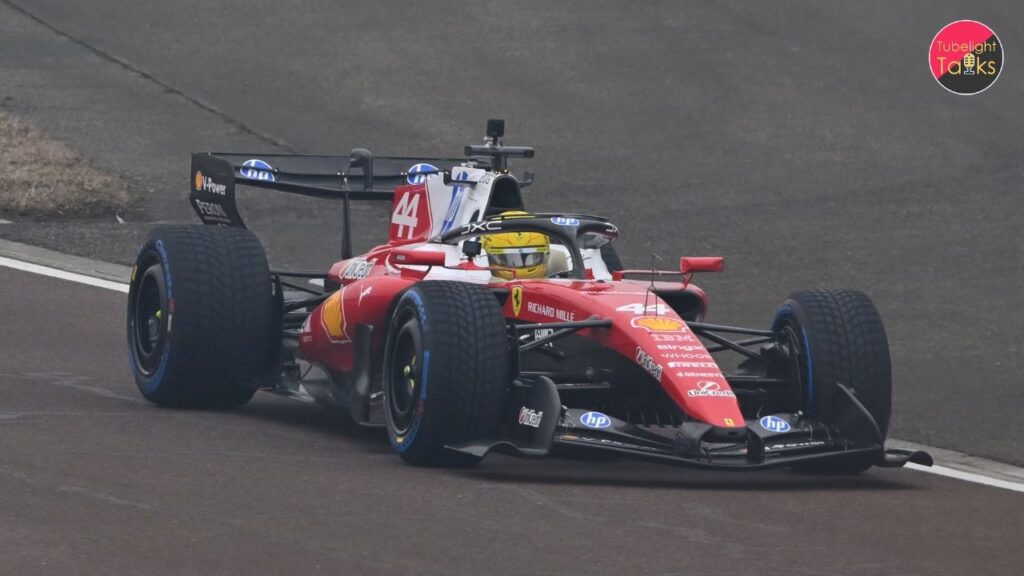
The new power units eliminate the MGU-H, simplifying architecture but increasing reliance on the MGU-K, which is more powerful than before. Energy recovery and deployment are now central to lap time, with drivers managing boost, recharge, and overtake modes throughout a lap.
Aerodynamically, cars are smaller, lighter, and narrower, with active front and rear wings replacing DRS. Underbody venturi tunnels have been removed, making way for flat step-plane floors, fundamentally altering how downforce is generated.
Fully sustainable, carbon-neutral fuels are now mandatory, requiring revised combustion systems to ensure clean and consistent burning. These fuels behave differently from traditional petrol, adding another layer of complexity during early running.
What Teams and Drivers Are Trying to Learn
The primary goal in Barcelona is reliability. Teams want to ensure that cars can complete laps without failures and that data from real-world running correlates with simulation results.
Energy management is a major area of focus, particularly how electrical power is recovered under braking and deployed on straights. Drivers are also adapting to new driving styles, including more lift-and-coast, altered braking phases, and different corner approaches.
Performance testing is secondary and, in many cases, deliberately avoided. Most teams expect meaningful performance comparisons to emerge only during the two Bahrain tests in February.
Which Teams Are Running — And When
Out of the 11 teams, 10 are expected to attend the Barcelona shakedown.
- Williams will skip the test entirely due to delays in its 2026 car programme
- McLaren plans to miss at least the first day, possibly the second
- Ferrari will begin running on day two
- Audi intends to start running from day one
- Cadillac, Racing Bulls, Alpine, Mercedes, Haas, and Aston Martin are all expected to participate on staggered schedules
Also Read: Apple invests $700 million in five‑year U.S. Formula One streaming rights
Teams have adopted differing philosophies, with some running basic specifications for reliability and others delaying track time to bring more mature designs.
Why Fans Will Learn Very Little From Barcelona
Because the test is private, the usual indicators — lap times, long runs, and driver comments — will be largely absent. While information is expected to leak through unofficial channels, interpreting it accurately will be difficult.
Historically, early testing reveals struggling teams more clearly than fast ones, and that pattern is likely to repeat. Any true understanding of competitiveness is expected to emerge only during the fully televised second Bahrain test.
What Comes Next for Formula 1’s 2026 Season
After Barcelona, teams will return to their factories to analyse data before heading to Bahrain for two three-day pre-season tests on February 11–13 and February 18–20. Only the final Bahrain test will be fully broadcast live.
Several teams will also hold car launches and livery reveals before the season begins. The first race of the 2026 Formula 1 season will take place at the Australian Grand Prix on March 6–8.
A Necessary Quiet Start to Formula 1’s Loudest New Era
The secrecy surrounding Formula 1’s first 2026 Barcelona test is not about hiding failure, but about managing an enormous technical transition. With every major component of the cars redesigned, teams are using this private shakedown to ensure the fundamentals work before performance becomes the priority.
Fans may feel frustrated by the lack of access, but the reality is that Barcelona is about survival, learning, and preparation — not spectacle. The true story of the 2026 season will begin to unfold in Bahrain. Barcelona is simply calm before that storm.
FAQs on F1s First 2026 Barcelona Test
1. Why is Formula 1 holding its first 2026 test in Barcelona in January?
F1 is testing early due to the massive 2026 regulation overhaul, allowing teams to validate new engines, cars, and systems before official pre-season testing begins.
2. Why is the F1 2026 Barcelona test being held behind closed doors?
The test is private to help teams focus on reliability checks, system validation, and data collection without media pressure during the earliest and most sensitive development phase.
3. How many days can teams run during the Barcelona shakedown?
Each Formula 1 team is allowed to run for only three days within the five-day Barcelona test window from January 26 to January 30.
4. Which F1 teams are missing or delaying running at the Barcelona test?
Williams will skip the test entirely due to car delays, while McLaren and Ferrari are delaying their first on-track running to maximise development time.
5. What can fans realistically learn from the private F1 Barcelona test?
Fans will see limited footage and interviews, but no clear performance picture, as teams are prioritising reliability and system checks over lap times or competitiveness.
Related Stories









Discussion (0)