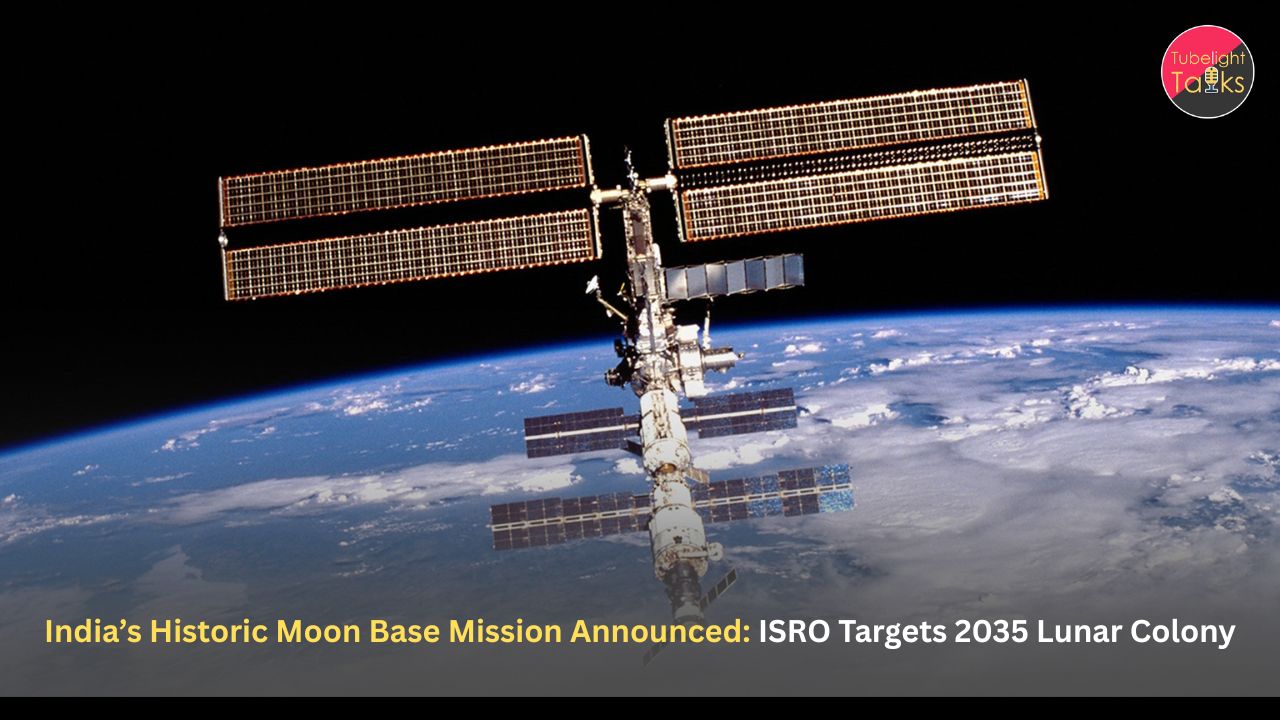
India’s Historic Moon Base Mission Announced: ISRO Targets 2035 Lunar Colony
Moon Base Mission Announced: In a groundbreaking revelation that places India among global space pioneers, the Indian Space Research Organisation (ISRO) has announced its plan to establish a permanent human base on the Moon by 2035. Dubbed the “Lunar Habitat Initiative”, the mission aims to set up a scientific, self-sustaining outpost near the Moon’s south pole—home to shadowed craters that could hold water ice.
A New Space Age for India
Vision Beyond Chandrayaan
Building upon the success of Chandrayaan-3, which achieved a soft landing near the Moon’s south pole in 2023, ISRO is preparing a bold multi-phase roadmap:
- 2028: Launch of Chandrayaan-4 with rover and sample return module
- 2030–2033: Robotic cargo missions to transport infrastructure, habitat modules, and power systems
- 2035: Crewed mission to set up and occupy India’s first-ever lunar base
This move puts India alongside space giants like NASA (Artemis Program) and China (ILRS Lunar Station) in the race for long-term lunar presence.
Strategic and Scientific Objectives
- Resource Utilization: Tap into lunar ice for water and oxygen, and regolith (moon dust) for building materials using 3D printing
- Scientific Research: Conduct long-term studies in astrophysics, lunar geology, and low-gravity biology
- Global Collaboration: Invite global agencies for a joint lunar research ecosystem led by India
- Security and Sovereignty: Secure strategic space presence in the new frontier of geopolitics
The project will be spearheaded by ISRO in collaboration with Department of Space, HAL, DRDO, and private aerospace startups.
Technological Challenges and Innovations
India’s moon base mission will push the frontiers of:
- Nuclear and solar hybrid energy systems
- AI-powered life support and habitat regulation
- Space-grade robotics for autonomous setup
- Radiation shielding and thermal control structures
- Reusable lunar landers
With a budget of over ₹1.2 lakh crore and backed by the newly announced Space Economy Promotion Fund, this mission is expected to create over 50,000 jobs in R&D and aerospace sectors.
India’s Global Standing Rises
International space agencies and think tanks have lauded India’s announcement:
- ESA (European Space Agency) expressed intent for collaborative payload deployment
- NASA welcomed the plan as a contribution to “open, peaceful space exploration”
- Japan and UAE have proposed technology partnerships in habitat and robotics
This move is being seen as a diplomatic and technological milestone that enhances India’s space leadership and soft power globally.
Certainly. Here are two additional paragraphs to further enrich the article “India’s Historic Moon Base Mission Announced: ISRO Targets 2035 Lunar Colony”:
Economic Ripple Effect: A New Era for India’s Space Economy
The announcement of a lunar base has triggered renewed investor interest in India’s space sector, especially among private aerospace and tech firms. Startups specializing in cryogenics, deep space communication, robotics, and additive manufacturing are expected to see record funding rounds in the next five years.
With the government backing the SpaceTech Innovation Mission and introducing tax incentives for space R&D, India’s space economy is projected to cross $100 billion by 2040, placing it among the top three globally. The Moon base vision could also inspire STEM education, fueling a new generation of scientists and engineers across the country.
A Nation’s Collective Dream: Science Meets Sovereignty
India’s 2035 Moon base is more than a technological milestone—it’s a symbol of national pride and strategic autonomy. As global powers compete for influence in space, India’s plan reflects a sovereign step towards self-reliance in extraterrestrial exploration. It brings together science, diplomacy, defense, and inspiration, showing the world that a developing nation can lead not just on Earth, but beyond it.
The mission also reinforces the idea that progress is meaningful only when it serves humanity as a whole, a sentiment echoed in the spiritual teachings of Sant Rampal Ji Maharaj, who emphasizes that unity, humility, and devotion must guide every great human endeavor—even those reaching for the Moon.
Spiritual Perspective: The Destination Beyond the Moon
Sant Rampal Ji Maharaj’s Teachings on the Universe and True Abode
As humanity dreams of settling on the Moon, Sant Rampal Ji Maharaj offers a deeper, timeless truth—that no planet or star can give eternal happiness. According to Tatvgyan (true spiritual knowledge) revealed by Sant Rampal Ji Maharaj, the material universe—including the Moon, Earth, and galaxies—is perishable.
“Even the Moon is bound by birth, decay, and death. True liberation lies not in space, but in reaching Satlok—the eternal divine realm beyond the material cosmos.”
By taking Naam Diksha (Initiation) from a Complete Saint and following Satbhakti as per holy scriptures, a soul can attain freedom from rebirth, sorrow, and death—far beyond any planet or base.
🪐 Explore the real universe:
👉 www.jagatgururampalji.org
📺 Sant Rampal Ji Maharaj YouTube
Call to Action
From the Moon to Satlok: Choose the Ultimate Journey
Build bases, launch missions—but also awaken the soul.
India’s lunar base plan is historic. But while we reach outward to space, we must also reach inward for spiritual truth.
✅ Begin your real journey with Naam Diksha
✅ Discover the secrets of creation through Satsang
✅ Choose Satlok—where peace is eternal and life never ends
“Science explores space. Satbhakti leads to salvation.”
FAQs on India’s 2035 Moon Base Mission
Q1. What is ISRO’s goal with the moon base by 2035?
To establish a permanent lunar research habitat near the Moon’s south pole for science, resource use, and strategic presence.
Q2. How is this different from past Chandrayaan missions?
While Chandrayaan-1 to 3 were robotic and exploratory, the new mission aims to establish human presence and infrastructure.
Q3. What challenges must India overcome?
Extreme temperatures, radiation, transport logistics, life support systems, and lunar dust mitigation are among the top challenges.
Q4. Will this mission be crewed?
Yes. ISRO aims to send astronauts to assemble and inhabit the lunar base by 2035.
Q5. What is the spiritual perspective on space exploration?
According to Sant Rampal Ji Maharaj, while space exploration is remarkable, it cannot deliver liberation. That lies in reaching Satlok through true worship, beyond the material world.
Related Stories









Discussion (0)