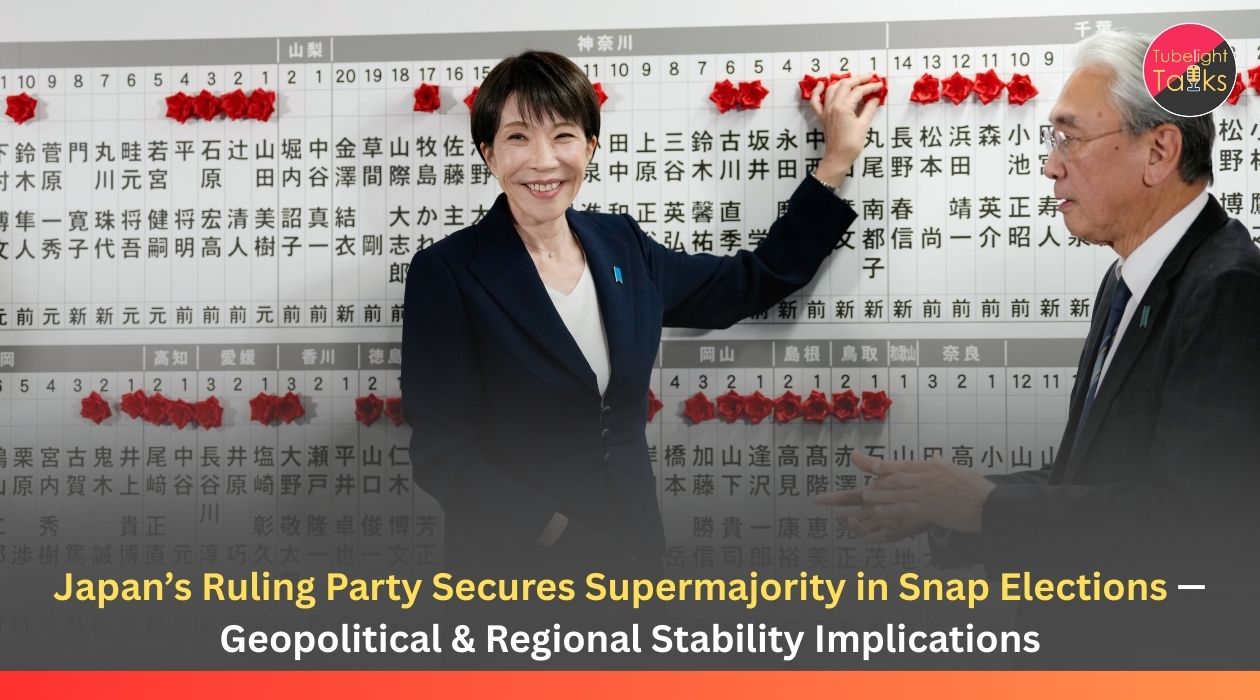
Japan’s Ruling Party Secures Supermajority in Snap Elections — Geopolitical & Regional Stability Implications
Japan’s Ruling Party Secures Supermajority: In a dramatic outcome to Japan’s February 8, 2026 snap general election, Prime Minister Sanae Takaichi and her Liberal Democratic Party (LDP) achieved a historic supermajority in the Lower House of parliament — winning a two‑thirds majority through a commanding performance alongside its coalition partner, the Japan Innovation Party. The ruling alliance now commands over 350 of the 465 Lower House seats, granting it exceptional legislative latitude.
Takaichi’s coalition scored one of the largest post‑war victories in modern Japanese politics, consolidating authority shortly after her ascension to party leadership in late 2025 and reshaping the country’s political trajectory.
Why the Snap Election Was Called
Takaichi dissolved the Lower House late last year in a calculated strategy to capitalize on strong approval ratings, secure broader electoral legitimacy, and accelerate her policy agenda. Analysts noted that her decision was a political gamble, aimed at transforming a precarious governing position into dominant control.
Despite harsh winter weather conditions and heavy snowfall during voting day, turnout remained robust — signaling broad public engagement with the stakes at hand.
Domestic Policy Directions — What the Supermajority Enables
With a supermajority backing her government, Takaichi can more easily pass legislation in areas including:
Defense & Security Overhaul
- Expanding defense spending toward 2 % of GDP or more.
- Enhancing Japan’s military capabilities and loosening restrictions on lethal weapons exports.
- Strengthening alliance commitments with key security partners, notably the United States, which publicly welcomed the election result.
These changes mark a significant shift from decades of Japan’s post‑World War II pacifism, potentially repositioning Tokyo as a more assertive military actor in the Indo‑Pacific.
Economic & Fiscal Policy
Takaichi campaigned on an economic platform that includes tax relief — notably a temporary suspension of the food consumption tax — designed to ease household burdens. However, this has stirred investor concern about fiscal sustainability given Japan’s longstanding high national debt.
The supermajority makes it easier to enact such fiscal policies, though balancing them with economic stability remains a key challenge.
Also Read: Sanae Takaichi Becomes Japan’s First Female Prime Minister: A Historic Shift in Japanese Politics
Geopolitical Implications
Recalibrating Japan‑China Relations
Takaichi’s assertive stance — particularly regarding China and Taiwan — has already strained bilateral ties. Her mandate emboldens proposals for stronger deterrence against regional threats, but also risks provoking Beijing’s economic and diplomatic retaliation.
Strengthening the US‑Japan Alliance
The United States applauded the election outcome, describing Japan as a “great ally” with reinforced capacity for collaboration on security and defense initiatives. This development could deepen military interoperability and shared Indo‑Pacific strategies.
However, evolving strategic ambitions also mean Tokyo must balance deeper deterrence with diplomatic channels to avoid escalating tensions further in the region.
Regional Security Architecture
Japan’s enhanced political stability may influence broader Indo‑Pacific dynamics, particularly in Southeast Asia and the South China Sea. Some regional partners view a stronger Tokyo as a stabilising force against assertive powers, while others remain cautious about heightened militarization.
Economic & Market Reactions
Financial markets responded positively to the election results, with Japan’s benchmark stock index — the Nikkei 225 — surging sharply on expectations of political stability and pro‑growth policy continuity. Other Asian markets also rallied on the news of Japan’s decisive political direction.
Yet economists caution that aggressive fiscal measures and defense spending could deepen Japan’s already high public debt — pressuring bond markets and future budgets.
Domestic Political Landscape & Opposition
The opposition faced significant losses, with many centrist and reformist parties underperforming amid Takaichi’s rise. The election also highlighted divisions within Japan’s political spectrum, as parties aligned around differing visions for social, economic, and defense policies.
Public Reaction & Voter Sentiments
While many Japanese voters welcomed political stability and the promise of bold reforms, some expressed concern about the pace and direction of change — particularly regarding military expansion and constitutional reinterpretation. Others cited economic anxieties, such as stagnation and rising living costs, as defining issues influencing their choices at the ballot box.
Global Reactions
- United States reaffirmed support for a robust US‑Japan partnership.
- Regional neighbors offered mixed responses — welcoming stability, but cautiously observing potential shifts in regional power balances.
- Beijing refrained from overt criticism but has signaled unease over directions that could affect cross‑strait relations with Taiwan.
True Strength in Uncertain Times
Beyond Political Power — Inner Stability
The unfolding political shifts in Japan — while significant on the world stage — remind us that external authority and geopolitical strength are temporal. Amid global uncertainties, spiritual wisdom points us toward inner stability and unwavering peace beyond political mandates.
According to Sant Rampal Ji Maharaj, the greatest power is not rooted in political dominance or military might, but in realising the eternal Supreme God — the source of all peace and strength beyond the changing world. True security comes when a soul escapes worldly cycle of conflict and suffering by attaining Satlok, the eternal abode of peace. Just as nations seek stability in alliances and policies, the individual soul seeks everlasting stability through divine knowledge.
Explore this spiritual refuge — a path beyond worldly ambiguity — through the teachings of Sant Rampal Ji Maharaj. Learn more: JagatGuruRampalJi.org.
FAQs: Japan’s Ruling Party Secures Supermajority
1. What is a supermajority, and why does it matter?
A supermajority — typically two‑thirds of parliamentary seats — allows a ruling party to more readily pass major legislation, including constitutional changes, without relying heavily on opposition support.
2. How many seats did the LDP and its allies win?
The ruling coalition won approximately 350+ seats in the 465‑seat Lower House, marking one of the most decisive victories in modern Japanese history.
3. What could this mean for Japan’s defense policy?
With dominant parliamentary control, Japan is likely to increase defense spending, strengthen military capabilities, and deepen strategic alliances — particularly with the United States.
4. How did markets respond to the election?
Japan’s Nikkei 225 index surged about 4.5% following the electoral outcome, driven by expectations of policy continuity and political stability.
5. What are regional reactions?
While allies view Japan’s stronger mandate positively, some neighboring countries — especially China — are wary of potential shifts in Tokyo’s defense and foreign policies.
Related Stories










Discussion (0)