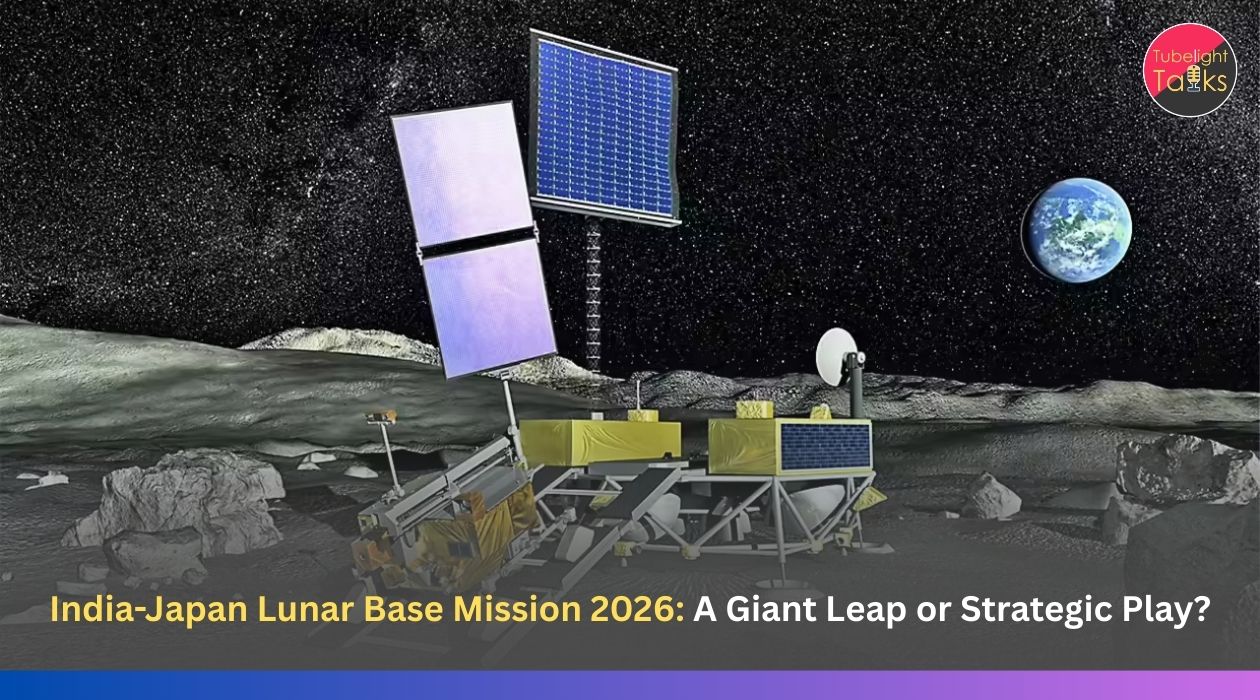
India-Japan Lunar Base Mission 2026: A Giant Leap or Strategic Play?
In a groundbreaking collaboration, India and Japan have officially launched a joint mission in 2026 to begin the groundwork for a lunar base, targeted for completion by 2030. Combining ISRO’s cost-effective engineering with JAXA’s advanced robotics, the initiative signals Asia’s bold entry into space colonization. But beyond science and pride, what are the real motives—and what lies beyond the Moon?
Mission Overview: India and Japan on the Moon
Joint Vision for Lunar Presence
On April 17, 2026, ISRO and JAXA announced the successful launch of the LUPEX (Lunar Polar Exploration) mission—a robotic precursor to the manned base.
- Objective: Explore water-ice in Moon’s south polar region
- Vehicles: JAXA rover + ISRO lander
- Timeline: Human base setup by 2030, beginning with habitat module tests in late 2026
- Funding: Combined $8 billion over 6 years
(Source:ISRO-JAXA Joint Statement, 2026)
Strategic Motivations: Beyond Science
Geopolitical Chess in Lunar Orbit
While presented as a scientific collaboration, analysts say the lunar base also serves strategic motives:
- Counterbalance to China’s Tiangong lunar ambitions
- Securing moon-based mining rights for rare earths and Helium-3
- Establishing early dominance in space governance frameworks
This mission is not just about discovery—but also about positioning power in outer space.
Also Read: India’s Historic Moon Base Mission Announced: ISRO Targets 2035 Lunar Colony
Scientific Goals: Exploring Resources and Life Support
Key Research Areas
- Extraction and purification of lunar ice for water and oxygen
- Solar-powered energy storage systems
- Testing regolith-based construction for radiation-proof shelters
- Studying long-term effects of low gravity on human biology
JAXA’s robotic arm and ISRO’s AI navigation module are both leading-edge technologies enabling these breakthroughs.
Economic Boost and Global Prestige
The collaboration is expected to boost:
- Aerospace startups in Bengaluru and Tokyo
- Bilateral trade in advanced materials and quantum tech
- India and Japan’s position in the UN Committee on Peaceful Uses of Outer Space (COPUOS)
For youth in both countries, this mission is becoming a symbol of hope, ambition, and futuristic career paths.
Public Reaction: Pride, Curiosity, and Debate
Citizens are celebrating the mission as a testament to Asian excellence, while others raise ethical questions about space exploitation, earthly inequality, and the environmental cost of space debris.
Social media is buzzing:
“We can’t fix Earth, but we’re building homes on the Moon?”
“Proud of ISRO & JAXA! Asia rising!”
“What about the spiritual aspect of such exploration?”
The Real Destination Is Not the Moon
Sant Rampal Ji Maharaj Explains the Ultimate Journey
While nations race to colonize planets, Sant Rampal Ji Maharaj Ji urges humanity to reflect inward.
“Building on the Moon may show progress, but the soul’s real home is Satlok, the immortal world where pain, death, and sorrow do not exist.”
— Sant Rampal Ji Maharaj
According to SatGyan, the physical universe—including stars, planets, and galaxies—is temporary and destructible, created by Kaal (the negative power).
Even if humans colonize the Moon, Mars, or beyond—they cannot escape:
- Karma
- Death
- Rebirth
Only through Naam Diksha from a Complete Saint, and by practicing true devotion, can one attain the eternal realm of Satlok—where souls live in permanent peace, free from gravity, time, and pain.
Discover the spiritual side of science.
🎥 Watch Spiritual Science Playlist
Call to Action
Go Beyond Rockets—Launch Your Soul’s True Journey
The India-Japan Moon mission is a proud milestone. But don’t forget the ultimate mission—your return to the divine world.
- While astronauts prepare lunar homes, you can prepare for eternal life in Satlok.
- This begins with Naam Diksha, SatGyan, and sincere devotion.
- Step into the spiritual orbit today:
FAQs on India-Japan Lunar Base Mission 2026
Q1. What is the India-Japan lunar mission about?
It’s a joint mission to explore and establish a human base on the Moon by 2030, starting with robotic exploration in 2026.
Q2. Why are they building a Moon base?
To secure resources like lunar water and Helium-3, conduct scientific research, and establish early presence for future space governance.
Q3. How is it strategic?
It helps counter China’s lunar expansion, positions India and Japan as space powers, and boosts their defense and tech sectors.
Q4. What is Satlok, as explained by Sant Rampal Ji Maharaj?
Satlok is the eternal world beyond space, where God Kabir Sahib resides. It’s free from birth, death, and sorrow.
Q5. How does one attain Satlok?
Through Naam Diksha from Sant Rampal Ji Maharaj, living a pure life, and practicing devotion as per holy scriptures.
Q6. Can science and spirituality coexist?
Yes. Sant Rampal Ji Maharaj teaches that science reveals how the universe works, but spirituality reveals why it exists.
Related Stories










Discussion (0)