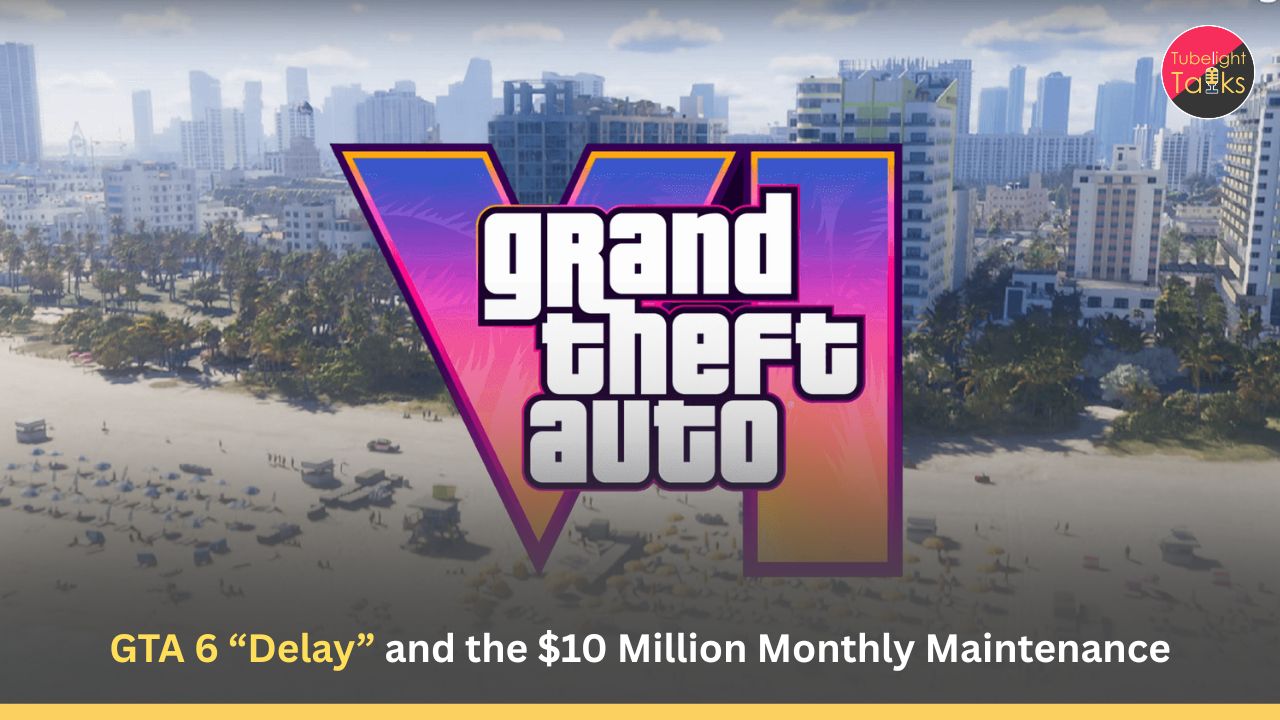
GTA 6 “Delay” and the $10 Million Monthly Maintenance: Why Every Tiny Update Becomes a Global Story
GTA 6 Delay: Remains the most profitable rumor-generator in gaming – and the latest wave is a perfect example. On one side: Take-Two continues to publicly point to November 19, 2026 as the release date and says Rockstar’s launch marketing begins in summer 2026. On the other: insider commentary has reignited talk of schedule risk, fueled by a viral “burn rate” claim – about $10 million per month – to keep GTA VI’s development and polish moving during extended timelines.
In 2026’s AAA landscape, that figure sounds shocking, but also strangely plausible. Here’s what’s official, what’s not, and why the economics of modern game development make GTA 6 “click-gold.”
What’s Official Right Now: GTA 6 Release Date and Marketing Window
Rockstar’s stated date: November 19, 2026
Rockstar has previously published a release-date update stating that Grand Theft Auto VI will release on Thursday, November 19, 2026, with an apology for adding additional time.
That single line is the anchor for everything: until Rockstar updates it again, November 19, 2026 is the official GTA VI release date.
Take-Two’s latest signal: “launch marketing set to begin this Summer”
Take-Two reinforced the schedule in its fiscal Q3 2026 communications, explicitly referencing the November 19th launch and projecting major momentum into fiscal 2027.
Multiple reports tied to that earnings cycle underline a key point for fans: Take-Two says GTA 6 marketing will kick off in summer 2026 – a move companies typically align with confidence that the date is approaching.
Why this matters more than trailer hype
A trailer is marketing. A confirmed marketing window in company materials is also marketing – but it’s financially committed marketing. That doesn’t guarantee zero risk, but it’s one of the strongest public “we’re on track” signals you can get from a publisher.
So Where Do “Minor Delay” Rumors Come From?
The “not content complete” conversation (and why it got misunderstood)
A large chunk of the recent delay chatter traces to commentary attributed to Bloomberg journalist Jason Schreier, discussed in gaming circles and summarized by Insider Gaming. The key claim: GTA 6 may not be “content complete” yet – meaning teams are still finalizing levels, missions, and deciding what makes the final cut.
But the nuance matters: the same discussion also stresses it’s “hard to say” with certainty this far out, while noting the November 2026 date can still feel more solid than prior windows.
The fiscal-year “buffer” that keeps getting cited
One detail fans repeat constantly: Take-Two’s fiscal year typically ends March 31, so a slip from late 2026 into early 2027 can still land inside the same fiscal reporting frame. Insider Gaming’s summary explicitly references that “buffer” idea in the context of schedule optionality.
This is why “minor delay” rumors don’t have to mean “years later.” In the internet’s shorthand, a “minor delay” can mean anything from a few weeks to a few months – often without solid sourcing.
Rumors multiply because GTA 6 has a history of date movement
GTA 6 has already been delayed publicly more than once over the past cycle (earlier windows shifting forward), and Reuters has noted that delays are increasingly common across the industry as budgets rise and expectations for polish intensify.
That history doesn’t prove another delay – but it explains why people assume one is always possible.
The $10 Million Per Month Claim: What It Actually Says (and What It Doesn’t)
Where the number comes from
The “$10 million monthly maintenance” figure is not an official Rockstar budget disclosure. It’s widely attributed to Insider Gaming reporter Tom Henderson, who said – based on a developer-provided number – that the additional time would cost Take-Two about $10 million per month extra, implying roughly $60 million over six months, and possibly nearer $100 million with other costs included.
This is crucial framing: the claim is about incremental cost during extended development/polish, not necessarily the entire monthly cost of Rockstar’s global operations, and not a confirmed internal financial statement.
Why people call it “maintenance”
Online, fans use “maintenance” as a catch-all word for:
- keeping large teams staffed through polish/bug-fixing
- retaining external vendors and specialized contractors
- running continuous build pipelines, QA labs, and security controls
- reworking missions, assets, and performance targets late in production
That’s not “maintenance” in the simple sense of server upkeep – it’s “keeping the machine running” while pushing quality toward Rockstar’s bar.
Is $10M/month believable in AAA terms?
It’s believable as an order-of-magnitude for a late-stage AAA burn rate, especially if it includes multiple studios, vendors, and global overhead – even if the precise number remains unverified. Broader industry reports regularly cite how AAA development can reach hundreds of millions, with live operations and long cycles adding pressure.
In other words: the shock isn’t that costs are high – it’s that GTA 6 is so large that even “one more month” becomes headline money.
Why Modern Game Development Costs Feel “Astronomical” in 2026
Bigger worlds, higher fidelity, longer timelines
The “GTA 6 costs are insane” discussion is really a proxy for the wider AAA reality: teams are larger, production cycles are longer, and the quality bar (animation density, simulation systems, lighting, performance modes, accessibility, online integration) is far higher than it was even one generation ago.
“Anything under $100 million is considered small” – the industry mood
Recent commentary from experienced developers has highlighted how budgets have ballooned to the point that some studios see sub-$100M projects as “small” by today’s top-tier standards.
That doesn’t mean every game costs that much. It means the top end of AAA has expanded so dramatically that GTA 6 sits at the extreme.
The “risk squeeze” and why publishers chase mega-hits
Consulting and industry analyses point to AAA studios facing rising costs, slower timelines, and margin pressure – pushing them toward established IP with predictable demand. GTA VI is the textbook example of “if any title can justify the spend, it’s this one.”
Layoffs and the paradox of big budgets
The industry is also living through layoffs and restructuring, even while blockbuster expectations remain enormous – one reason the GDC “state of the industry” conversation has been so intense around sustainability and burnout.
This paradox fuels public fascination: How can an industry cut jobs and still spend so much on a single game? The answer often lies in project concentration – one or two mega-projects dominating a publisher’s future.
Also Read: Gran Turismo World Series: Manufacturers Cup Exhibition Season Returns on November 12
What That $10M “Burn” Could Represent: A Practical Breakdown
1) People (the biggest line item)
In late-stage AAA, staffing isn’t just “developers.” It’s producers, QA, automation engineers, performance teams, cinematics, mission designers, narrative tools, audio, localization, UI/UX, accessibility, build engineers, infosec, and more. Extended schedules keep large parts of that web active.
Even a rough mental model shows why costs scale fast: thousands of people, fully loaded costs, and vendor contracts add up quickly – especially when polishing a world as dense as a Rockstar sandbox.
2) Outsourcing and specialist vendors
High-end animation support, art production, localization, capture support, and testing partnerships often sit outside the core studio headcount. When timelines extend, vendors often extend too – sometimes with renegotiated scopes.
3) Tooling, infrastructure, and “always-on” pipelines
Modern production depends on continuous integration, automated testing, internal distribution, secure asset management, and performance telemetry. Those systems aren’t optional – particularly after the industry’s increased sensitivity to leaks, hacks, and pre-release breaches.
4) The most expensive thing: late changes
“Content complete” and “feature complete” aren’t buzzwords – late changes can be brutally expensive because they ripple into other systems. A mission tweak can break scripting; a new traversal requirement changes collision; a lighting change shifts performance budgets; a UI change affects localization.
This is why perfection-driven studios buy time. It costs money now, but it can protect the launch (and brand) later.
“Click-Gold” Economics: Why GTA 6 Turns Tiny Signals Into Huge Headlines
Scarcity multiplies attention
Rockstar releases information sparingly. When supply is low, demand spikes – so even ambiguous signals (a rumored delay, a line from an earnings call, a “not content complete” comment) become massive traffic drivers.
Cross-industry impact makes it bigger than gaming
Reuters has pointed out that GTA VI’s timing affects broader industry scheduling – publishers consider moving their own releases to avoid the “blast zone.”
That’s why GTA 6 isn’t just a gaming story. It’s a business calendar story for entertainment.
Even “no news” becomes news
Take the physical-copies rumor: speculation spread that Rockstar might delay physical editions to prevent leaks, and Take-Two’s CEO responded that it was “not the plan.” The rumor itself generated huge coverage – despite being denied.
GTA VI has reached the point where denial is also content.
What Fans and Analysts Should Watch Next (Without Getting Played)
1) Summer 2026 marketing: the real indicator
If Take-Two’s stated marketing window arrives with major assets (trailers, hands-on previews, platform partnerships), that’s a stronger confidence signal than forum chatter.
2) Any Rockstar Newswire update
Rockstar’s own channels remain the final word on release timing. Everything else is commentary – sometimes informed, sometimes not.
3) “Content complete” headlines: treat them carefully
Even credible reporters can have their comments flattened into misleading headlines. “Not content complete” doesn’t equal “delayed,” and “content complete” doesn’t equal “ready.” The truth is usually: big games are messy until very late.
4) Take-Two filings and earnings language
When a company repeats a date across earnings materials and guidance cycles, it tends to reflect internal planning confidence – though not a guarantee.
The Cost of Hype and the Value of Self-Restraint
The GTA 6 frenzy shows how quickly desire turns into agitation: one rumor can trigger anger, impatience, and endless argument. Teachings on living with virtue and self-discipline emphasize calm decision-making, honesty, and restraint over impulse – qualities that help individuals avoid being dragged by constant temptations and anxieties.
The Jagatguru Rampal Ji Maharaj platform repeatedly discusses controlling vices such as attachment and greed, and living with moral steadiness rather than being ruled by emotional storms. In the context of “click-gold” culture, that message lands naturally: progress is real when guided by patience and clarity, not by endless craving for the next update.
Call to Action
If you want reliable GTA 6 updates, anchor your expectations to official Rockstar statements and Take-Two investor communications, then treat insider claims as signals – not confirmations. When you see “GTA 6 delay confirmed,” check whether Rockstar actually changed the date or whether someone is repackaging commentary for clicks.
And when you see massive budget numbers, remember: the only confirmed public facts are the release targets and business guidance – not internal burn-rate spreadsheets.
FAQs
Q1. Is GTA 6 delayed again right now?
No new official delay has been announced. The official public target remains November 19, 2026, per Rockstar’s published messaging and Take-Two’s recent communications.
Q2. Where does the “$10 million per month” GTA 6 cost claim come from?
It’s widely attributed to insider reporter Tom Henderson, citing a developer-provided estimate about extra monthly cost during extended development, not an official Rockstar budget release.
Q3. Does “not content complete” mean GTA 6 will be delayed?
Not necessarily. It indicates remaining work and schedule risk, but it’s not an official delay announcement. The same discussions often note the November 2026 date can still feel more solid than earlier windows.
Q4. When does Take-Two say GTA 6 marketing starts?
Take-Two’s recent communications and coverage indicate summer 2026 for Rockstar’s launch marketing push.
Q5. Why is GTA 6 such “click-gold” for media outlets?
Because official updates are scarce, demand is massive, and GTA VI’s timing affects the broader industry’s release calendar – making even small signals newsworthy.
Q6. What’s the smartest way to track GTA 6 without getting misled?
Prioritize Rockstar’s official channels and Take-Two investor updates first; treat rumors as unconfirmed until those sources change.
Related Stories








Discussion (0)