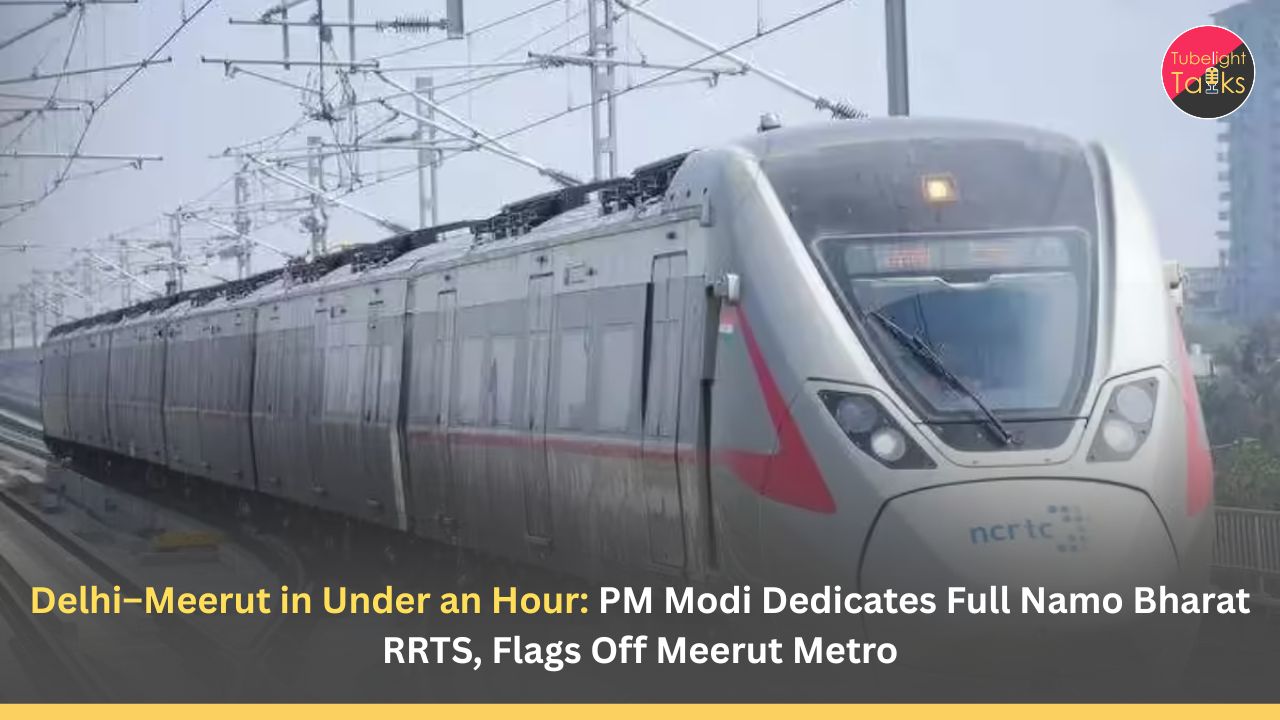
Delhi–Meerut in Under an Hour: PM Modi Dedicates Full Namo Bharat RRTS, Flags Off Meerut Metro
Meerut, February 22, 2026: India’s fastest regional commute story reached a defining moment today as Prime Minister Narendra Modi visited Meerut to dedicate the entire 82-km Delhi–Meerut Namo Bharat RRTS corridor to the nation and flag off the Meerut Metro. The inauguration includes the crucial 5-km stretch between Sarai Kale Khan and New Ashok Nagar in Delhi, completing the missing link that commuters have been waiting for.
With Namo Bharat designed for high-speed, high-frequency service, the promise is simple: Delhi to Meerut in under an hour – reliable, predictable, and built for “New India” mobility.
What Happened Today in Meerut
The flag-off at Shatabdi Nagar and the big dedication event
According to the Prime Minister’s Office/PIB schedule, the Prime Minister’s programme in Meerut features the flag-off of the Meerut Metro and the Namo Bharat train at Shatabdi Nagar Namo Bharat Station, followed by a metro ride up to Meerut South Station. The larger dedication event covers development projects worth around ₹12,930 crore.
Why this inauguration is being called a national benchmark
Today’s announcement is not only about opening new track. It formalises a model of integrated urban and regional transit – where a regional rapid rail spine (Namo Bharat RRTS) and an intra-city metro (Meerut Metro) can operate on the same infrastructure. PIB describes this as a first-of-its-kind initiative in the country and positions it as a benchmark for modern, seamless public transport.
The Big Reveal: Full 82-km Delhi–Meerut Namo Bharat Corridor Is Now Complete
The two missing pieces that complete the corridor
The headline upgrade today is the completion of the entire 82-km Delhi–Meerut Namo Bharat Corridor. The remaining sections inaugurated include:
- 5 km between Sarai Kale Khan and New Ashok Nagar in Delhi
- 21 km between Meerut South and Modipuram in Uttar Pradesh
With these stretches, the corridor now connects Delhi to Meerut end-to-end, turning what was a phased rollout into a full, continuous rapid rail route.
What “Namo Bharat RRTS” actually means for commuters
Namo Bharat is India’s first Regional Rapid Transit System (RRTS), engineered for fast, comfortable point-to-point travel across longer distances than a typical metro – without feeling like “intercity travel stress.” PIB notes a design speed of 180 kmph, aimed at making regional travel dramatically faster across major NCR urban centres.
On NCRTC’s own description, the Namo Bharat network is planned as a world-class commuter transit service with high speed (160 kmph) and high frequency (trains every 15 minutes to start with) – a combination that is meant to keep wait times low while delivering express-like journey times.
The “under an hour” promise – why it’s realistic
For years, Delhi–Meerut has been a classic NCR pain point: the distance isn’t extreme, but the time variability is. Peak traffic, incidents, weather, and bottlenecks on road corridors can turn a routine trip into a draining one. The Namo Bharat RRTS is designed to change that equation by converting the commute into something closer to a timed service: predictable departures, fewer interruptions, and consistent running speed across dedicated infrastructure.
NCRTC’s service vision explicitly targets significant journey-time reduction for regional commuters through high-speed, high-frequency operations.
Also Read: PM Modi Flags Off 4 New Vande Bharat Trains from Varanasi Today
Sarai Kale Khan: Delhi’s New Multi-Modal Gateway to the Corridor
Why Sarai Kale Khan matters more than a “new station opening”
Sarai Kale Khan isn’t being introduced as just another stop – it is positioned as the originating station of the corridor and a major multi-modal hub. PIB highlights that it will connect, in close integration, with:
- Hazrat Nizamuddin Railway Station
- Delhi Metro’s Pink Line
- Veer Haqeeqat Rai ISBT
- Ring Road connectivity
In practical terms, this means the Delhi–Meerut Namo Bharat corridor gains a powerful “catchment” point – where rail, metro, bus, and road networks converge, making last-mile and interchanges smoother for a much larger commuter base.
The Delhi link that commuters were waiting for: Sarai Kale Khan–New Ashok Nagar
The 5-km Sarai Kale Khan–New Ashok Nagar section is being treated as a critical connector because it completes the Delhi end of the route and unlocks the corridor’s full potential – especially for passengers who want a clean transfer between Delhi Metro, railways, and the Namo Bharat RRTS. Once the origin station is live, it reshapes trip planning: commuters can think in terms of “one corridor, many entry points,” instead of stitching together road-based first/last mile workarounds.
Meerut Metro Launch: A City Metro Riding the Rapid Rail Spine
One infrastructure, two services: the most watched innovation today
Meerut Metro’s launch is being closely followed because it is not a standalone metro project running in isolation. PIB states that Meerut Metro services between Meerut South and Modipuram will operate on the same infrastructure as Namo Bharat – creating a shared corridor that supports two commuting needs:
- High-speed intercity/regional travel (Delhi–Meerut rapid rail)
- Swift intra-city movement within Meerut (metro service pattern)
This matters for how Indian cities and regions build transit in the future. Shared infrastructure can reduce duplication, compress timelines, and improve passenger convenience – especially when station design and service planning anticipate easy transfers rather than forced exits and re-entry.
“India’s fastest metro”: what the numbers say
Meerut Metro is being promoted as India’s fastest metro system, with PIB noting a maximum operational speed of around 120 kmph. It is also expected to cover the stretch between Meerut South and Modipuram in about 30 minutes with all scheduled stoppages, making it a serious alternative to road travel for intra-city movement.
What this means for Meerut’s daily life
A metro is not only a transport upgrade – it changes how a city uses time. For working professionals, it compresses commute fatigue. For students, it widens access to institutions without demanding costly relocations. For families, it makes city movement safer and more structured. With Meerut Metro stitched into the larger Namo Bharat RRTS story, Meerut becomes both a destination and a connector – linked to Delhi with regional rapid rail speed, while also gaining its own internal mobility backbone.
Commute Revolution: What “Delhi to Meerut in Under an Hour” Unlocks
A new mental map of NCR
When a commute becomes under an hour – and stays that way reliably – cities start to feel closer than they look on a map. The Delhi–Meerut Namo Bharat Corridor effectively upgrades Meerut from “day-trip distance” to “daily commute distance,” which can shift patterns across:
- Employment (more people can work in one city and live in another)
- Education (access to colleges, coaching hubs, skill centres)
- Healthcare (faster access to big hospitals and specialist care)
- Business (smoother client meetings, logistics planning, workforce mobility)
This is why the project is being framed as a “commute revolution,” not just a transit milestone.
Productivity gains: the invisible headline
Infrastructure headlines often focus on concrete – bridges, stations, tunnels. But the biggest gain is time. If even a portion of regular commuters save 30–60 minutes each day, the region gains thousands of hours of productive and personal time – time that can go to work, family, study, rest, or health. NCRTC’s stated objective of improving ease of living and doing business through shorter travel times aligns directly with this “time dividend.”
A commuter experience designed to feel modern
Namo Bharat’s pitch is not only speed – it’s “metro-like frequency with regional-rail reach.” NCRTC describes the service as commuter-centric, planned for high frequency and multi-modal integration, to keep the system usable for everyday riders rather than occasional travellers. That distinction is important: this is meant to be the default habit for NCR mobility, not a luxury option.
The “New India” Infrastructure Story: Speed, Integration, Sustainability
Decongestion and cleaner air: why transit planning is climate planning
PIB explicitly links the integrated Namo Bharat RRTS + Meerut Metro approach to decongesting road traffic and reducing vehicular carbon dioxide emissions. In a region where traffic congestion also translates into air-quality stress, shifting a meaningful share of commuters from private vehicles to fast, frequent mass transit is not just convenience – it’s a public health and environmental strategy.
A benchmark for integrated urban and regional transit
India’s biggest transport bottleneck is often not the speed of any single mode – it’s the friction between modes. If a commuter has to: auto → metro → walk → bus → train, the journey becomes exhausting even if each segment is fast. The Sarai Kale Khan hub concept, along with the shared infrastructure approach in Meerut, reflects a “network-first” mindset: build the interchanges into the design, so passengers don’t feel punished for transferring.
The corridor effect: how rapid rail shapes growth
Every major rapid transit corridor creates a “corridor effect”: areas around stations become more valuable, more investable, and more connected. Over time, you typically see:
- more planned housing clusters and rentals around stations
- growth in retail, offices, and services near multi-modal nodes
- better access to jobs across the region (especially for youth and first-generation commuters)
- increased attractiveness for employers who need a wider labour pool
NCRTC itself frames the network as enabling polycentric growth, improved access to jobs and facilities, and overall ease of living through shorter travel times.
What Commuters Should Know Before Their First Ride
Expect “metro habits” with “regional reach”
If you’ve used metro systems, the commuter logic will feel familiar: arrive, tap/scan, board quickly, and move with frequency. NCRTC notes that trains are planned to run every 15 minutes to start with, which is a strong base frequency for regional rapid transit and can reduce platform crowd stress when scaled properly.
The stations to watch first
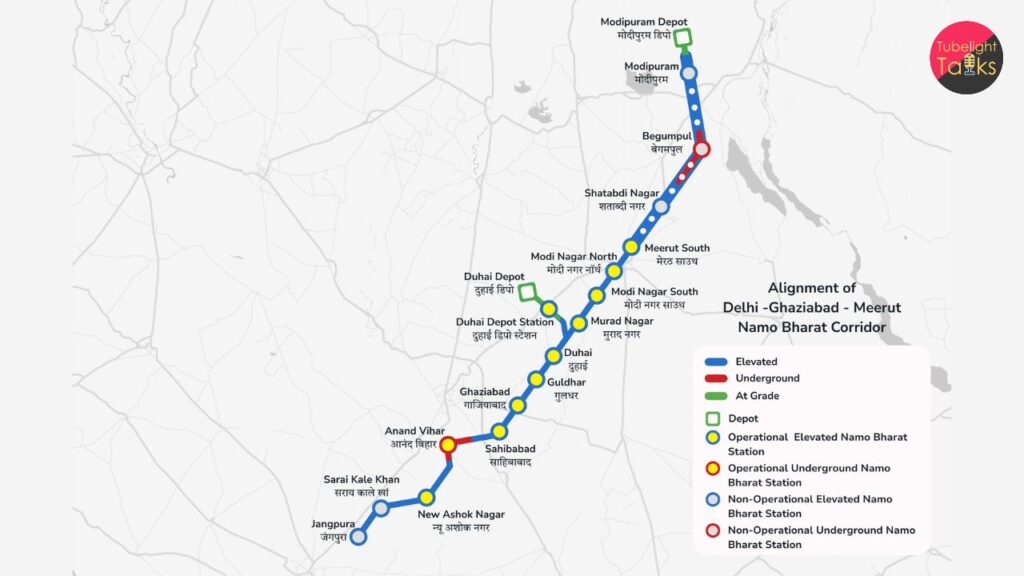
From a commuter perspective, these names will become daily vocabulary across NCR:
- Sarai Kale Khan Namo Bharat Station (origin hub in Delhi)
- New Ashok Nagar (critical Delhi link)
- Meerut South (key interchange point for Meerut’s network)
- Shatabdi Nagar, Begumpul, Modipuram (newly commissioned Meerut-side stations highlighted by PIB)
Why This Milestone Feels Different for NCR
It changes the daily conversation from “traffic” to “timings”
For decades, NCR commuting has been dominated by road unpredictability. With the full Delhi–Meerut Namo Bharat Corridor now dedicated, the conversation shifts to scheduled mobility: when is the next train, what is the interchange, which station is closest, and how quickly can you get home. That is how global city-regions behave when rapid transit becomes strong enough to compete with private vehicles.
It turns infrastructure into lived experience
Big projects only become “real” when the public starts using them: students catching early rides, office-goers planning predictable arrival times, families choosing weekend trips without fearing traffic chaos. With the Meerut Metro and Namo Bharat RRTS being introduced together in this final commissioning phase, the corridor is more likely to feel complete from day one – because it serves both regional travel and city movement in the same story.
Beyond the Fastest Commute: Choosing a Destination That Brings Peace
Even as the Namo Bharat RRTS and Meerut Metro make life faster and easier, many people quietly realise that speed alone doesn’t remove stress – because the mind often carries restlessness from one station to the next. In Sant Rampal Ji Maharaj’s teachings and Sat Gyaan, a different kind of “journey planning” is emphasised: controlling the mind, living with discipline, and turning attention toward true devotion so inner peace becomes stable, not dependent on external comfort.
His official platforms repeatedly encourage learning through satsang and spiritual knowledge, and they explain the importance of initiation (Naam Diksha) and right understanding as the foundation of lasting wellbeing. For those inspired by today’s “commute revolution,” this spiritual perspective offers a gentle reminder: the best journey is not only about reaching a city faster – it’s also about reaching calmness within, so life’s destination feels meaningful.
Call to Action: Plan Your First Ride on the Commute Revolution
If you live in Delhi-NCR or travel frequently toward Ghaziabad, Modinagar, or Meerut, this is the right week to rethink your routine. Start by identifying your nearest station and your best interchange (Metro/ISBT/Rail). Keep an eye on official announcements for service details, passenger advisories, and operating updates – especially around Sarai Kale Khan’s multi-modal integration and Meerut Metro’s initial service pattern.
And if this milestone motivates you to improve life beyond convenience – use the saved commute time wisely: invest in health, family, learning, and spiritual reflection through authentic satsang resources available on the official channels of Sant Rampal Ji Maharaj.
FAQs: Delhi–Meerut Namo Bharat RRTS
1. What did PM Modi inaugurate in Meerut today?
He flagged off the Meerut Metro and the Namo Bharat train, and dedicated the entire 82-km Delhi–Meerut Namo Bharat Corridor to the nation, along with other projects worth around ₹12,930 crore.
2. Which new RRTS stretches are opening with this inauguration?
The remaining sections include the 5-km Sarai Kale Khan–New Ashok Nagar stretch in Delhi and the 21-km Meerut South–Modipuram stretch in Uttar Pradesh.
3. Why is Sarai Kale Khan station important for commuters?
PIB describes Sarai Kale Khan as the originating station and a major multi-modal hub connecting Hazrat Nizamuddin railway station, Delhi Metro’s Pink Line, Veer Haqeeqat Rai ISBT, and Ring Road links.
4. What’s special about the Meerut Metro in this project?
Meerut Metro runs on the same infrastructure as Namo Bharat within Meerut – presented as a first-of-its-kind integration – helping both intercity and intra-city travel work together.
5. How fast is Namo Bharat RRTS designed to be?
PIB notes Namo Bharat has a design speed of 180 kmph, and NCRTC describes the network operations as high speed (160 kmph) with high frequency.
6. How long will Meerut Metro take between Meerut South and Modipuram?
PIB states the metro will cover the stretch in about 30 minutes with scheduled stoppages, and it is being promoted as India’s fastest metro with around 120 kmph maximum operational speed.
Related Stories









Discussion (0)