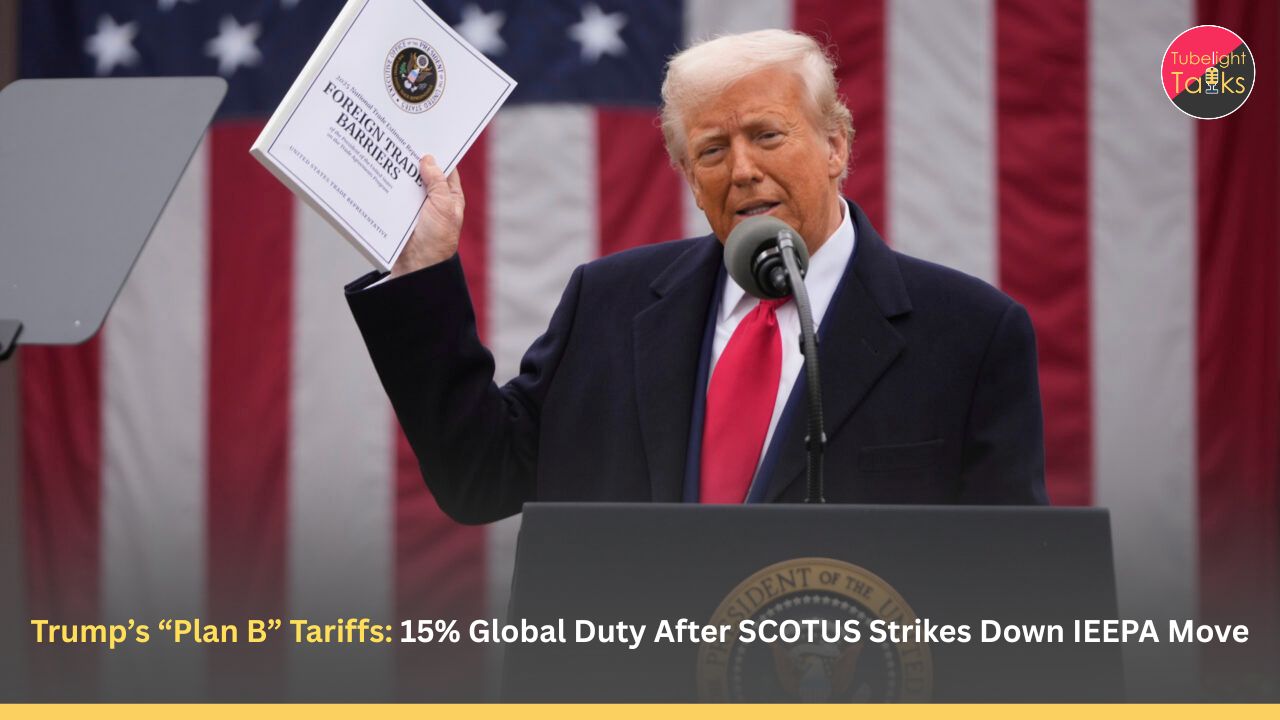
Trump’s “Plan B”: Global Tariffs Signalled at 15% After Supreme Court Setback
Trump’s “Plan B”: Washington’s tariff drama has entered a new phase. Days after the U.S. Supreme Court ruled that President Donald Trump could not use the International Emergency Economic Powers Act (IEEPA) to impose sweeping import duties, the White House shifted gears – leaning on alternative statutory powers and a fast-moving set of new trade investigations.
Now, Trump is signalling an even tougher line: a proposed 15% global tariff on imports from all countries, as “Trade War 2.0” builds momentum. Abroad, major “Global South” economies – especially India and Brazil – are already repositioning to protect critical minerals and steel supply chains.
The SCOTUS Defeat That Triggered “Plan B”
What the Supreme Court actually struck down
In Learning Resources, Inc. v. Trump (decided February 20, 2026), the Supreme Court held that IEEPA does not authorize the President to impose tariffs. The Court pointed out that the statute lists many powers over transactions and trade controls, but is “absent… any mention of tariffs or duties,” underscoring that tariff power requires clear congressional authorization.
Why this ruling matters beyond one tariff program
The decision is a constitutional warning shot: Congress holds the power to “lay and collect” duties, and presidents must point to specific statutory authority if they want to impose broad import taxes. Importantly, the opinion and dissents also signal that other tariff statutes still exist – meaning the Court did not end the tariff playbook; it narrowed the “emergency shortcut.”
Trump’s “Plan B”: 15% Global Tariffs and a New Legal Route
The new approach: Section 122 and a temporary import surcharge
After the ruling, the administration pivoted toward Section 122 of the Trade Act of 1974 (19 U.S.C. §2132), which allows a temporary import surcharge – up to 15% – to address “fundamental international payments problems,” generally tied to balance-of-payments stress.
A White House proclamation (February 20, 2026) imposed a 10% ad valorem import surcharge for 150 days, effective February 24, 2026, with an end date tied to late July unless modified earlier or extended by Congress.
So what’s changing to 15% – and what’s confirmed vs reported
The White House proclamation publicly documents the 10% rate and notes Section 122’s statutory ceiling of 15%.
Separately, major outlets report that Trump has signalled moving the global duty to 15% – a rapid escalation framed as a tougher “replacement” after the SCOTUS defeat.
Also Read: U.S. Supreme Court Strikes Down Trump’s Global Tariffs – And Washington’s Next Move Is Already Here
The Hook: Bypassing the Court With New Trade Probes
Section 301 investigations: the administration’s main detour
The U.S. Trade Representative’s office has laid out the core of the workaround strategy:
- impose the Section 122 surcharge immediately, and
- launch multiple Section 301 investigations into alleged “unjustifiable, unreasonable, discriminatory, and burdensome” practices by many trading partners – on an accelerated timeline.
This matters because Section 301 is a more established legal route for tariffs – linked to investigative findings and process steps – unlike the IEEPA emergency approach rejected by the Court.
What else stays on the table: Section 232 and ongoing cases
The White House order ending certain IEEPA tariff actions makes clear it does not affect other duties, including those under Section 232 (national security tariffs) and Section 301.
USTR also says it will maintain existing Section 232 tariffs and continue ongoing Section 301 investigations (including those involving Brazil and China).
What the Proclamation Covers: Exemptions, Supply Chains, and Pressure Points
Exemptions that matter most for global industry
The Section 122 proclamation lists significant carve-outs – particularly relevant to the “critical minerals and industrial inputs” story. It states the surcharge will not apply to certain categories including critical minerals, energy products, some agricultural goods, pharmaceuticals/ingredients, certain electronics, and items already subject to Section 232 restrictions – among others.
Why this is strategic: exemptions can soften inflation pressure, reduce immediate supply shocks, and keep leverage focused on targeted categories – while still allowing a broad “global tariffs” headline.
The real-world impact: what economists estimate so far
The Budget Lab at Yale estimates that after the SCOTUS ruling removed IEEPA tariffs, effective rates fell – then rose again after Section 122 tariffs, and were updated to reflect the announced move from 10% to 15%. It also projects measurable household cost pressure and labor-market effects, depending on whether the tariffs expire after 150 days or become effectively permanent.
Trending Angle: “Trade War 2.0” Is Not Just About the U.S.
Why a flat global tariff changes the psychology of trade
Country-specific tariffs often lead to country-specific negotiations. A broad import surcharge shifts the center of gravity: it becomes less about one bilateral dispute and more about a system-wide shock to costs, pricing, and sourcing. That’s why businesses now read every announcement as a signal of where the U.S. is headed next – especially as Section 301 probes ramp up.
Expect retaliation to be more supply-chain targeted than headline loud
The trade pattern in 2026 is different from the last “trade war” era: clean-energy manufacturing, semiconductors, and defense-linked materials are now central. That’s why any “Global South response” is likely to focus on leverage points such as:
- processing capacity (refining, recycling),
- export licensing and standards,
- long-term offtake agreements, and
- coordinated industrial policy around minerals and steel.
India and Brazil: The “Global South” Supply-Chain Countermove Takes Shape
A shared message: minerals, steel, and resilient value chains
As tariff uncertainty rises, India and Brazil are intensifying coordination in exactly the sectors most sensitive to tariff shocks: rare earths, critical minerals, and steel value chains.
India’s Ministry of External Affairs joint statement from President Lula’s February 2026 state visit explicitly notes cooperation on “rare earth minerals and critical minerals,” welcoming an MoU intended to strengthen “supply value chains” across exploration, mining, processing, recycling, and refining.
Steel supply chains as “insurance” against tariff volatility
India’s Ministry of Steel (PIB) announced an MoU with Brazil to strengthen and secure the steel supply chain – covering investment in exploration and mining, processing/recycling technologies, automation, and AI-enabled geoscientific analysis.
This is the clearest “response mechanism” Global South economies can control quickly: build alternative sourcing and processing partnerships so tariff swings don’t choke industrial inputs.
Also Read: India-US Mega Trade Breakthrough: US Cuts Tariffs on Indian Goods to 18%
Brazil’s strategic framing: don’t just export raw minerals
Brazil’s foreign ministry communications and speeches have repeatedly stressed the geopolitical value of critical minerals and the need to move up the value chain – processing domestically and building partnerships that generate jobs and development at home.
What Happens Next: Three Scenarios Markets Are Watching
1) The 150-day clock runs out – then politics decides
Section 122 is time-limited unless Congress extends it. The current proclamation sets a defined effective period that ends in late July (unless modified earlier).
That creates a built-in cliff: either tariffs fade, get replaced with targeted Section 301/232 actions, or become a congressional battle.
2) Section 301 becomes the “new normal” tariff engine
USTR has already mapped a pathway of broad Section 301 probes covering many major partners and multiple issue areas – suggesting a strategy of replacing a blunt global surcharge with a more durable set of legally-structured tariffs.
3) Another court fight – this time over Section 122 facts and thresholds
Section 122’s trigger is tied to “fundamental international payments problems.” If the administration stretches that concept, expect legal challenges arguing the factual predicate doesn’t fit. The stakes are huge because the new tariff architecture depends on surviving judicial review.
The Calm That Economies Also Need
In moments like “Trade War 2.0,” nations chase stability through laws, tariffs, and supply chains – but individuals still carry anxiety that no policy can fully remove. Sant Rampal Ji Maharaj’s teachings and Sat Gyaan repeatedly remind people that chasing worldly pursuits alone does not deliver lasting peace; as one message puts it, “Countless lifetimes have been spent chasing worldly pursuits… Did anything worthwhile come out of them?”.
Instead, the focus is on true devotion, disciplined living, and inner steadiness through satsang and right spiritual knowledge – so even when markets swing and headlines intensify, the mind does not become hostage to uncertainty.
Call to Action: Track Official Orders and Protect Your Supply Chain
Rely on primary documents first: follow White House proclamations and USTR updates on Section 122 implementation, exemptions, and new Section 301 investigations.
If you’re in India’s metals, engineering, auto, pharma, or electronics ecosystem, watch how exemptions (like critical minerals and pharmaceuticals) evolve, and how India–Brazil cooperation on minerals and steel can de-risk inputs over the next 12–24 months.
FAQs: Trump’s “Plan B”
1 What did US Supreme Court Rules anout IEEPA?
Ans: The U.S. Supreme Court ruled that President Donald Trump could not use the International Emergency Economic Powers Act (IEEPA) to impose sweeping import duties.
2 What is change after Supreme Court disallowed IEEPA?
Ans: White House shifted gears – leaning on alternative statutory powers and a fast-moving set of new trade investigations.
3 What is new plan may be excercised by US President?
Abs: US President Trump is signalling an even tougher line: a proposed 15% global tariff on imports from all countries.
4 What is global impact?
Ans: As “Trade War 2.0” builds momentum, major “Global South” economies – especially India and Brazil are already repositioning to protect critical minerals and steel supply chains.
Related Stories







Discussion (0)