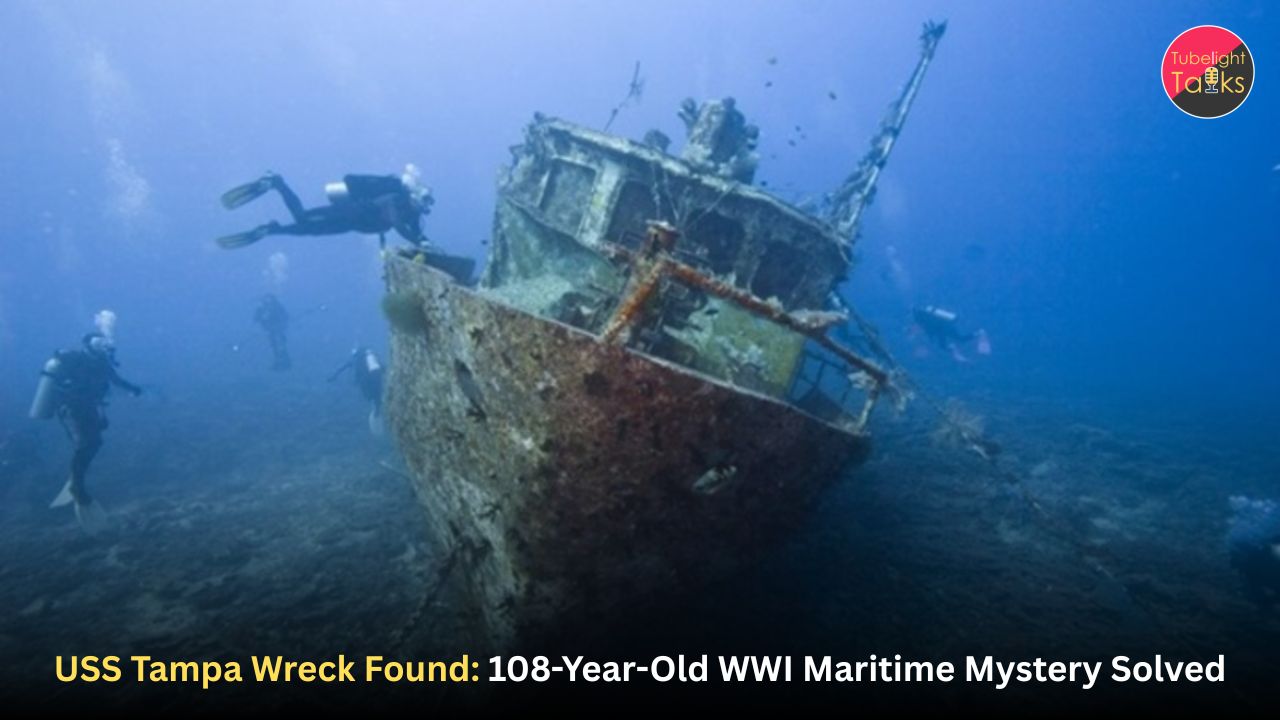
USS Tampa Wreck Found: 108-Year-Old World War I Mystery Solved Off the UK Coast
The 108-year-old mystery of the lost World War I cutter Tampa has finally been solved. The U.S. Coast Guard confirmed that the wreckage of Coast Guard Cutter Tampa was located about 50 miles off Newquay, Cornwall, at a depth exceeding 300 feet in the Atlantic Ocean. The ship, often called USS Tampa because it served under U.S. Navy control during World War I, was torpedoed by German submarine UB-91 on September 26, 1918, while sailing toward Milford Haven, Wales.
It sank in less than three minutes, killing all 131 people aboard and becoming the largest single American naval combat loss of life in World War I.
USS Tampa or USCGC Tampa: Understanding the Name Behind the Mystery
Why the Ship Is Called by Two Names
The vessel at the center of this historic discovery is officially the U.S. Coast Guard Cutter Tampa, or USCGC Tampa. It is also widely referred to as USS Tampa because, during World War I, U.S. Coast Guard cutters were transferred to U.S. Navy control for wartime service. The Coast Guard’s historical publication explains that when the United States entered World War I on April 6, 1917, the Coast Guard was officially transferred to the Navy, and cutters such as Tampa served in convoy protection duties.
This dual identity is important because Tampa belongs to both Coast Guard and naval history. It was a Coast Guard cutter by origin, crew culture, and legacy, but it served under the Navy during the war. That is why many public reports call it a U.S. warship, while official Coast Guard releases identify it as Coast Guard Cutter Tampa.
A Correction on the Location
Some summaries describe the wreck as being found “off Wales,” but the official U.S. Coast Guard statement places the site approximately 50 miles off Newquay, Cornwall, United Kingdom, at more than 300 feet deep. The Wales connection comes from Tampa’s final voyage: the cutter had left convoy duty and was heading toward Milford Haven, Wales, for coal when it was struck by UB-91.
This clarification matters for historical accuracy. The ship’s last intended destination was Wales, but its confirmed wreck site is off Cornwall in the Atlantic/Celtic Sea region.
How the 108-Year-Old Mystery Was Solved
The Gasperados Diving Team’s Three-Year Search
The wreckage was located and confirmed by Gasperados, a British technical-diving team. The U.S. Coast Guard said the all-volunteer team first contacted the Coast Guard Historian’s Office in 2023 and spent three years conducting an extensive search.
AP reported that the Gasperados team conducted 10 trips to possible dive locations. Team leader Steve Mortimer described the discovery as the result of three years of research and exploration, saying that Tampa is hugely important to the United States and to the relatives of those who died, because their final resting place is now known.
The discovery was not accidental. It required archival research, technical diving skill, weather planning, historical cross-checking, and physical confirmation at depth. Searching for a century-old wreck in deep Atlantic waters is extremely difficult because coordinates from wartime reports can be imprecise, currents can move debris, and the seabed may contain many unidentified wrecks.
Coast Guard Historians Helped Confirm the Site
The U.S. Coast Guard Historian’s Office played a major role in confirming the wreck. Coast Guard Atlantic Area Historian Dr. William Thiesen said the office provided historical records and technical data, including archival images of Tampa’s deck fittings, ship’s wheel, bell, weaponry, and photographs of the ship.
This kind of confirmation is essential in maritime archaeology. A wreck must be matched to historical dimensions, construction details, fittings, damage patterns, location evidence, and documentary records. In this case, the Coast Guard confirmed the site after the Gasperados team’s search and documentation.
Also Read: Russia-Ukraine WWII Anniversary Ceasefires: May 8–9 Brings a Fragile Humanitarian Window
The Final Voyage of Tampa
A Ship That Had Served With Distinction
Before its loss, Tampa had already built an impressive wartime record. Divernet reported that during 11 months of war service, Tampa helped protect 18 convoys from German U-boats between Gibraltar, the south coast of England, and routes farther north. Only two casualties occurred among the escorted vessels during that period.
This made Tampa a respected convoy escort. Its mission was not glamorous in the public imagination, but convoy duty was one of the most important naval tasks of World War I. Merchant ships carried troops, food, fuel, supplies, and war material. German submarine warfare targeted these lifelines. Escorts such as Tampa helped keep Allied shipping alive.
Torpedoed by UB-91
On September 26, 1918, Tampa left convoy duty off North Cornwall and was heading toward Milford Haven to refuel. At around 7:30 p.m., German submarine UB-91 fired a torpedo that struck the cutter midships on the port side. Divernet reported that the attack occurred under the command of Captain Charles Satterlee, and the cutter went down with all aboard.
The U.S. Coast Guard confirmed that Tampa sank in less than three minutes after being torpedoed in the Bristol Channel area. All 131 aboard died: 111 Coast Guardsmen, four U.S. Navy personnel, and 16 British Navy personnel and civilians.
A Tragedy Weeks Before the Armistice
The sinking happened only weeks before the end of World War I. The Armistice was signed on November 11, 1918. This timing deepened the tragedy. The crew had survived dangerous convoy duty for months, only to be lost near the war’s end.
The Coast Guard’s historical publication describes Tampa as the only one of six U.S. Coast Guard cutters sent overseas for convoy duty that never returned. It says Tampa became a poignant reminder of the ultimate human sacrifice made during the war.
The Human Cost: 131 Lives Lost
The Largest Single American Naval Combat Loss in World War I
The sinking of Tampa remains the largest single American naval combat loss of life during World War I. The official Coast Guard announcement confirms that all 131 aboard were killed, and AP repeated that the casualty toll included Coast Guard, Navy, British Navy, and civilian personnel.
This distinction is historically important. Many Americans remember World War I through trench warfare, the Western Front, and Army casualties. Tampa reminds us that the war at sea also carried enormous sacrifice.
Families Waited More Than a Century
For families of the lost crew, the discovery means more than historical interest. It gives them a confirmed final resting place. For generations, descendants knew the story of the cutter’s loss, but the exact wreck location remained uncertain. The Gasperados discovery now creates a physical point of remembrance in the sea.
Adm. Kevin Lunday, commandant of the Coast Guard, said the loss of Tampa with all hands in 1918 left an enduring grief in the service and that locating the wreck connects the Coast Guard to the crew’s sacrifice.
From Miami to Tampa: The Cutter’s Early Life
Built as Miami
Tampa began its life as Miami, a cutter built at Newport News, Virginia. The Coast Guard historical publication records that the vessel was constructed by Newport News Shipbuilding and Dry Dock Company, launched in 1912, and measured 190 feet with a displacement of 1,050 tons.
The ship originally served the Revenue Cutter Service, which later became part of the modern U.S. Coast Guard. It performed law enforcement, navigation safety, fisheries, patrol, and ice-related duties before wartime service.
Renamed for Tampa, Florida
The cutter had a strong relationship with Tampa, Florida. The Coast Guard historical publication notes that Miami participated in the Gasparilla Carnival and was renamed Tampa on February 1, 1916, in honor of its close connection with the city.
This makes the wreck discovery meaningful not only to the Coast Guard and the families of the crew, but also to the city whose name the cutter carried.
Why the Discovery Matters for Maritime History
Solving a Wartime Puzzle
The discovery solves one of World War I’s lingering maritime mysteries. Allied ships searched after the sinking, but only small debris was recovered at the time. The wreck itself remained hidden for more than a century. Now, the confirmed site helps historians reconstruct the final chapter of the cutter’s service.
Maritime archaeology is not only about finding wrecks. It helps verify records, correct assumptions, preserve memory, and connect archival history with physical evidence. Tampa’s wreck is now a historical site, a war grave, and a research opportunity.
A War Grave That Requires Respect
The wreck is also a final resting place. Because all 131 people aboard died, the site must be approached with dignity. Future exploration should avoid disturbance unless required for documentation, protection, or official research. The Coast Guard said it is developing plans for underwater research and exploration in coordination with specialized capabilities, historians, cutter forces, robotics and autonomous systems, and dive resources.
That careful language matters. The goal is not treasure hunting. The goal is remembrance, historical understanding, and respectful documentation.
The Role of Technical Diving
Why This Was a Difficult Dive
The wreck lies deeper than 300 feet. This is beyond ordinary recreational diving limits and requires technical diving expertise. Divers operating at such depths must manage breathing gases, decompression schedules, limited bottom time, cold water, currents, low visibility, equipment redundancy, and emergency risk.
The Gasperados team’s work shows how volunteer technical divers can contribute to historical research when they collaborate with official historians and follow respectful documentation practices.
Video and Physical Evidence
Divernet reported that the team planned to make video footage of the wreck available to the U.S. Coast Guard. Such footage is valuable because it allows historians and archaeologists to study the condition of the wreck, identify features, assess damage, and plan future non-invasive research.
In modern maritime archaeology, remotely operated vehicles, sonar, photogrammetry, underwater imaging, and robotics can help document wrecks without unnecessary disturbance.
Remembering Captain Charles Satterlee and the Crew
Leadership Until the End
Tampa’s last captain, Charles Satterlee, was an experienced Coast Guard officer. The Coast Guard historical publication records that Satterlee joined Tampa in December 1915 and had roots in a prominent Connecticut family. He had served in earlier conflicts and received recognition for his service before World War I.
Under Satterlee’s command, Tampa served in dangerous convoy operations. The loss of the ship was not due to negligence but to the brutal reality of submarine warfare. German U-boats could strike quickly, often without warning, and a torpedo hit could destroy a vessel within minutes.
A Crew From Many Walks of Life
The Coast Guard’s remembrance publication emphasizes that Tampa’s crew included husbands, fathers, sons, brothers, uncles, and cousins from many walks of life. It describes them as dedicated and hopeful men who left for war with the intention of returning, only to lose their lives weeks before the conflict ended.
This human framing is important. Naval history can become a list of ships, dates, and weapons. Tampa’s story is ultimately about people.
Also Read: Houthi Attacks in Red Sea Spark Global Trade Crisis: Oil, Shipping, and Security in Turmoil
Purple Hearts and Long-Delayed Recognition
Honoring the Fallen
The Times of India reported that Tampa’s crew were posthumously awarded the Purple Heart in recognition of their sacrifice, and the Coast Guard has long treated the loss as one of its deepest wartime wounds.
Recognition matters because wartime sacrifice can be forgotten when bodies are not recovered, wrecks remain missing, and generations pass. The rediscovery of Tampa renews public attention to the crew’s service and the families’ loss.
Memory Across Generations
Many descendants of World War I servicemen live with inherited memory rather than direct memory. They know names from family stories, photographs, letters, service records, medals, and memorial plaques. A confirmed wreck location gives that inherited memory a stronger anchor.
For the Coast Guard, Tampa is also institutional memory. It reminds the service of its wartime role, its convoy duties, and the courage of cutter crews who served far from home.
Why Shipwreck Discoveries Still Matter Today
History Beneath the Sea
Thousands of wrecks remain hidden under the world’s oceans. Each one carries a story of technology, trade, war, weather, migration, sacrifice, or tragedy. Finding a wreck can change what historians know about an event.
In Tampa’s case, the wreck gives researchers a chance to study how the torpedo damaged the ship, how the hull settled, and what physical features survived. It may also help refine historical understanding of UB-91’s attack and the ship’s final moments.
Closure Without Disturbance
Closure does not require raising a wreck. In many cases, leaving a war grave undisturbed is the most respectful choice. Documentation, mapping, and remembrance can preserve the story without removing artifacts.
The discovery itself is enough to transform memory. The crew’s final resting place is no longer unknown.
Lessons From the Tampa Discovery
Patience in Historical Research
The Tampa discovery shows that historical truth sometimes takes generations to uncover. Archival records, family memory, diving expertise, and official cooperation came together after 108 years.
This is a lesson for historians, researchers, and students: even old mysteries can be solved when evidence is patiently gathered and examined.
Technology and Devotion to Duty
Modern diving technology helped locate the wreck, but the deeper story remains devotion to duty. Tampa’s crew carried out a dangerous mission during a world war. The Gasperados team carried out a careful search to honor that service. The Coast Guard historians helped connect the past with the present.
This combination of courage, research, and respect makes the discovery meaningful.
A Final Resting Place and a Deeper Reflection
The discovery of Tampa reminds humanity that war does not end when the guns fall silent; its grief can remain in families and institutions for more than a century. The teachings of Sant Rampal Ji Maharaj and Sat Gyaan explain that violence, ego, hatred, greed, and wrong conduct bring suffering to human society, while true worship according to holy scriptures leads the soul toward peace and liberation.
Sant Rampal Ji Maharaj’s teachings guide people to live with truth, compassion, humility, and freedom from social evils such as intoxication, corruption, dishonesty, and harmful actions. In the context of Tampa’s rediscovery, this spiritual message flows naturally: memorials and wreck discoveries honor sacrifice, but humanity’s greater responsibility is to prevent future suffering through righteous conduct, compassion, and true spiritual knowledge.
The sea has preserved the remains of a tragic war story; Sat Gyaan reminds us to preserve humanity from repeating the same cycle of conflict.
Call to Action: Honor the Fallen, Preserve History, Seek True Knowledge
The discovery of the Tampa wreck should inspire historians, students, military families, Coast Guard personnel, and citizens to study World War I maritime history with respect. The wreck site should be treated as a war grave, and future research should be guided by dignity, documentation, and remembrance. Families of the fallen deserve sensitivity, and the crew’s sacrifice should be taught as part of the wider history of convoy warfare and maritime service.
At the same time, every individual should also seek true spiritual knowledge. Listen to the discourses of Sant Rampal Ji Maharaj, understand Sat Gyaan, and adopt a disciplined life based on truth, compassion, devotion, and moral conduct. Remembering history is important, but transforming human conduct is essential for lasting peace. The article structure follows the uploaded Team 5 content style reference.
FAQs on USS Tampa Wreck Found
1. What wreck has been discovered after 108 years?
The wreckage of U.S. Coast Guard Cutter Tampa, also commonly referred to as USS Tampa because it served under Navy control during World War I, has been discovered off Cornwall in the United Kingdom.
2. Where exactly was the Tampa wreck found?
The official U.S. Coast Guard statement says the wreck lies approximately 50 miles off Newquay, Cornwall, at a depth exceeding 300 feet in the Atlantic Ocean. The ship had been sailing toward Milford Haven, Wales, when it was torpedoed.
3. Who found the wreck?
The wreck was located and confirmed by Gasperados, a British technical-diving team. The all-volunteer team had been researching and searching for the wreck for three years.
4. How did Tampa sink?
Tampa was torpedoed by the German submarine UB-91 on September 26, 1918, during World War I. The Coast Guard says the cutter sank in less than three minutes.
5. How many people died on Tampa?
All 131 people aboard died: 111 Coast Guardsmen, four U.S. Navy personnel, and 16 British Navy personnel and civilians. It remains the largest single American naval combat loss of life in World War I.
6. What happens next at the wreck site?
The U.S. Coast Guard says it is developing plans for underwater research and exploration in coordination with historians, specialized capabilities, robotics and autonomous systems, cutter forces, and dive resources.
Related Stories







Discussion (0)