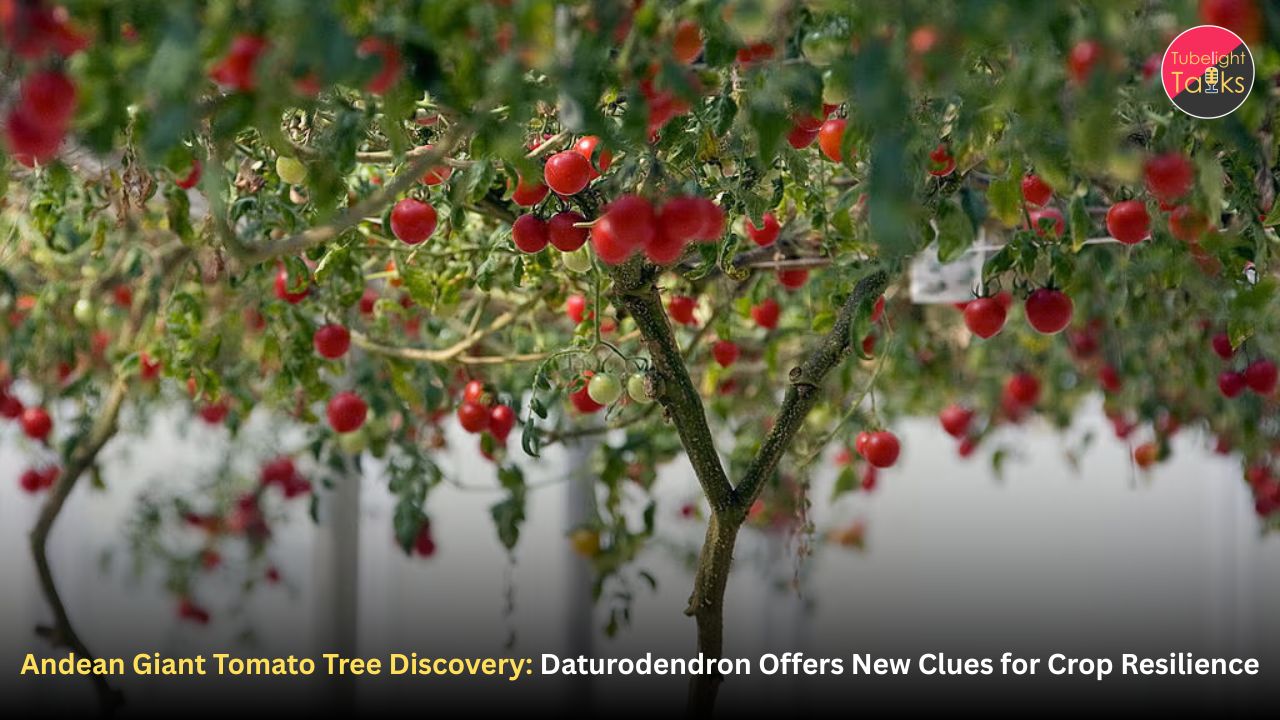
Andean Giant Tomato Tree Discovery: Daturodendron Reveals New Genetic Clues for Climate-Resilient Crops
Scientists have identified a rare 66-foot Andean tree called Daturodendron absconditum, a newly described genus and species in the nightshade family, Solanaceae. The discovery is drawing attention because Solanaceae includes globally important crops such as potatoes, tomatoes, eggplants, peppers, and several medicinal or toxic plants. Found in the Andean cloud forests of Colombia and Peru, Daturodendron is not a tomato tree in the culinary sense, but it is a distant botanical relative within the same wider family.
Its unusual tree-like form, evolutionary position, and alkaloid chemistry may help researchers understand how nightshades evolved and how crop relatives can support future climate-resilient food research.
Andean Giant Tomato Tree: What Scientists Have Found
A Rare Tree in the Nightshade Family
The newly described plant, Daturodendron absconditum, belongs to the family Solanaceae, also known as the nightshade or potato family. Kew notes that potato is a member of Solanaceae, the same family that includes tomato, aubergine, chilli pepper and petunias. Britannica describes Solanaceae as a flowering plant family containing 102 genera and about 2,280 species, many of considerable economic importance as food and drug plants.
That family connection is why headlines are calling the discovery a “giant tomato tree” or “relative of tomatoes and potatoes.” Scientifically, the plant is not a tomato or potato; it is part of the wider nightshade family and is placed in the tribe Datureae, which includes Datura, Brugmansia, and Trompettia. The 2026 Taxon paper describes Daturodendron absconditum as a monotypic genus, meaning the genus currently contains only one known species.
A 66-Foot Tree Hidden in Cloud Forests
Reports based on the study describe Daturodendron as an Andean cloud-forest tree that can reach around 20 meters, or 66 feet, in height. reported that the plant grows as a woody tree with one trunk and can reach 66 feet in humid forest, unlike many familiar nightshades that are herbaceous or shrubby.
The official Spanish-language report from the Real Jardín Botánico-CSIC described the discovery as a new tree genus of the Solanaceae family found in the cloud forests of the Andes of Colombia and Peru. It noted that only a small number of isolated populations are currently known.
Why This Discovery Matters
A New Branch in the Solanaceae Family Tree
The scientific paper states that Daturodendron absconditum was described based on taxonomic, phylotranscriptomic, and metabolomic evidence. Its phylogenetic position places it as sister to all other members of Datureae, a tribe that previously included Datura, Brugmansia, and Trompettia.
This matters because evolutionary relationships are like a map. If scientists place a species in the wrong location on the map, they may misunderstand how traits evolved. By correctly placing Daturodendron, researchers can better study the evolution of tree-like growth, flower orientation, fruit type, seed form, and chemical defenses in nightshades.
More Than a Curiosity
The discovery is not important simply because the tree is tall or related to familiar vegetables. It is important because wild relatives and distant plant lineages can carry genetic, biochemical, and ecological information that cultivated crops do not have. In an age of climate stress, heatwaves, new pests, drought, changing rainfall, and soil degradation, plant scientists increasingly study wild relatives to understand resilience.
No credible source reviewed for this article says Daturodendron is already being used directly to breed tomatoes or potatoes. The correct interpretation is more careful: this tree offers new evolutionary and genetic information that could guide future research into Solanaceae diversity, stress adaptation, alkaloid chemistry, and crop improvement.
Also Read: Moringa Water Filtration: Plant-Based Microplastic Removal Offers Hope for Safer Drinking Water
What Makes Daturodendron Different?
Tree-Like Growth
Most people think of tomato and potato plants as small garden crops. Daturodendron, by contrast, is arborescent, meaning tree-like. The Taxon study distinguishes the new genus by its arborescent habit, erect flowers, circumscissile calyx, leathery corollas, and distinctive seed shape.
This tree form is significant because Datureae includes both herbaceous and woody members. Datura species are usually herbaceous, while Brugmansia, known as angel’s trumpets, includes woody shrubs or small trees. Daturodendron adds a new evolutionary reference point for understanding how growth form shifted within the tribe.
Erect Flowers and Distinct Fruits
The study notes that the genus is distinguished by erect flowers and fruit traits that differ from its relatives. Datureae has long interested researchers because its members show contrasting traits, including herbaceous versus arborescent habit, erect versus pendent flowers, and fleshy indehiscent versus dry dehiscent fruits.
In simple terms, flower direction, fruit structure, and seed shape help scientists understand pollination, dispersal, adaptation, and evolutionary history. A plant’s appearance is not random; it reflects millions of years of interaction with environment, pollinators, animals, climate, and chemical defenses.
The Science Behind the Discovery
Taxonomy, Genomics and Chemistry Together
The research is powerful because it combines three kinds of evidence. Taxonomy examines physical features and classification. Phylotranscriptomics uses large-scale gene-expression data to infer evolutionary relationships. Metabolomics studies chemical compounds produced by the plant. Together, these methods give a stronger foundation than morphology alone.
The paper states that Daturodendron absconditum was described based on taxonomic, phylotranscriptomic, and metabolomic evidence.
This matters because many plant groups are difficult to classify by appearance alone. Convergent evolution can make unrelated plants look similar, while close relatives can sometimes look very different. DNA and chemical evidence help reduce uncertainty.
Tropane Alkaloids: Useful, Powerful and Dangerous
The study detected scopolamine and hyoscyamine in D. absconditum, which are tropane alkaloids also associated with other Datureae members. The paper says these compounds have major ethnomedical relevance and that their detection in Daturodendron is consistent with other tropane-alkaloid-producing members of Datureae.
This point needs caution. Tropane alkaloids can be medically important, but they can also be toxic. The discovery should not encourage anyone to consume or experiment with wild nightshade plants. The value is scientific: understanding how plants produce these compounds can support pharmacology, toxicology, ecology, and evolutionary biology.
Why the Andes Are So Important for Crop Science
A Hotspot of Nightshade Diversity
The Andes are central to the story of tomatoes, potatoes, and many wild nightshade relatives. Britannica notes that Solanaceae members are found worldwide but are most abundant and widely distributed in tropical regions of Latin America, where many genera are endemic.
The potato itself has deep Andean roots. Britannica describes the potato as native to the Peruvian-Bolivian Andes and one of the world’s main food crops. That makes Andean plant diversity especially valuable for food security research.
Cloud Forests as Living Laboratories
Andean cloud forests are humid, mountainous ecosystems where elevation, mist, rainfall, slope, temperature, and isolation create unique habitats. Plants living there often adapt to narrow ecological niches. These adaptations can interest scientists studying drought tolerance, disease resistance, temperature response, reproductive biology, chemical defense, and genetic diversity.
The Real Jardín Botánico-CSIC report identified the new genus from cloud forests in the Andes of Colombia and Peru, emphasizing that only a limited number of isolated populations are known.
Also Read: Global Forest Assessment: Forest Loss Eases in 2025, but the World Still Needs Faster Action
How Daturodendron Could Help Climate-Resilient Crop Research
Genetic Blueprints Do Not Mean Immediate Crop Transfer
The phrase “genetic blueprints” should be understood as scientific potential, not immediate agricultural application. Daturodendron is a distant relative within Solanaceae, not a ready-to-use tomato breeding line. Its genome, transcriptome, growth traits, chemistry, and ecology can still provide clues about how nightshades evolved and adapted.
For example, researchers may study gene families linked to defense compounds, growth form, reproductive biology, fruit structure, stress tolerance, or metabolism. Such knowledge can help scientists understand what genetic options exist across Solanaceae. Future crop research may use this knowledge indirectly through comparative genomics, gene discovery, or evolutionary modeling.
Wild Relatives and Food Security
A 2015 study on Solanaceae food biodiversity noted that conservation helps safeguard food security and that a taxonomic inventory of plant diversity is an important first step in conservation. It also described Solanaceae as a major plant family providing food species.
This principle applies strongly to Daturodendron. Even if it never becomes a crop relative used directly in breeding, documenting it expands the known diversity of the family. Biodiversity knowledge is the foundation of future crop resilience. Unknown species cannot be studied, protected, or responsibly used.
Why Conservation Is Urgent
Rare and Isolated Populations
The Real Jardín Botánico-CSIC report says only a small number of isolated populations are currently known. That makes conservation important. A plant with few known populations can be vulnerable to habitat loss, road expansion, agriculture, mining, climate change, fire, invasive species, or illegal collection.
When a newly described species is already rare, scientists must move quickly from discovery to protection. Taxonomic publication is only the first step; habitat monitoring, seed banking, local conservation partnerships, and field surveys may be needed.
Cloud Forests Under Climate Pressure
Cloud forests are particularly sensitive to climate change. As temperatures rise, cloud layers may shift upward, moisture patterns may change, and species adapted to narrow elevation bands may lose suitable habitat. For a rare tree known from limited Andean sites, climate change could become a long-term threat.
Protecting Daturodendron therefore means protecting its cloud-forest habitat. A single species cannot survive if the ecosystem around it collapses.
Botanical Discovery and Local Knowledge
Science Is Built on Collections and Fieldwork
New species are rarely discovered by a single dramatic moment. They are usually recognized through years of herbarium work, field observation, specimen comparison, local collaboration, and laboratory analysis. The Taxon paper involved researchers from Colombia, Peru, Spain, Germany, Bulgaria, Brazil, and the United States, showing the international nature of modern taxonomy.
The paper history shows it was received in June 2025, revised through November 2025, accepted in November 2025, and published in April 2026. This timeline reminds readers that serious science is reviewed, corrected, tested, and documented.
Local Conservation Must Be Respected
Because the plant is endemic to Colombia and Peru, any future research should respect national biodiversity laws, Indigenous and local community rights, conservation ethics, and benefit-sharing principles. Genetic resources are not free raw material for outside exploitation. Responsible science must involve local institutions and protect natural habitats.
This is especially important when a plant may contain medically relevant or commercially interesting compounds. Scientific curiosity must not become biopiracy.
Why the “Giant Tomato Tree” Headline Needs Care
Useful for Public Interest, But Scientifically Simplified
Calling Daturodendron a “giant tomato tree” helps the public understand its relationship to familiar foods. But it can also mislead readers into thinking it grows tomatoes or can directly produce climate-proof tomato crops. The accurate explanation is that it belongs to the same wider family as tomatoes and potatoes, not the same genus as tomato or potato.
Tomato belongs to Solanum lycopersicum, while potato belongs to Solanum tuberosum. Daturodendron is a different genus in Datureae. The family connection is real, but distant.
A Better Way to Understand It
A better phrase may be: “a giant Andean tree in the tomato and potato family.” This keeps the excitement without distorting the science. It tells the truth: this is a remarkable tree-like nightshade, not a vegetable plant.
Science communication matters because public trust depends on accuracy. A discovery can be fascinating without exaggeration.
Broader Impact on Agriculture
Learning From Diversity
Crop resilience often comes from diversity. When cultivated crops become genetically narrow, they may become vulnerable to pests, disease, heat, drought, or changing rainfall. Wild relatives and diverse family members preserve traits that modern crops may lack.
Studying Daturodendron could help scientists ask new questions: How did tree-like growth evolve in Datureae? How do nightshades regulate chemical defenses? How did fruit and seed traits shift across the family? Which genes are conserved across crop and non-crop relatives? Which traits help survival in cloud forests?
These questions may not produce an immediate variety of tomato or potato, but they build the knowledge needed for future innovation.
Climate-Resilient Food Systems Need Basic Science
The world needs crop science that can respond to climate change. Heat-tolerant tomatoes, disease-resistant potatoes, water-efficient peppers, and resilient eggplants may all depend on understanding plant diversity. Basic taxonomy, field botany, and evolutionary biology are therefore not “old-fashioned” sciences; they are essential for future food security.
The Daturodendron discovery is a reminder that some of tomorrow’s answers may begin with a tree hidden in a cloud forest.
India’s Connection to the Discovery
Why Indian Readers Should Care
India is a major producer and consumer of tomato, potato, brinjal, chilli, and other Solanaceae crops. Climate stress already affects these crops through heatwaves, irregular rainfall, pests, floods, disease outbreaks, and price volatility. Any global research that deepens knowledge of Solanaceae genetics can indirectly matter to Indian agriculture.
Kew identifies potato as part of the Solanaceae family that includes tomato, aubergine, chilli pepper and petunias. This same family is deeply present in Indian kitchens, farms, markets, and food inflation debates.
Opportunity for Research Collaboration
Indian agricultural universities, plant geneticists, botanists, and crop scientists can learn from such discoveries by strengthening crop wild relative research, plant taxonomy, seed banks, botanical surveys, climate-resilient breeding, and international collaboration.
India’s own biodiversity also contains many under-studied plants. The lesson from the Andes is clear: protecting wild plants today may help secure food systems tomorrow.
Biodiversity, Humility and the Divine Order of Nature
The discovery of Daturodendron reminds humanity that creation is vast, subtle, and full of hidden wisdom. A tree can remain scientifically unrecognized for decades, yet hold clues about evolution, medicine, ecology, and food security. The teachings of Sant Rampal Ji Maharaj and Sat Gyaan emphasize that human beings should live with humility, truth, compassion, and devotion according to holy scriptures. His teachings guide people away from intoxication, violence, dishonesty, corruption, greed, and harmful conduct, and toward true worship of the Supreme God.
In the context of biodiversity, this message flows naturally: nature should not be exploited with arrogance but protected with responsibility. Just as scientists study the hidden genetic wisdom of plants, Sat Gyaan guides human beings to discover the hidden purpose of human life—true devotion, righteous living, and liberation from suffering. Environmental protection becomes more meaningful when supported by moral and spiritual discipline.
Call to Action: Protect Wild Plant Diversity and Seek True Knowledge
Science, Conservation and Spiritual Responsibility Must Move Together
The discovery of Daturodendron absconditum should inspire governments, universities, botanists, farmers, conservation groups, and citizens to support plant taxonomy, cloud-forest protection, seed banking, and research on crop wild relatives. Climate-resilient food systems cannot be built only in laboratories; they require conservation of forests, respect for local communities, and protection of genetic diversity.
At the same time, every individual should also seek true spiritual knowledge. Listen to the discourses of Sant Rampal Ji Maharaj, understand Sat Gyaan, and adopt a disciplined life based on truth, compassion, devotion, and moral conduct. Protecting biodiversity supports worldly survival, while true worship gives the soul its permanent path. The article structure follows the uploaded Team 5 content style reference.
FAQs on the Andean Giant Tomato Tree Discovery
1. What is the Andean “giant tomato tree”?
The phrase refers to Daturodendron absconditum, a newly described tree-like genus and species in the Solanaceae family, the same wider family as tomatoes and potatoes. It is not an actual tomato tree but a distant botanical relative.
2. How tall can Daturodendron grow?
Reports based on the study describe Daturodendron as capable of reaching about 20 meters, or 66 feet, in humid Andean forest conditions.
3. Where was Daturodendron found?
The species is endemic to the Andean regions of Colombia and Peru, with known populations in cloud forest or montane rainforest habitats.
4. Why is it related to tomatoes and potatoes?
It belongs to the Solanaceae family, also called the nightshade or potato family. This family includes important crops such as potato, tomato, eggplant, chilli pepper, and other plants.
5. Can this tree directly improve tomato or potato crops?
Not immediately. There is no evidence that Daturodendron is already being used directly in crop breeding. Its value lies in evolutionary, genetic, and biochemical clues that may guide future research into Solanaceae diversity and resilience.
6. Why is the discovery important for conservation?
Only a small number of isolated populations are currently known, and the species occurs in sensitive Andean cloud-forest habitats. Conservation is important because rare wild relatives can hold valuable genetic and ecological information for future science.
Related Stories










Discussion (0)