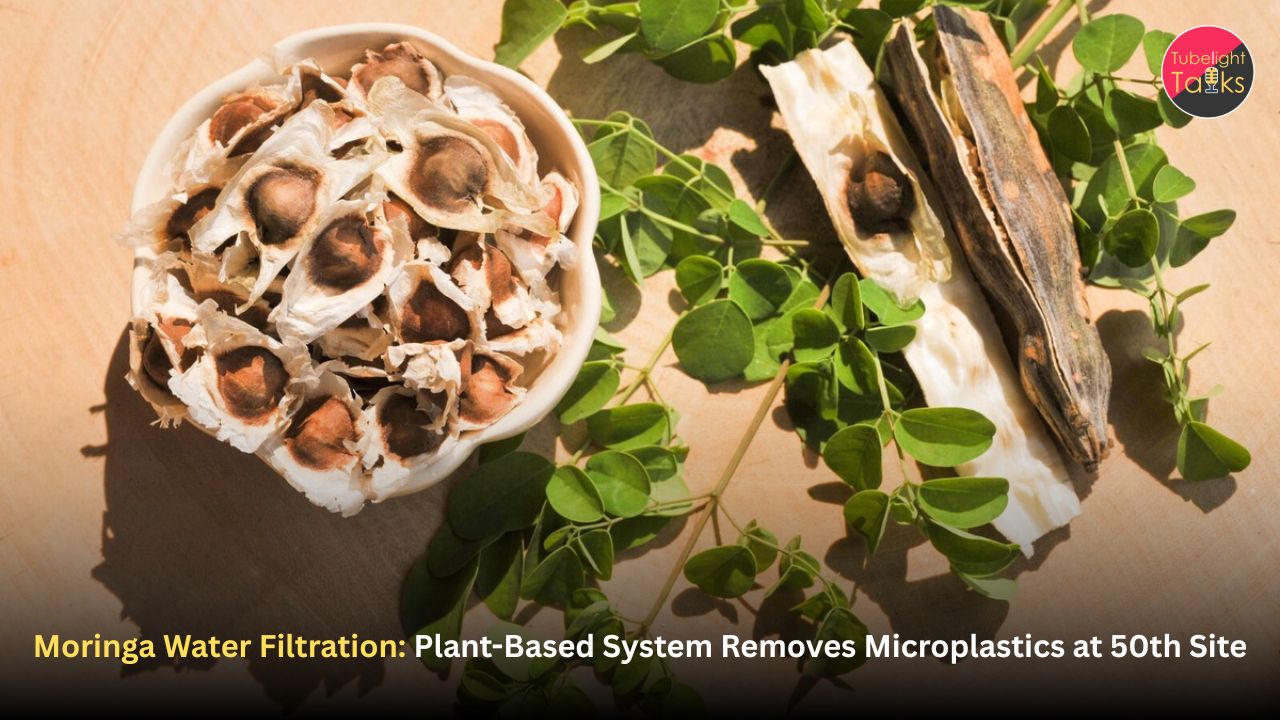
Moringa Water Filtration: Plant-Based Microplastic Removal Offers Hope for Safer Drinking Water
A decentralized water purification project using Moringa seed extracts has reportedly scaled to its 50th international site, giving new attention to a simple, natural and low-cost method for removing microplastics from drinking water. Recent studies show that saline extracts from Moringa oleifera seeds can remove more than 98% of certain microplastics under controlled conditions, close to the 99% removal figure highlighted in project updates.
The method works through natural coagulation: tiny plastic particles clump together and can then be filtered out. While more real-world testing is needed, Moringa water filtration could become especially useful for rural communities, small towns and decentralized water systems.
Moringa Water Filtration: Why This Project Matters
Microplastics Are a Growing Water Concern
Microplastics are tiny plastic particles usually smaller than 5 millimetres. They come from degraded plastic waste, synthetic clothing fibres, packaging, industrial products, tyres, paints and personal care products. These particles have been found in rivers, lakes, oceans, bottled water, tap water, soil, air and even biological samples.
The concern is not only environmental. Microplastics can carry chemical additives, pollutants and biological contaminants. Scientists are still studying the full long-term impact on human health, but the widespread presence of microplastics in drinking water has created an urgent need for affordable removal methods.
Large treatment plants may use advanced filtration, coagulation and membrane systems, but many smaller communities cannot afford expensive technologies. That is where plant-based, decentralized water purification methods such as Moringa seed extraction become important.
A Natural Solution for Decentralized Communities
Moringa oleifera, commonly called the drumstick tree or miracle tree, is native to India and widely grown in tropical and subtropical regions. Its seeds have long been used in traditional water clarification because they contain natural proteins that help suspended particles clump together.
In modern water treatment language, this process is called coagulation and flocculation. When Moringa seed extract is added to water, charged proteins can neutralize particles. The particles then gather into larger clumps, which can settle or be removed through filtration.
This makes Moringa water filtration especially attractive for decentralized use. It can support villages, schools, relief camps, remote clinics, small towns and local water systems where large infrastructure is not available.
How Moringa Seed Extract Removes Microplastics
Coagulation: The Science Behind the Method
Microplastics are difficult to remove because they are very small, light and widely dispersed in water. A normal cloth filter or basic sedimentation method may not capture them effectively. Moringa seed extracts work by encouraging microplastic particles to bind with other suspended matter and form larger clusters.
Once the particles form larger clumps, filtration becomes easier. In controlled studies, saline extracts from Moringa seeds have performed similarly to aluminum sulfate, a common chemical coagulant used in treatment plants. In some alkaline water conditions, Moringa extract has reportedly performed even better.
This is significant because aluminum sulfate and other chemical coagulants can be effective, but they also require careful handling, dosing, cost management and sludge treatment. Moringa offers a biodegradable and plant-based alternative.
Why Saline Extracts Are Important
Simply crushing Moringa seeds and mixing them with water can help reduce turbidity, but it may also leave behind organic matter. Saline extraction improves performance by helping draw out active coagulant proteins more effectively. This can increase microplastic removal efficiency and make the process more consistent.
However, researchers also note a challenge: Moringa extract can increase dissolved organic carbon in treated water. This means the method must be paired with proper filtration and post-treatment steps to avoid microbial regrowth or changes in water quality.
Also read: Microplastic Solution: Moringa Seed Extract Shows Powerful Potential for Cleaner Drinking Water
The 50th International Site: A Milestone With Careful Optimism
Scaling From Laboratory to Communities
The reported 50th international site represents an important milestone for decentralized Moringa water filtration. Laboratory success is valuable, but real-world use is the true test. Community sites must deal with different water sources, changing seasons, mixed pollutants, local habits, maintenance capacity and supply chains.
Scaling the method across international locations can help answer practical questions: How much seed extract is needed? How often should filters be cleaned? Does the method work in river water, groundwater, rainwater and municipal supply? How should sludge be disposed of? Can local communities prepare the extract safely? What training is needed?
These questions are essential before Moringa filtration can be recommended widely as a safe drinking water solution.
Why the 99% Claim Needs Context
Project updates highlight up to 99% microplastic removal. Recent public scientific studies have reported more than 98% removal efficiency for certain microplastics under specific tested conditions. The difference may sound small, but scientific accuracy matters. Removal rates depend on water chemistry, microplastic type, particle size, pH, dosage, mixing time and filtration method.
Therefore, the strongest responsible statement is this: Moringa seed extract has shown very high microplastic removal potential, above 98% in controlled studies, and may reach around 99% under optimized or project-specific conditions. Large-scale field validation is still needed.
Benefits of Moringa-Based Water Filtration
Low Cost and Local Availability
Moringa grows in many warm regions, including India, Africa, Southeast Asia and parts of Latin America. In places where the tree is already cultivated, seeds may be locally available. This reduces dependence on imported chemicals and expensive treatment systems.
For low-resource communities, affordability is critical. A water solution that requires costly cartridges, electricity, imported parts or specialist maintenance may fail after initial enthusiasm. Moringa filtration has the advantage of being simple, plant-based and potentially locally managed.
Sustainable and Biodegradable
Moringa seed extract is biodegradable and plant-derived. This gives it an environmental advantage over some synthetic treatment chemicals. If carefully managed, the method can reduce chemical dependence and support more sustainable water treatment.
This does not mean it is risk-free. Natural does not automatically mean safe in every setting. Proper dosage, filtration, microbial control and water testing remain necessary. But as a green water treatment option, Moringa has strong potential.
Useful for Rural and Emergency Settings
Decentralized Moringa filtration can be useful in rural areas, disaster zones, refugee camps, schools and small settlements where centralized treatment is weak. In emergencies, rapid and low-cost water clarification can be lifesaving.
Microplastics are not the only concern in such settings. Turbidity, bacteria, organic matter and chemical contamination may also be present. Moringa can help with turbidity and particles, but it should not be treated as a complete solution for all contaminants unless combined with disinfection and testing.
Challenges Before Wider Adoption
Water Safety Must Be Verified
Any drinking water method must be tested for safety. Removing microplastics is valuable, but treated water must also be free from harmful bacteria, viruses, parasites, toxic chemicals and excess organic matter. Moringa-based treatment may need to be combined with sand filtration, membrane filtration, boiling, chlorination, ultraviolet treatment or solar disinfection depending on local conditions.
Standardization Is Needed
Different Moringa seeds may vary in protein content depending on variety, growing conditions, storage and processing. Without standardization, treatment performance may vary. Communities need clear instructions on seed preparation, extract concentration, dosage, mixing time, settling time, filtration and storage.
Sludge Disposal
When microplastics are removed from water, they do not disappear. They become concentrated in sludge or filter waste. This material must be handled responsibly so microplastics do not return to the environment.
Not a Replacement for Plastic Reduction
Moringa filtration can help remove microplastics from water, but it does not solve the root problem: plastic pollution. The world must still reduce plastic waste, improve recycling, control industrial discharge, redesign packaging and prevent plastics from entering rivers and oceans.
Also Read: Moringa Seeds Offer Green Solution for Microplastic Removal
India’s Connection to Moringa Water Filtration
A Plant Deeply Familiar to India
Moringa is widely known in India as drumstick or sahjan. It is used in food, traditional health practices and agriculture. Its leaves, pods and seeds are familiar in many households. This cultural familiarity could make Moringa-based water solutions easier to understand and accept in some Indian communities.
India also faces serious water challenges: groundwater stress, river pollution, rural drinking water gaps, urban waste, plastic contamination and climate-linked floods and droughts. Low-cost water treatment innovations can support community resilience when they are tested and implemented responsibly.
Opportunity for Rural Innovation
India can lead in Moringa-based decentralized water systems through agricultural universities, water research institutes, rural technology missions, women’s self-help groups, Panchayats and startups. If farmers grow Moringa, local processing units can prepare seed extract or filtration materials. This could create rural livelihoods while improving water safety.
However, any rollout must be evidence-based. Field trials, public health monitoring and quality control should come before mass promotion.
Clean Water and Moral Responsibility
The Moringa water filtration project reminds us that nature often holds simple solutions, but human beings must use them responsibly. Clean water is not only a technical need; it is a moral duty. The teachings of Sant Rampal Ji Maharaj and Sat Gyaan emphasize truth, compassion, humility, righteous conduct and true worship according to holy scriptures. His teachings guide people away from intoxication, corruption, greed, dishonesty, violence and harmful practices. In the context of water pollution, this message is deeply relevant.
Microplastics exist because human society has overused, wasted and carelessly discarded plastic. Sat Gyaan teaches that outer cleanliness must be supported by inner purity. A society that follows truth, restraint and responsibility will protect rivers, water bodies and future generations. Technology can filter water, but spiritual wisdom can filter human conduct.
FAQs on Moringa Water Filtration
1. What is Moringa water filtration?
Moringa water filtration is a plant-based purification method that uses extracts from Moringa oleifera seeds to make suspended particles and microplastics clump together so they can be filtered more easily.
2. Can Moringa seed extract remove microplastics?
Yes. Recent studies show that saline extracts from Moringa seeds can remove more than 98% of certain microplastics under controlled conditions, with project updates citing up to 99% removal in optimized settings.
3. How does Moringa remove microplastics?
Moringa seed proteins act as natural coagulants. They help neutralize charges on tiny particles, causing microplastics and other suspended matter to form larger clumps that can be removed by filtration.
4. Is Moringa filtration safe for drinking water?
It has strong potential, but treated water must still be tested and may require additional filtration or disinfection. Moringa can increase organic matter, so proper treatment design is important.
5. Why is this method useful for rural areas?
Moringa is low-cost, plant-based and locally available in many tropical regions. It can support decentralized water purification where large treatment plants or expensive chemicals are not practical.
6. Does Moringa filtration solve plastic pollution?
No. It can help remove microplastics from water, but the root solution is reducing plastic waste, improving recycling, preventing pollution and managing sludge or filter waste responsibly.
Related Stories







Discussion (0)