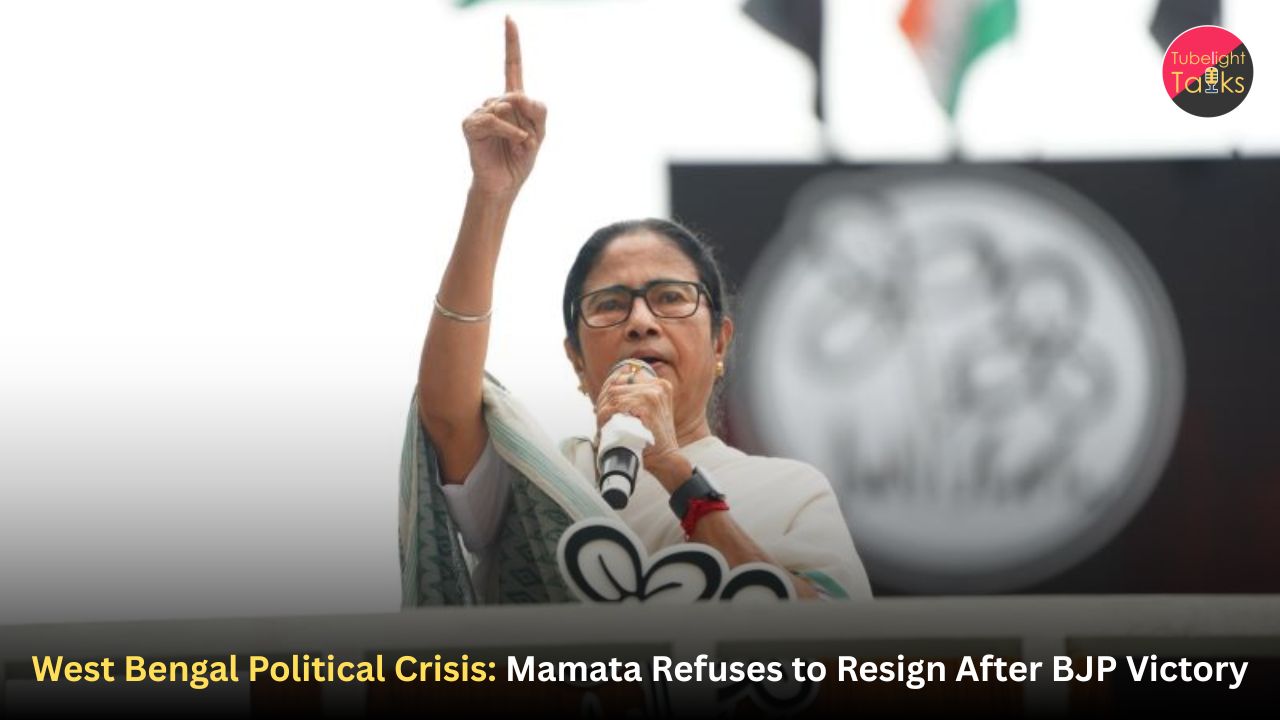
West Bengal Political Crisis: Mamata Banerjee Refuses to Resign After BJP Victory
West Bengal has entered a tense post-election political crisis after Chief Minister Mamata Banerjee refused to resign despite the BJP securing a decisive victory in the Assembly election. Officially reported results showed the BJP winning 207 seats in the 294-member Assembly, while the Trinamool Congress was reduced to 80 seats. Mamata has rejected the mandate, alleging that votes were “looted” and the election process was rigged.
BJP leaders have strongly criticized her stand, calling it a violation of democratic norms and describing the situation as “political anarchy.” The standoff has now placed constitutional procedure, the Governor’s authority, public order and peaceful transfer of power at the center of Bengal’s political debate.
BJP’s Bengal Victory: A Historic Power Shift
BJP Secures a Decisive Mandate
The BJP’s victory in West Bengal marks one of the most dramatic political shifts in the state’s recent history. The party won a commanding majority, reportedly securing 207 seats, far above the 148-seat majority mark in the 294-member Assembly. The result ended the long dominance of the Trinamool Congress, which had ruled the state for years under Mamata Banerjee’s leadership.
This result is politically significant because West Bengal was once considered one of the toughest states for the BJP to win. The party had expanded gradually through parliamentary elections, organizational work, religious-nationalist messaging, anti-incumbency campaigning and consolidation of opposition votes. But the 2026 Assembly verdict has taken that effort to a new level.
The result also strengthens the BJP’s national position. A Bengal win gives the party a powerful foothold in eastern India, strengthens its claim of being a truly pan-Indian force and opens new political possibilities in states where it previously struggled.
TMC Reduced to Opposition
The Trinamool Congress, once the dominant political force in Bengal, has been pushed into a much weaker position. From being the ruling party, it now faces the prospect of sitting in opposition with around 80 seats. This is not a minor setback; it is a structural political defeat.
For Mamata Banerjee, the result is personally and politically severe. She built the TMC as an anti-Left movement, defeated the long-ruling CPI(M), and shaped Bengal politics for more than a decade. Losing power to the BJP changes the state’s political direction and challenges her image as Bengal’s strongest mass leader.
Also Read: West Bengal Trends Signal Possible Political Realignment as BJP Takes Early Lead
Mamata Banerjee Refuses to Resign
Allegations of Rigging and Vote Loot
After the results, Mamata Banerjee refused to step down from the Chief Minister’s post. She alleged that the election process was rigged and that votes were looted by force. Reports said she claimed her party had not truly lost and accused the Election Commission of bias, calling the result a dark chapter in India’s democratic history.
Her stand has created a major constitutional and political controversy. In a parliamentary system, once a ruling party loses majority in the Assembly, the sitting Chief Minister is expected to resign or face dismissal if unable to command the House. Mamata’s refusal to resign despite the BJP’s clear majority has therefore intensified the crisis.
TMC Frames It as a Fight for Democracy
The TMC is attempting to frame Mamata’s refusal as a protest against alleged manipulation rather than a rejection of democracy. Party supporters argue that she is resisting what they see as electoral injustice. Mamata has reportedly described the verdict as a conspiracy and has sought to rally opposition support around claims of irregularities.
However, such claims require strong evidence. In a democracy, allegations of rigging must be taken through legal and constitutional channels, including election petitions, recount demands where applicable and court proceedings. Refusal to resign without proving majority support creates a different kind of crisis.
BJP Calls It “Political Anarchy”
BJP Says Mandate Must Be Respected
The BJP has sharply criticized Mamata Banerjee’s refusal to resign. Party leaders have accused her of disrespecting the people’s verdict and creating political anarchy. BJP leaders have argued that India is a democracy, not a monarchy, and that a Chief Minister cannot continue after losing a clear mandate.
For the BJP, the issue is now both political and moral. The party wants to show that it has won legitimately and that the outgoing government is trying to delay the transfer of power. The BJP is likely to use this standoff to project itself as the defender of democratic procedure in the state.
Demand for Constitutional Action
BJP leaders are expected to press the Governor to act if Mamata does not resign voluntarily. In such a situation, the Governor may ask the outgoing Chief Minister to prove majority support. If she cannot, the Governor can invite the BJP legislative party leader to form the government.
The crisis could intensify if the TMC mobilizes protests or refuses administrative cooperation. That is why public order has become a key concern.
Governor’s Role in the Crisis
Constitutional Procedure Comes Into Focus
The Governor’s role becomes crucial when there is a transition after an election. If the ruling party loses majority and the Chief Minister refuses to resign, the Governor must ensure that the constitutional process continues. This may include seeking a formal resignation, asking the Chief Minister to prove majority or inviting the new majority party to form government.
The Governor is not expected to decide political legitimacy based on public speeches. The key test is majority support in the Assembly. Since the BJP has won a decisive majority, the constitutional expectation is that power should transfer smoothly.
A Peaceful Transition Is Essential
The greatest risk is not merely legal delay but public instability. West Bengal has a long history of intense political rivalry, and post-poll tension can easily lead to street confrontations. Election officials have already called for strict security measures and patrolling amid threats of violence.
A peaceful transfer of power is essential for public confidence. Voters must see that election results have meaning. If defeated governments refuse to leave office, democratic stability weakens.
Also Read: Historic Voter Turnout in Tamil Nadu and West Bengal Signals Strong Democratic Participation
Why This Crisis Matters Nationally
Bengal Is Not an Ordinary State
West Bengal is one of India’s most politically important states. It has a large population, a strategic border with Bangladesh, major cultural influence, significant minority demographics, and economic importance in eastern India. A political crisis there has national implications.
The BJP’s victory changes the eastern political map. It could affect border policy, citizenship debates, central-state relations, industrial strategy, policing, welfare delivery and national election calculations.
Opposition Politics Faces a New Challenge
Mamata Banerjee has been one of the most visible opposition figures at the national level. Her defeat weakens her ability to act as a national anti-BJP pole. If she refuses to resign and the crisis escalates, opposition unity may become more complicated. Some opposition leaders may back her claims of rigging, while others may hesitate to support a refusal to respect electoral results.
The crisis therefore tests not only Bengal politics but the national opposition’s democratic credibility.
Risks of Escalation
Street Violence and Party Clashes
Political violence is one of the biggest immediate concerns. After a heated election, party workers can clash over victory processions, control of local offices, allegations of intimidation or revenge attacks. Reports of threats and unrest have already led election authorities to push for security vigilance.
Both the BJP and TMC must act responsibly. Leaders on both sides should instruct workers to avoid provocation. A political transition should not become a public safety crisis.
Administrative Paralysis
If the outgoing government refuses to cooperate and the incoming majority is delayed, administration may suffer. Files may stop moving, officials may hesitate, law-and-order decisions may become politicized and public services may be affected.
Ordinary citizens should not pay the price for political confrontation. Governance must continue even during transition.
What Happens Next?
Mamata May Face Pressure to Step Down
The most likely next step is mounting pressure on Mamata Banerjee to resign. If she continues to refuse, the Governor may take constitutional steps. BJP legislators may formally elect their leader and submit proof of majority. The Governor can then invite the BJP to form government.
Legal Challenge Is Possible
The TMC may challenge specific results or alleged irregularities through legal channels. This is a valid democratic route. But court challenges generally do not allow a defeated government to remain in office indefinitely after losing majority. Evidence, not rhetoric, will determine the outcome of legal claims.
BJP Government Formation Likely
Given the BJP’s decisive seat count, government formation appears likely once the constitutional process moves forward. The key question is whether the transition happens peacefully or through confrontation.
Democracy, Mandate and Moral Responsibility
The West Bengal crisis reminds society that power is temporary and the people’s mandate must be respected. Elections become meaningful only when winners remain humble and losers accept the process with dignity while using lawful methods to challenge genuine grievances. The teachings of Sant Rampal Ji Maharaj and Sat Gyaan emphasize truth, humility, compassion, righteous conduct and true worship according to holy scriptures.
His teachings guide people away from ego, corruption, dishonesty, intoxication, violence and misuse of power. In the context of Bengal’s political crisis, this message is deeply relevant. Leaders must not treat office as personal property. Sat Gyaan teaches that authority should be used for public welfare, not pride or conflict. A state becomes peaceful when rulers and citizens follow truth, restraint and moral discipline.
FAQs on West Bengal Political Crisis
1. Why is West Bengal facing a political crisis?
West Bengal is facing a political crisis because Chief Minister Mamata Banerjee has refused to resign despite the BJP winning a decisive Assembly majority.
2. How many seats did the BJP win?
Reports said the BJP won 207 seats in the 294-member West Bengal Assembly, securing a clear majority.
3. What did Mamata Banerjee allege?
Mamata Banerjee alleged that the election process was rigged and that votes were looted by force. She accused the Election Commission of bias.
4. Why is BJP calling the situation political anarchy?
BJP leaders say Mamata’s refusal to resign after losing majority disrespects the democratic mandate and violates constitutional norms.
5. What can the Governor do?
The Governor can ask the outgoing Chief Minister to prove majority support or invite the BJP, which has a majority, to form the government.
6. What is the biggest risk now?
The biggest risks are political violence, administrative paralysis and erosion of public trust if the transition of power is delayed or mishandled.
Related Stories





Discussion (0)