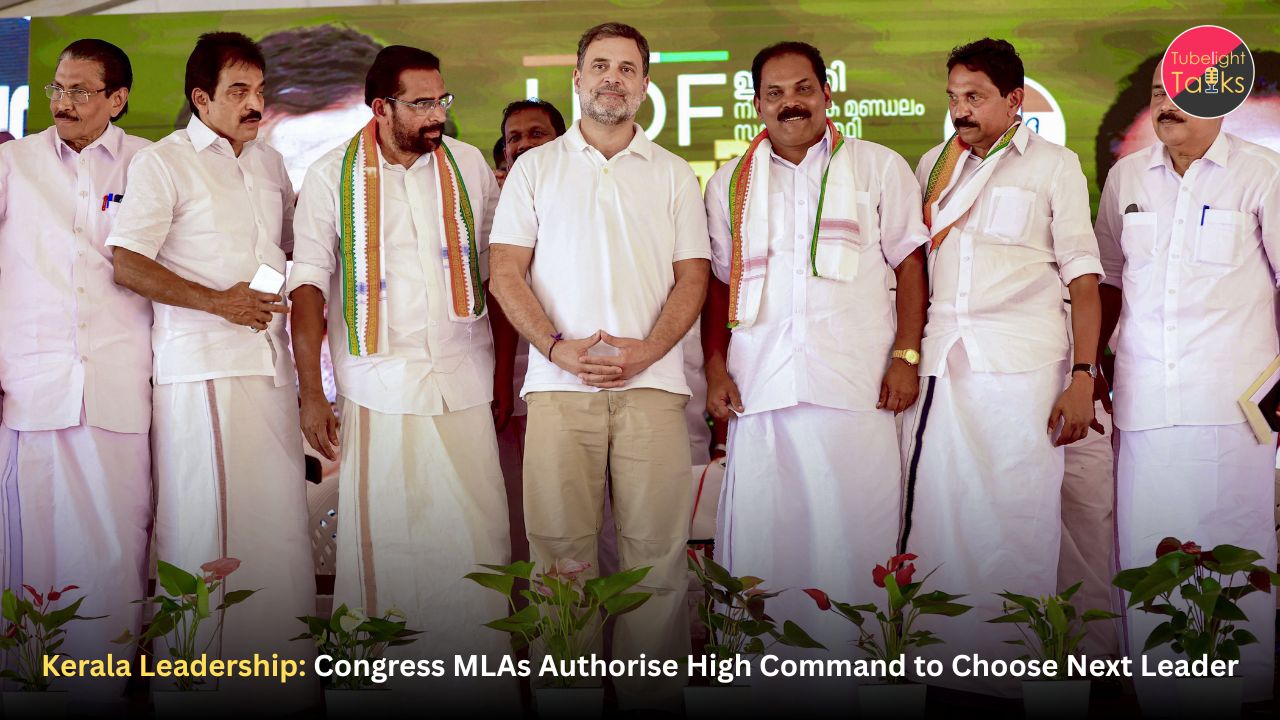
Kerala Leadership: Newly Elected Congress MLAs Authorise High Command to Choose Next Leader
Kerala Leadership: The newly elected Congress MLAs in Kerala have passed a unanimous one-line resolution authorising the party high command to choose the next Congress Legislature Party leader, clearing the way for the central leadership to decide who will lead the new United Democratic Front government. The resolution was passed after the Congress Legislature Party meeting in Thiruvananthapuram, following the UDF’s major victory in the Kerala Assembly elections.
AICC observers Mukul Wasnik and Ajay Maken held consultations with newly elected MLAs and senior alliance leaders before submitting their findings to the party leadership in Delhi. The leading names in discussion include K. C. Venugopal, V. D. Satheesan and Ramesh Chennithala. The final decision is now expected from Congress president Mallikarjun Kharge and the high command.
Kerala Congress Legislature Party Meeting: What Happened?
One-Line Resolution Passed Unanimously
The Congress Legislature Party in Kerala passed a one-line resolution authorising the party high command to choose the CLP leader. Congress observer Ajay Maken confirmed that the entire CLP unanimously passed the resolution and handed over a copy to the leadership. This follows the Congress tradition in many states where newly elected MLAs formally leave the final leadership choice to the central leadership after internal consultations.
The resolution is short, but its political importance is large. It prevents a public vote or open factional contest among MLAs and allows the central leadership to balance regional representation, seniority, electoral message, coalition stability and national strategy.
In Kerala, where Congress politics has historically involved strong factional currents, such a resolution helps avoid immediate confrontation. It also gives the high command room to speak to allies, assess public mood and decide which leader can best run the new government.
AICC Observers Hold One-on-One Talks
AICC observers Mukul Wasnik and Ajay Maken met MLAs individually and recorded their views. Maken said the observers held one-to-one discussions, noting not only preferred names but also broader concerns and suggestions expressed by the legislators. The report has been submitted to the party high command.
This individual consultation process matters because it gives MLAs a chance to speak privately. In a public meeting, legislators may hesitate to reveal their real preferences due to factional pressure. One-on-one discussions allow observers to understand the actual balance of support inside the party.
The observers also met senior leaders and UDF allies as part of the government-formation process. The next Chief Minister will not only lead Congress MLAs but also head a coalition government, so alliance confidence is essential.
Also Read: Kerala Trends Point Toward Possible Power Shift as UDF Moves Ahead of LDF
Who Are the Main Contenders?
K. C. Venugopal
K. C. Venugopal, Congress general secretary and a close figure in the party’s national organization, is being discussed as a major contender. NDTV reported that sources said a majority of Congress MLAs were backing Venugopal for the Chief Minister’s post.
Venugopal’s strength is his central position in the Congress organization. He has experience in national-level coordination, parliamentary politics and party management. If chosen, it would signal strong central leadership control over the Kerala government.
However, his selection could also raise questions because he has been deeply involved in national party responsibilities. The high command would need to weigh whether moving him to Kerala strengthens the state government or weakens the party’s national machinery.
V. D. Satheesan
V. D. Satheesan, the outgoing Leader of Opposition, is another strong name. He led the opposition campaign in the Assembly and has been a prominent face against the previous LDF government. Hindustan Times reported that Satheesan, Venugopal and Ramesh Chennithala are among the top contenders.
Satheesan’s supporters argue that he worked at the state level, challenged the LDF government directly and represents a modern, assertive Congress image in Kerala. As Leader of Opposition, he built visibility among voters and party workers.
His challenge may be internal balancing. Kerala Congress has several senior figures, and Satheesan’s elevation would require careful handling of other factions.
Ramesh Chennithala
Ramesh Chennithala, a veteran Congress leader and former Leader of Opposition, remains an experienced contender. He has deep organizational roots, government experience and long-standing influence in Kerala politics.
Chennithala’s supporters may see him as a seasoned administrator and consensus figure. His critics may argue that the party should move toward a generational shift after the UDF victory.
The final decision may therefore involve not only who has the most MLAs but also who can balance experience, public appeal, party unity and coalition management.
Also Read: South India Political Earthquake: Tamil Nadu and Kerala Election Results 2026
Why the High Command Has a Difficult Choice
UDF Victory Raises Expectations
The Congress-led UDF’s victory has created high public expectations. Voters have not merely changed a government; they have given the alliance responsibility to deliver on governance, economic revival, welfare, employment, education, health and social harmony.
The next Chief Minister must move quickly from political victory to administrative performance. Kerala’s electorate is politically aware and demanding. A government that appears divided early may lose momentum.
Factional Balance Matters
Congress in Kerala has historically been shaped by factional alignments. The central leadership must avoid a decision that creates resentment among senior leaders, MLAs or district groups. Even if one leader becomes Chief Minister, others may need meaningful cabinet roles or organizational responsibilities.
The one-line resolution gives the high command authority, but authority must be used carefully. A decision imposed without emotional management can create future instability.
UDF Allies Must Be Comfortable
The Congress cannot govern alone if the UDF coalition is central to the mandate. Allies such as the Indian Union Muslim League and Kerala Congress factions will watch the leadership decision closely. Earlier, IUML leader M. K. Muneer clarified that the party had not backed any specific Congress leader and trusted Congress to make a unified decision.
This gives Congress flexibility, but it also places responsibility on the party to choose a leader who can coordinate well with allies.
The Role of Mallikarjun Kharge and Delhi Leadership
Final Decision With Congress President
Congress president Mallikarjun Kharge is expected to play the decisive role after receiving reports from AICC observers. Deccan Chronicle reported that newly elected Congress MLAs passed a resolution asking Kharge to decide the next Chief Minister, with observers returning to Delhi to submit their report.
Kharge’s decision must account for MLA preference, alliance stability, Kerala’s social balance, party revival, national optics and future parliamentary politics. The choice will be watched beyond Kerala because it could indicate how Congress balances state leadership with central authority.
Delhi Meeting Expected
Economic Times reported that the AICC was in a tight spot over the Kerala CM post and scheduled a meeting in Delhi on Saturday to deliberate. The report noted that Venugopal and Satheesan were both holding firm in the leadership race.
This indicates that the decision may not be simple. The leadership must avoid a prolonged delay, but it must also prevent a rushed decision that leaves factions unhappy.
Why Kerala Leadership Matters Nationally
Congress Needs a Model State
For Congress, Kerala can become an important governance showcase. The party has struggled nationally in recent years, and a strong UDF government in Kerala could help Congress project administrative credibility, welfare delivery and coalition management.
The Chief Minister chosen now will therefore carry more than state responsibility. He may become part of Congress’s national argument that the party can govern effectively.
Kerala’s Political Cycle
Kerala has long seen alternation between the UDF and LDF. A UDF victory after a long gap raises questions about whether Congress can convert anti-incumbency into sustained public trust. The new leadership will need to show competence quickly.
Development and Social Balance
Kerala has strong human-development indicators but faces economic challenges, unemployment concerns, migration pressures, aging population issues, climate vulnerability, coastal erosion, higher-education reforms and public-finance constraints. The next Chief Minister must understand both welfare politics and growth policy.
Key Challenges Before the New Leader
Employment and Youth Migration
Many young Malayalis continue to seek education and jobs outside the state or abroad. The new government will need to create better opportunities in IT, tourism, healthcare, education, startups, logistics, creative industries and green economy sectors.
Fiscal Management
Kerala’s public finances have been under pressure. Welfare commitments, salaries, pensions, infrastructure spending and borrowing limits will require careful balancing. The new Chief Minister must combine welfare sensitivity with financial discipline.
Climate and Disaster Preparedness
Kerala has faced floods, landslides, coastal erosion and extreme rainfall in recent years. Climate resilience, river management, urban drainage, hill-area safety and coastal protection must remain high priorities.
Public Health and Education
Kerala’s health and education systems are strong, but they need modernization. The government must improve hospital capacity, medical staffing, public schools, higher education quality and skill development.
Coalition Stability
The Chief Minister must keep the UDF together. Cabinet allocation, policy consultation and respect for allies will matter from the first week itself.
What Happens Next?
High Command Decision
The immediate next step is the Congress high command’s decision. The observers’ report, MLA consultations and alliance feedback will guide the final call.
CLP Leader Announcement
Once the leader is chosen, the Congress Legislature Party will formally accept the decision, and the UDF will move toward government formation.
Governor Meeting and Swearing-In
After leadership is finalized, the UDF will stake claim before the Governor. The swearing-in ceremony will follow once the Governor invites the leader to form the government.
Cabinet Formation
After the Chief Minister is chosen, attention will shift to cabinet composition. Congress will need to balance regions, communities, experience, youth, women’s representation and alliance claims.
Leadership, Humility and the SatGyaan Message
The Kerala leadership decision shows that power should not become a struggle of ego, but a responsibility of public service. JagatguruRampalJi.org explains that Sant Rampal Ji Maharaj strictly opposes corruption, stealing and dishonesty, and teaches that people must maintain good karmas and avoid acts that create negative consequences.
The same official source also says He advocates humility and honesty at work, where employers should treat employees with respect and employees should perform duties with integrity. This SatGyaan is directly relevant to political leadership: the Chief Minister’s chair is not a reward for ambition, but a duty toward citizens. When leaders act with humility, honesty and fear of wrongdoing, governance becomes service. When ego, factionalism and greed dominate, public welfare suffers.
Sant Rampal Ji Maharaj’s teachings guide society toward truth, moral discipline, peace, brotherhood and devotion to Supreme God Kabir. Kerala’s next leader, whichever name the Congress high command chooses, will be judged not by factional victory but by service, justice, transparency and compassion toward the people.
FAQs on Kerala Leadership Decision
1. What did the newly elected Congress MLAs in Kerala decide?
They unanimously passed a one-line resolution authorising the Congress high command to choose the next Congress Legislature Party leader.
2. Who confirmed the resolution?
Congress observer Ajay Maken confirmed that the entire CLP passed the resolution and handed over a copy to the leadership.
3. Who are the main contenders for Kerala Chief Minister?
The main names in discussion include K. C. Venugopal, V. D. Satheesan and Ramesh Chennithala.
4. Who will take the final decision?
The final decision will be taken by the Congress high command, led by party president Mallikarjun Kharge, after reviewing observers’ reports and MLA feedback.
5. Did the observers meet MLAs individually?
Yes. AICC observers held one-on-one discussions with MLAs and recorded their views before submitting the report to the high command.
6. Why is the Kerala leadership decision important?
It will determine who leads the new UDF government and how Congress manages governance, coalition balance, party unity and public expectations after its election victory.
Related Stories




Discussion (0)