Shocking US Canada Trade Dispute Escalates with 50% Tariffs
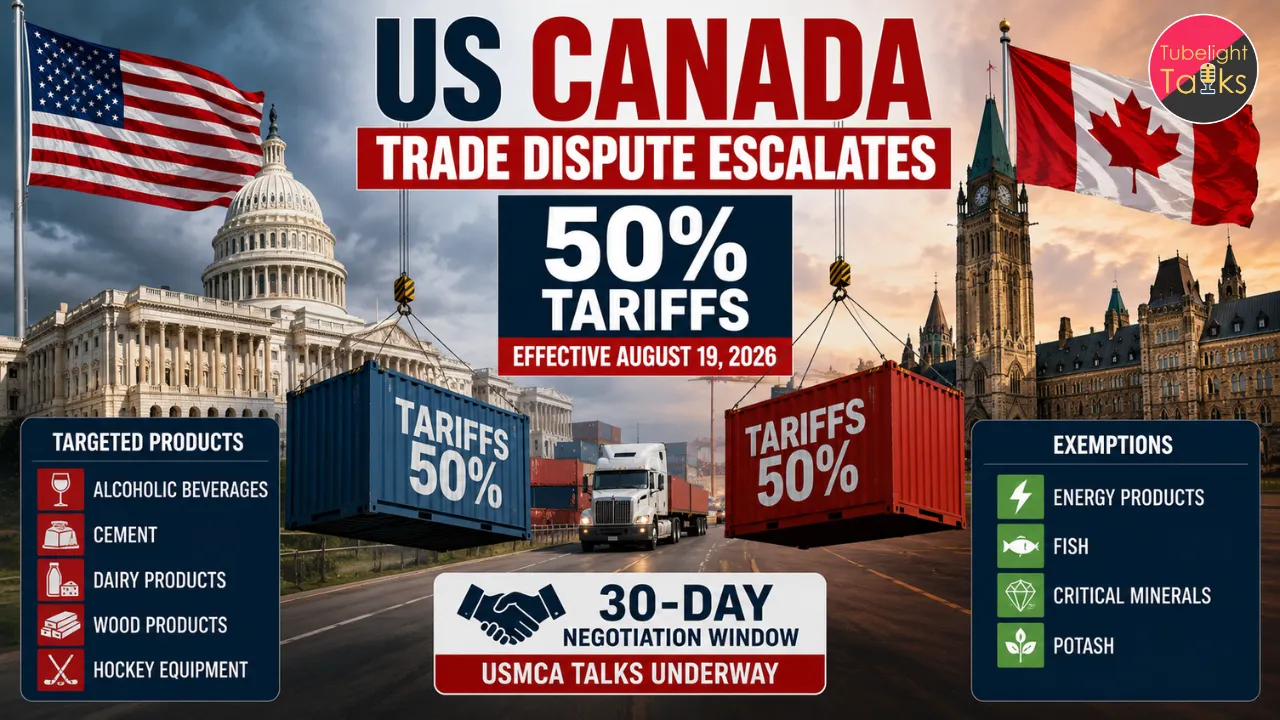
The US Canada trade dispute entered a volatile new phase in July 2026 after the US administration signed proclamations to levy a 50% tariff on select Canadian goods. Invoking Section 338 of the Tariff Act of 1930—a legal provision that has remained largely untested in modern trade governance—the measures target a wide assortment of products. These include alcoholic beverages, cement, dairy items, wood products, and hockey equipment.
The White House stated the tariffs are designed to hold Ottawa accountable for alleged “discriminatory treatment” and market access restrictions on US automobiles, alcohol, and agricultural goods.
Targeted Sectors and the 30-Day Negotiation Window
Impact of the US Canada Trade Dispute on Key Sectors
The newly announced duties cover roughly 5% of Canadian exports to the United States, specifically targeting sectors where demand is highly sensitive to price changes. Notably, the orders explicitly exclude vital energy commodities, critical minerals, and potash to prevent immediate supply chain shocks for US domestic industries.
Also Read: Major Ukraine Military Shakeup: Zelenskyy Sacks Syrskyi, Appoints Drapatyi
However, the tariffs remove exemptions for items previously protected under the United States-Mexico-Canada Agreement (USMCA). With a built-in 30-day delay before the duties take effect on August 19, 2026, trade officials and economists view the measure as a high-leverage tactic to accelerate broader USMCA modernization talks as the US Canada trade dispute unfolds.
US–Canada Tariff & Economic Impact Matrix (July 2026)
| Operational Variable | Disclosed Details & Scope |
| Tariff Rate & Legal Authority | 50% duty under Section 338 of the Tariff Act of 1930. |
| Implementation Date | 30-day grace period; effective August 19, 2026. |
| Targeted Export Products | Wine/spirits, cement, dairy, timber, and hockey gear. |
| Explicit Product Exemptions | Energy products, fish, critical minerals, and potash. |
Economic Consequences of the US Canada Trade Dispute
Economists caution that the proposed tariffs could have far-reaching consequences for manufacturers, retailers, and consumers across both countries. The financial repercussions of the US Canada trade dispute could extend across integrated North American supply chains—including construction, agriculture, consumer goods, and sporting equipment.
Industries relying on cross-border trade may experience higher production costs and price volatility if negotiations fail before the implementation deadline. Financial markets are also closely monitoring the dispute for its potential impact on regional investment and cross-border trade flows.
Response From Ottawa and Business Leaders
Canadian Prime Minister Mark Carney responded to the announcement by reiterating that Ottawa stands prepared to “intensify” talks with Washington to resolve outstanding trade friction. Carney emphasized that Canada’s past measures were proportionate responses to unilateral US trade actions that violated core USMCA principles.
Also Read: War Costs Soar: US-Iran Conflict Escalates with $37.5 Billion Tab
Meanwhile, business associations on both sides of the border have urged fast-track diplomatic engagement during the 30-day window. Stakeholders affected by the US Canada trade dispute are calling for a fast resolution to avoid cost increases for consumers and severe supply chain disruptions.
Future of USMCA Negotiations
Trade analysts believe the next month will be critical for determining the future direction of North American economic cooperation. Diplomatic teams from Washington and Ottawa are expected to continue intensive negotiations in an effort to resolve market access concerns before the tariffs take effect.
Observers note that a negotiated settlement could preserve the stability of the USMCA framework. Conversely, failure to reach an agreement may encourage retaliatory measures and prolong uncertainty for businesses operating across the continent.
Service, Humility and Public Duty
The ongoing economic disputes and tariff standoffs between neighboring nations serve as a reminder of the instability created when trade policies are driven by national rivalry and commercial friction. Sant Rampal Ji Maharaj’s spiritual guidance teaches that material wealth and economic dominance offer no permanent security.
SatGyan reveals that societal harmony and genuine prosperity are realized when leaders approach public duty with deep humility, rejecting commercial greed and acting with transparent fairness for the collective well-being of all people.
FAQs on the US Canada Trade Dispute
What started the recent US Canada trade dispute in July 2026?
The US Canada trade dispute escalated after the US administration announced 50% tariffs on select Canadian imports, citing alleged market access restrictions and discriminatory practices against American goods.
Which products are affected by tariffs in the US Canada trade dispute?
Affected goods include alcohol, cement, dairy products, timber, and hockey equipment. Essential energy commodities, fish, critical minerals, and potash are explicitly exempted.
When do the new 50% tariffs take effect?
The tariffs are set to take effect 30 days after the initial announcement, on August 19, 2026.
Which legal provision was used to order the new tariffs?
The US administration invoked Section 338 of the Tariff Act of 1930 to order the new duties.
How are leaders responding to the escalating US Canada trade dispute?
Canadian Prime Minister Mark Carney stated that Canada is prepared to intensify bilateral talks while defending its trade rights, while business leaders across North America are pushing for a diplomatic compromise.
Related Stories










Discussion (0)