War Costs Soar: US-Iran Conflict Escalates with $37.5 Billion Tab
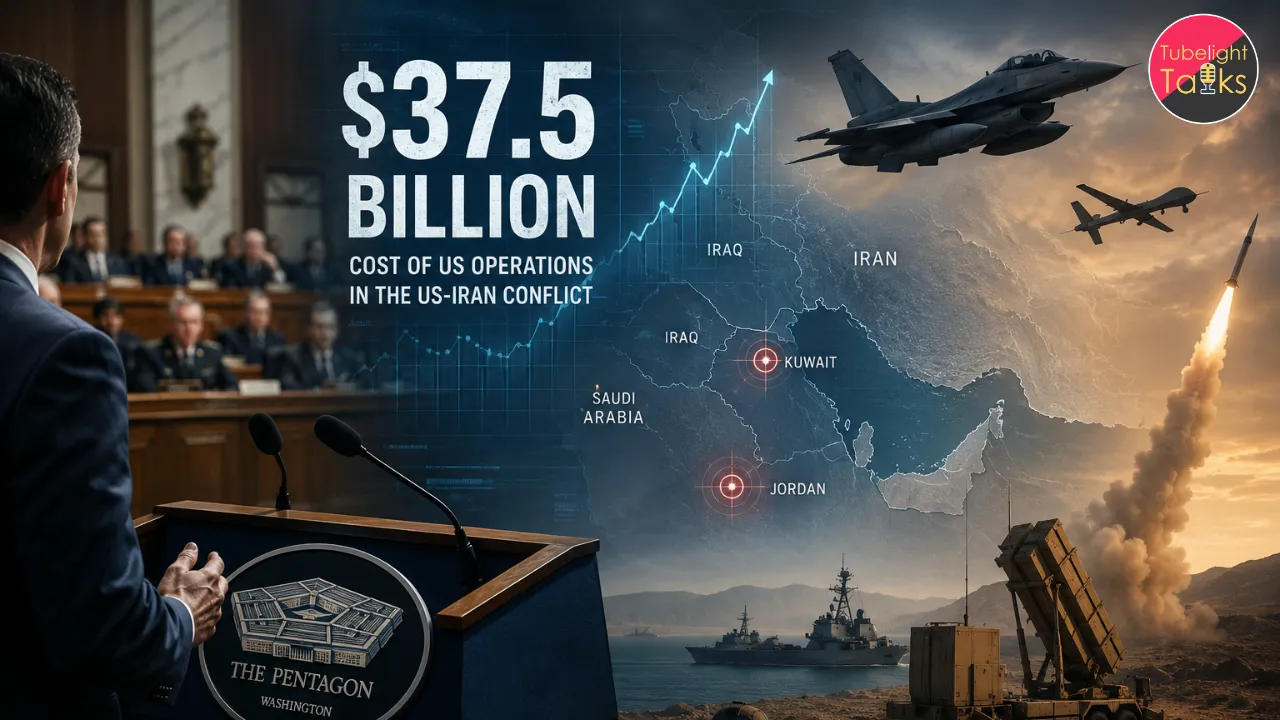
The US-Iran conflict has reached a critical fiscal and operational threshold in July 2026. Appearing before the Senate Appropriations Committee in Washington, US Defense Secretary Pete Hegseth revealed that American military operations against Iranian targets have cost approximately $37.5 billion so far.
Accompanied by Chairman of the Joint Chiefs of Staff General Dan Caine, Hegseth defended a massive $67 billion supplemental funding request. This crucial package aims to replenish depleted precision munitions, sustain naval deployments, and maintain operational readiness across West Asia.
The testimony comes amid escalating night strikes and retaliatory salvoes across the Persian Gulf. US installations and allied airspaces in Jordan and Kuwait face persistent drone and missile targeting as the US-Iran conflict intensifies.
Escalating Regional Hostilities in the US-Iran Conflict
Base Targeting Across Kuwait and Jordan
Despite extensive air and naval campaigns executed by US and allied forces, Iranian missile units and regional proxy networks continue to project significant strike capability. Regional military hubs have sustained repeated night-time drone swarms and ballistic missile fire.
Also Read: BRICS Expansion 2026 The Expanded 11-Nation Bloc Reshapes Global Economic Order
These targeted areas include critical staging facilities and forward operating bases in Jordan and Kuwait. The Pentagon confirmed that 18 American service members have lost their lives since the resurgence of open hostilities. Roughly 430 personnel have been injured, highlighting the evolving tactical risk faced by forward-deployed coalition forces.
In response to sustained threats, coalition air defense batteries, including Patriot and THAAD interceptors, have been operating at maximum operational tempo across the Arabian Peninsula. However, the high expenditure rate of specialized air defense interceptors and long-range cruise missiles has raised serious concerns. Military logistics planners are now questioning long-term inventory sustainability.
Growing Concerns Among US Allies
The expanding US-Iran conflict has heightened security concerns among Washington’s regional allies. Governments across the Gulf have strengthened the protection of strategic energy infrastructure, ports, and airbases. They fear that continued missile and drone attacks could spill over into neighboring territories.
Regional defense coordination has intensified significantly. Intelligence sharing and joint surveillance operations are increasing to detect potential threats before they reach critical civilian and military assets.
Military analysts note that prolonged instability could compel additional US force deployments and extended naval patrols in the Persian Gulf. Such measures would likely increase operational expenditures and place additional strain on military personnel already engaged in sustained high-tempo operations.
Pentagon Financial & Operational Metrics (July 2026)
| Financial / Operational Indicator | Disclosed Value & Scope |
| Current Conflict Expenditure | $37.5 Billion cumulative (including projected costs through Sept. 30). |
| Requested Supplemental Funding | $67.1 Billion total earmarked for Iran operations & readiness. |
| Munitions & Readiness Allocation | $21 Billion for readiness/replenishment; $46 Billion for production & capability. |
| US Casualty Report | 18 service members killed; ~430 injured in theater operations. |
Political Friction Over the US-Iran Conflict on Capitol Hill
Debate Over War Powers and Budget Allocation
The disclosure of the $37.5 billion price tag has triggered sharp political debate in the US Congress. Lawmakers from both parties expressed growing frustration over rising costs tied to the US-Iran conflict and the absence of a clear diplomatic exit strategy.
Democratic senators, led by Appropriations Committee Vice Chair Patty Murray, voiced strong opposition. They warned against “rubber-stamping” multi-billion dollar supplemental requests without explicit congressional authorization or defined strategic objectives.
Conversely, Pentagon officials emphasized that failing to pass the funding package would severely impair basic military readiness. The Department of Defense would be forced to curtail routine training exercises and delay essential fleet maintenance schedules. General Caine cautioned that long-term operational resilience depends on rapidly scaling up domestic production lines for solid rocket motors, hypersonic systems, and counter-drone technologies.
Global Energy and Supply Chain Vulnerabilities
The financial shockwaves of the US-Iran conflict extend far beyond Capitol Hill budget hearings. Commercial transit through the Strait of Hormuz remains heavily disrupted due to active missile threats and naval blockades.
Consequently, global crude oil futures and maritime insurance premiums have experienced extreme volatility. Energy analysts warn that prolonged operational standoffs in West Asia could trigger secondary inflationary pressures across international markets. This reality complicates global trade recovery and tests the economic resilience of major import-dependent nations.
Diplomatic Efforts Face Mounting Challenges
While military operations continue, international diplomatic efforts to reduce tensions remain active but face significant obstacles. Several global powers and regional organizations have called for an immediate ceasefire and renewed negotiations.
Also Read: South China Sea Flashpoint: 14-Nation Coalition Reaffirms 2016 Ruling as Tensions Surge
They warn that a prolonged US-Iran conflict could destabilize the broader Middle East and disrupt global economic growth. However, ongoing exchanges of missile strikes and retaliatory operations have made confidence-building measures increasingly difficult to implement.
Security experts argue that the coming weeks will be crucial. They will determine whether the conflict shifts toward broader regional escalation or returns to diplomatic engagement. The outcome will likely influence international energy markets, defense spending priorities, and geopolitical alignments across West Asia for years to come.
Service, Humility and Public Duty
The staggering financial cost and tragic loss of human life in modern warfare serve as a sobering reminder of the limitations of worldly power and strategic dominance. Sant Rampal Ji Maharaj’s spiritual guidance teaches us that true security, lasting peace, and genuine prosperity can never be achieved through the destruction of life or the expenditure of massive wealth on weaponry.
SatGyan reveals that geopolitical conflicts burn out of control when national leadership allows pride, territorial ambition, and retaliatory anger to dictate public policy. According to the eternal spiritual laws of Supreme God Kabir, ultimate global stability is realized only when leaders and citizens approach governance with profound humility.
Society must recognize the sacred value of every human life. Prioritizing selfless service, transparent duty, and spiritual truth over physical dominance remains the only path to enduring peace.
FAQs on the Escalating US-Iran Conflict
What is the current total cost of operations in the US-Iran conflict as of July 2026?
US Defense Secretary Pete Hegseth reported to Congress that military operations in the US-Iran conflict have cost $37.5 billion so far, including anticipated costs through September 30.
How much supplemental funding is the Pentagon seeking from Congress?
The Pentagon is requesting $67.1 billion in supplemental war funding. This includes $21 billion earmarked for military readiness and $46 billion for capability expansion and munitions replenishment.
Which regional allied territories have seen active drone and missile targeting?
US bases and allied installations across Jordan and Kuwait have experienced repeated drone swarms and missile strikes.
What casualties have US forces reported in the ongoing US-Iran conflict?
The Pentagon reported that 18 US service members have been killed and approximately 430 injured since hostilities escalated in the US-Iran conflict.
What operational impacts could occur if supplemental funding is delayed?
Defense officials warned that without urgent funding, military training exercises would need to be curtailed, and long-term fleet maintenance delayed.
Related Stories









Discussion (0)