Vital Impact of the MSME Development Amendment Bill 2026 Passed by Parliament
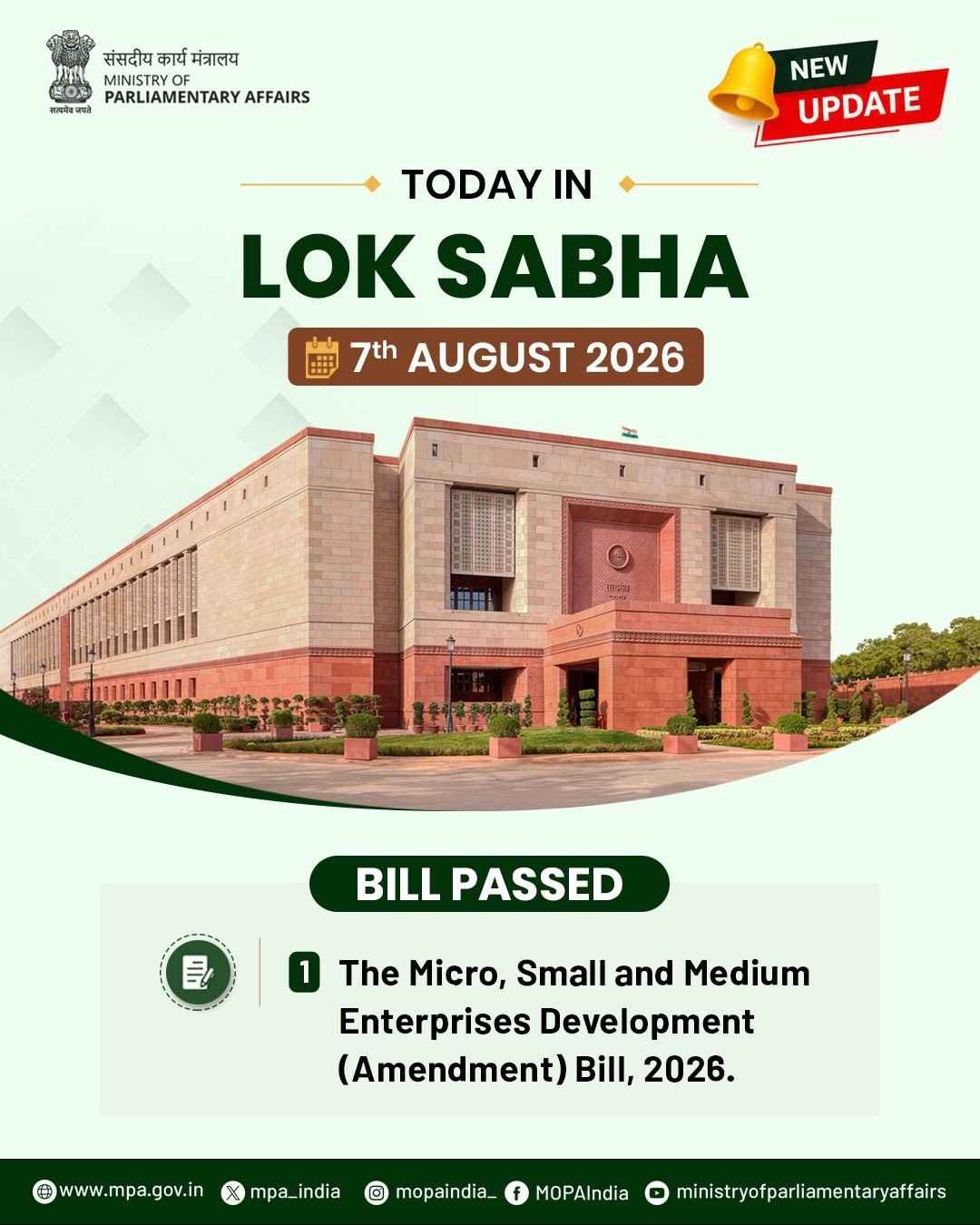
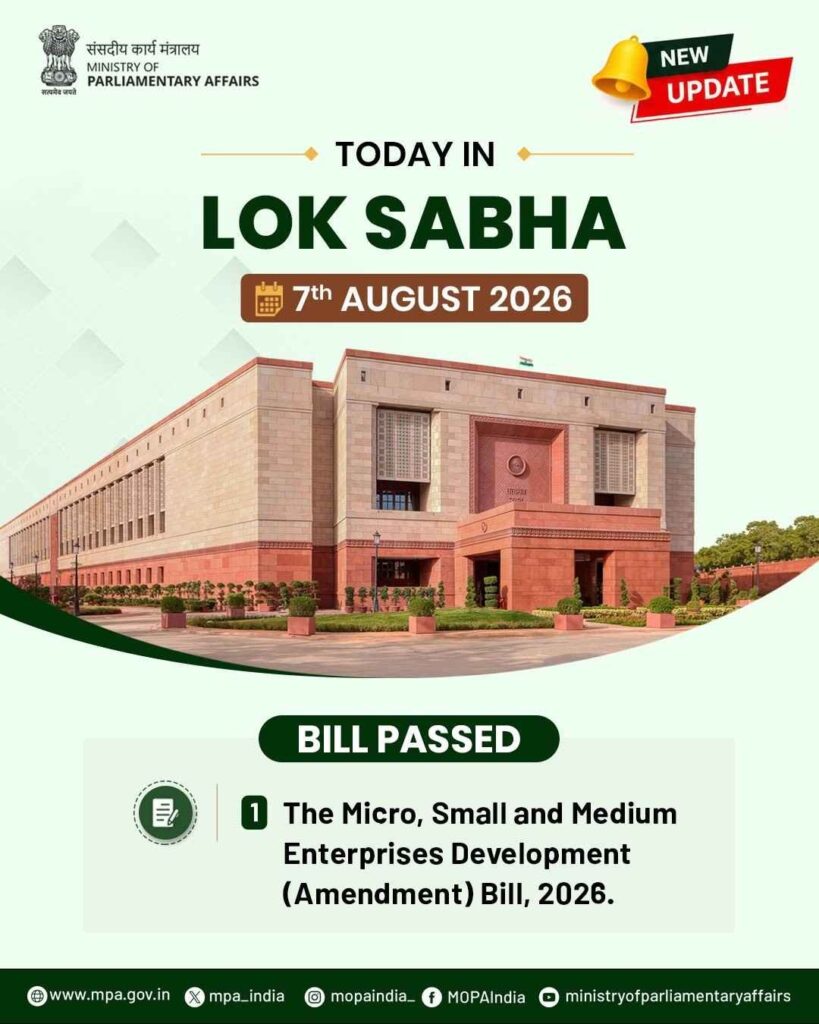
The highly anticipated MSME Development Amendment Bill 2026 passed by Parliament has officially become a reality, promising a major structural overhaul for small businesses across India. Cleared by the Rajya Sabha on August 3 and subsequently by the Lok Sabha on August 7, 2026, this vital legislation seeks to eradicate the chronic issue of delayed payments.
Small business owners have long struggled with severe liquidity crunches due to trapped capital and inefficient payment cycles. This legislative update aims to completely dismantle those operational hurdles. By enforcing strict mediation timelines and introducing mandatory digital platforms, the government is reinforcing the economic backbone of the nation.
Also Read:Lok Sabha Passes Bill Enabling Changes to UPI Charges and Digital Payment MDR Framework
Understanding the MSME Development Amendment Bill 2026
The micro, small, and medium enterprise sector is universally acknowledged as a primary growth engine for the nation’s gross domestic product. However, outdated regulations from the original 2006 Act failed to keep pace with rapid digital transformation and complex modern supply chains. The introduction of the MSME Development Amendment Bill 2026 was driven by the urgent need to address systemic payment delays that stifle business expansion.
Union MSME Minister Jitan Ram Manjhi highlighted that outstanding credit to the sector has surged significantly. The credit guarantee extended to these enterprises has witnessed exponential growth, jumping from historical averages to over 10 lakh crore rupees in recent years. This underscores the administration’s aggressive intent to support industrial growth.
To modernize the ecosystem, the government is heavily leaning into digital infrastructure. The new framework empowers the central government to dynamically classify enterprises based on equipment investment and annual turnover, moving away from rigid statutory thresholds.
Key Economic Data and Implementation Timelines
Whenever significant policy shifts occur, understanding the raw data and chronological mandates is crucial for industry compliance. The table below outlines the core economic contributions of the sector and the strict new deadlines enforced by the government.
| Economic Metric & Legal Feature | Data Point / Mandated Timeline |
| National GDP Contribution | Approximately 31% of India’s GDP |
| National Manufacturing Output | Approximately 35% of Total Output |
| National Merchandise Exports | Nearly 48% of Total Exports |
| Mandated Mediation Timeline | Must be completed within 90 days of first appearance |
| Mandated Arbitration Timeline | Award required within 90 days of pleading completion |
| Minimum Payment on Appeal | 50% of awarded sum if dispute is pending over 6 months |
Also Read :Critical Impact of the FCRA Amendment Bill 2026 Revealed
Core Provisions of the MSME Development Amendment Bill 2026
The legislative text introduces several groundbreaking mechanisms designed to protect suppliers from exploitative corporate practices. One of the most celebrated features of the MSME Development Amendment Bill 2026 is the voluntary nature of digital registration, which removes bureaucratic red tape for emerging entrepreneurs.
- Digital Onboarding: Registration is now voluntary and facilitated through a highly efficient, unified central digital platform.
- TReDS Integration: Central Public Sector Enterprises (CPSEs) are legally bound to use the Trade Receivables Discounting System to guarantee faster settlements.
- Revenue Recovery: State governments are newly empowered to recover mediated settlement dues as arrears of land revenue.
- Graded Penalties: Minor compliance failures no longer invite immediate criminal charges, fostering a safer business environment.
Impact on Liquidity and Dispute Resolution
For decades, small-scale manufacturers have operated on razor-thin margins. When large corporate buyers delay invoice settlements, the resultant cash flow crisis can easily bankrupt a micro-enterprise. The amended legislation directly tackles this by institutionalizing the TReDS platform for all government sector buyers.
By mandating that all CPSEs settle procurement invoices through this RBI-regulated electronic system, suppliers gain immediate access to working capital. Financial institutions discount the invoices, ensuring the manufacturer is paid promptly while the buyer manages their own credit cycle.
Dispute resolution has traditionally been a protracted, expensive affair. Small enterprises rarely have the legal budgets required to sustain multi-year litigations against massive corporate entities. The new law imposes rigorous time-bound constraints: mediation must conclude within 90 days, and arbitration must be finalized within 90 days of pleadings.
Decriminalization Measures
Another massive relief for business owners is the shift away from criminalizing administrative errors. Historically, minor lapses in compliance could lead to severe legal harassment.
The amended framework replaces conviction-based penalties with a graded monetary fine system. First-time non-compliance offenses are met with warnings rather than aggressive legal action. This encourages entrepreneurs to focus on innovation and market expansion rather than living in constant fear of regulatory missteps.
Finding Ultimate Stability Beyond Economic Policies
The corporate world, frequently plagued by delayed payments, market volatility, and mounting debts, brings immense mental distress to business owners. While vital legislation and financial reforms provide necessary temporary economic relief, they cannot cure the deep-rooted anxieties of human existence.
Wealth, business deals, and economic policies only provide fleeting relief in this mortal realm. True prosperity, mental fortitude, and eternal peace can only be achieved by understanding the spiritual laws that govern our universe. This profound truth is beautifully captured in Kabir Sahib’s sacred Vani:
“Kabir, sab jag nirdhana, dhanvanta nahi koye |
Dhanvanta soi janiye, jaape Ram naam dhan hoye ||”
(The entire world is destitute; only those who possess the wealth of God’s Name are truly rich.)
Furthermore, holy scriptures like Bhagavad Gita Chapter 15 Verse 4 urge us to seek that Supreme God to attain eternal salvation, completely liberating us from the material world’s endless anxieties.
According to the sacred teachings of Sant Rampal Ji Maharaj, aligning our daily actions with the Supreme God (Kabir Sahib) ensures that all our worldly and spiritual needs are met seamlessly. By taking refuge in a true spiritual master, one can easily overcome financial hurdles and mental agonies. True spiritual knowledge (Tatvagyan) allows individuals to live a balanced, stress-free life while walking the guaranteed path to ultimate salvation. To learn more about securing genuine peace in this chaotic world, must read the holy book Way of Living.
For getting free copy of this book must click this link.
Factual FAQs on the MSME Development Amendment Bill 2026
1. What are the primary objectives of the MSME Development Amendment Bill 2026?
The legislation aims to address delayed payments, simplify dispute resolution mechanisms, mandate digital invoice settlements, and decriminalize minor compliance lapses to improve the overall ease of doing business.
2. How does the MSME Development Amendment Bill 2026 handle delayed payment disputes?
The bill introduces a strict 90-day timeline for concluding mediation. If arbitration becomes necessary, the arbitral award must be delivered within 90 days following the completion of the formal pleadings.
3. What is the mandate regarding the TReDS platform in the new law?
The legislation legally requires all Central Public Sector Enterprises (CPSEs) to settle their procurement invoices from suppliers exclusively through the RBI-regulated Trade Receivables Discounting System to ensure faster liquidity.
4. How does the bill protect suppliers during prolonged legal appeals?
If a corporate buyer challenges an arbitral award and the legal proceedings remain pending for more than six months, the court must order the immediate release of at least 50 percent of the awarded amount to the supplier.
5. Is registration strictly mandatory under the MSME Development Amendment Bill 2026?
No, the updated legislative framework makes the filing of the registration memorandum entirely voluntary for all micro, small, and medium enterprises, utilizing a newly established centralized digital platform.
Related Stories






Discussion (0)