Black Hole Star: The Discovery of MoM-BH-1 at Cosmic Dawn
An extraordinary black hole star observed at the dawn of cosmic time is changing what we know about the early universe.
Astronomers using NASA’s James Webb Space Telescope (JWST) detected an ultra-distant object named MoM-BH-1. This target existed just 660 million years after the Big Bang, during an epoch known as cosmic dawn.
In our chemistry lab experiments, we study how atoms absorb and emit light across different gas pressures. When light travels through dense atomic vapor, specific wavelengths get absorbed, leaving clear spectral fingerprints. Looking at MoM-BH-1 is like studying a giant chemical reaction in space.
The object does not behave like a standard galaxy or a typical quasar.
Instead, light from its center passes through a thick envelope of atomic hydrogen gas. This creates a distinct red glow caused by light scattering. Scientists published these findings in the journal Nature, marking a major milestone in deep-space research.
Decoding the Physics of a Black Hole Star
To understand a black hole star, we must look at how energy moves through gas.
In a normal star like our Sun, nuclear fusion at the core releases energy that pushes outward against gravity. In contrast, this hybrid object derives its energy from a central black hole pulling in nearby matter.
As material falls toward the center, friction and gravitational acceleration heat the gas to millions of degrees. This intense radiation blasts outward into a surrounding cloud of unburned hydrogen.
Also Read: New Imaging Technique Captures Matter in Trillionths of a Second
The gas density in this cloud exceeds 10⁹ particles per cubic centimeter. That is remarkably dense for interstellar space.
Black Hole Star Structure
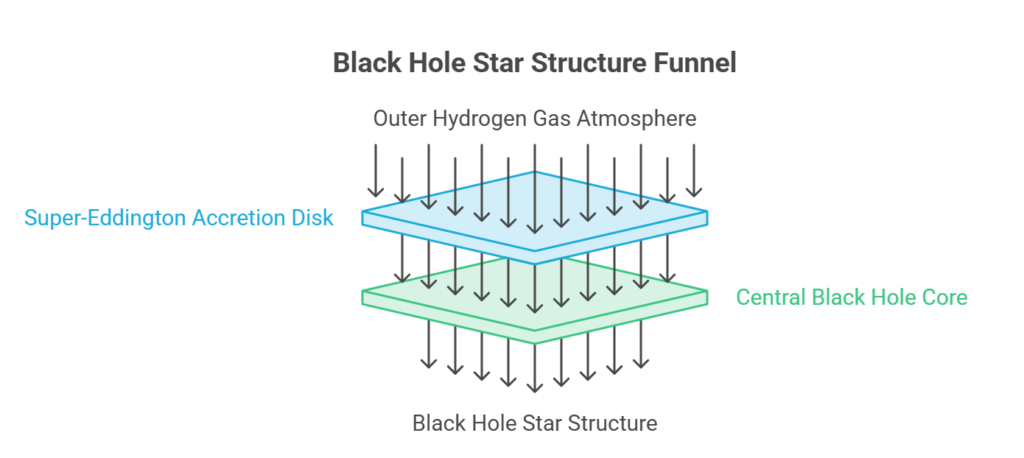
This dense gas layer acts like a pseudo-photosphere, similar to the outer surface of a supergiant star.
It absorbs short ultraviolet wavelengths and scatters longer red wavelengths. This process gives the object its unique spectral appearance.
Spectral Breakdown: Gas Envelope Versus Stellar Fusion
When we analyze light in a spectrometer, electron transitions leave exact signatures.
In MoM-BH-1 , researchers observed an exceptionally strong Balmer break. A Balmer break happens when electrons in hydrogen atoms jump from the second energy level (n = 2) to higher ionized states, absorbing photons shorter than 364.6 nanometers.
The strength of this Balmer break in MoM-BH-1 reached a value of 7.7. That number is far too high to be produced by normal star clusters alone.
Spectral modeling using synthesis codes shows that an accreting black hole embedded in turbulent hydrogen gas replicates this exact signature.gene
Data Comparison: MoM-BH-1 Versus Standard Cosmic Objects
To see why this discovery stands out, we can compare its physical measurements against typical early quasars and normal young galaxies observed at similar redshifts.
| Feature / Metric | MoM-BH-1 — Black Hole Star | Standard Early Quasar | Young Cosmic Dawn Galaxy |
| Primary Power Source | Central black hole accretion | Accretion disk | Stellar nuclear fusion |
| Reddening Mechanism | Hydrogen gas Rayleigh scattering | Heavy cosmic dust extinction | Interstellar dust |
| Gas Envelope Density | > 10⁹ cm⁻³ | < 10⁵ cm⁻³ | 10²–10⁴ cm⁻³ |
| Balmer Break Strength | ~7.7 — extreme non-stellar value | Very low / absent | ~1.5–2.5 — stellar |
| Central Black Hole Mass | ~100,000 solar masses | 10⁸–10⁹ solar masses | N/A or small |
| Accretion Regime | Super-Eddington growth rate | Standard Eddington limit | N/A |
How a Black Hole Star Solves Early Universe Mysteries
For years, astrophysicists faced a frustrating puzzle regarding how giant black holes formed so quickly.
Telescopes previously found supermassive black holes containing a billion solar masses just 700 million years after the Big Bang. Standard chemical and physical models showed that slow accretion could not feed a black hole fast enough to reach that size so early.
The discovery of a black hole star provides the missing physical step.
When a black hole is wrapped in a dense cloud of hydrogen, the surrounding gas acts as a direct fuel reservoir. This state allows super-Eddington accretion, where matter falls inward at rates far exceeding normal physical limits.
Rethinking the Little Red Dots in Early Cosmology
In recent JWST survey images, astronomers kept noticing strange red sources dubbed “Little Red Dots” (LRDs).
Researchers originally assumed these dots looked red because they were buried under thick layers of cosmic dust. Standard calculations used heavy dust-correction factors, leading to massive estimates for early black hole sizes.
However, spectral analysis of MoM-BH*-1 suggests that gas scattering, rather than dust, causes this intense redness.
Atomic hydrogen scatters blue light away while allowing red photons to pass through. This is the same chemical-physical principle that turns Earth’s sunsets red when sunlight passes through thick layers of air.
By suggesting that these objects can be dust-free gas envelopes, this discovery may affect earlier black-hole mass calculations and our understanding of cosmic evolution.
Beyond Cosmic Dust: Finding Eternal Truth in a Transient Universe
While advanced space telescopes allow us to peer billions of light-years into the physical universe, they also remind us of the temporary nature of material creation.
Scientists spend lifetimes tracking the lifecycles of stars, gas clouds, and black holes, yet material science can only observe outer physical manifestations. It cannot answer why creation exists or what lies beyond this physical realm.
In our world, human beings face constant hardships, uncertainty, and spiritual restlessness despite technological progress. The physical universe operates under temporary chemical reactions and decay.
According to the spiritual discourses of Sant Rampal Ji Maharaj, the ultimate goal of human life is to understand the true Creator and attain eternal salvation beyond the perishable cosmos.
Sant Rampal Ji Maharaj explains through sacred scriptures that our physical world is prone to destruction, while the supreme realm (Satlok) remains forever unchanged and free from suffering.
By connecting with authentic spiritual knowledge (Tattvagyan) and practicing dedicated devotion, one can transcend the cycles of birth and death.
Readers seeking lasting peace and answers to life’s deepest questions are invited to watch the spiritual discourses on the Official YouTube Channel of Sant Rampal Ji Maharaj.
Frequently Asked Questions (FAQs)
Q1. What is a black hole star discovered by JWST?
A black hole star is an early cosmic object containing a growing central black hole wrapped in a dense, star-like envelope of hydrogen gas. The surrounding gas acts like a stellar surface, scattering light and creating a red glow without relying on nuclear fusion.
Q2. How far away is object MoM-BH-1 in space and time?
Object MoM-BH-1 existed 660 million years after the Big Bang during cosmic dawn. Because light takes billions of years to travel across the expanding universe, JWST is observing this object as it appeared over 13 billion years ago.
Q3. Why is MoM-BH-1 reddened by gas instead of dust?
The extreme redness of MoM-BH-1 is caused by atomic hydrogen gas scattering light. High gas density surrounding the core scatters shorter blue wavelengths and passes longer red wavelengths, similar to how Earth’s atmosphere creates red sunsets.
Q4. What is a Balmer break in astronomical spectra?
A Balmer break is a sharp drop in light intensity at 364.6 nanometers caused by hydrogen electrons absorbing photons as they jump from the second energy level.
In MoM-BH-1 , an extremely strong Balmer break indicates light interacting with dense, turbulent gas clouds.
Q5. How does this discovery change our understanding of supermassive black holes?
It demonstrates that early black holes could grow rapidly through super-Eddington accretion inside dense gas clouds.
It also suggests that some distant red objects may be shrouded in gas rather than dust, potentially helping refine black-hole mass estimates in the early universe.
Related Stories










Discussion (0)