Green Hydrogen in India: Why It Matters for Clean Energy
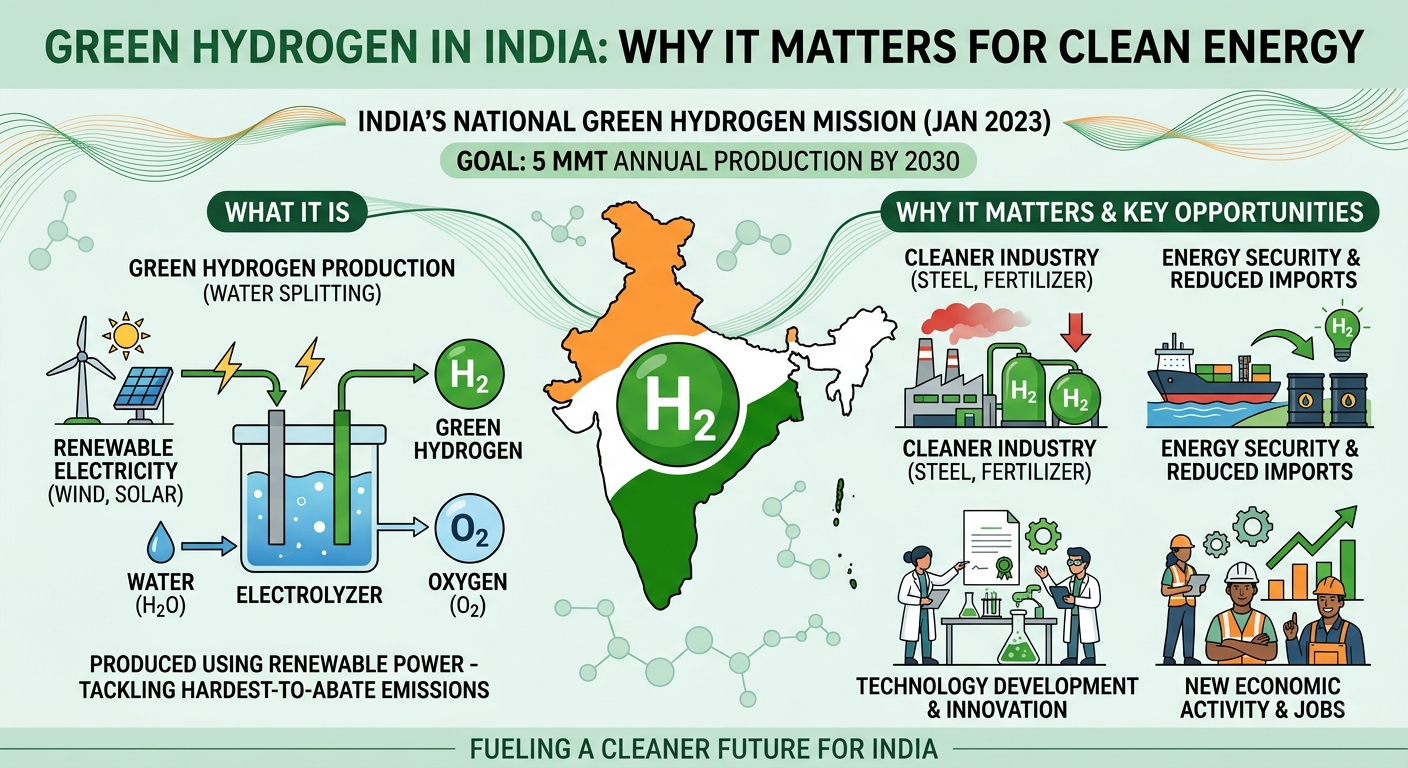
India’s clean-energy transition is entering a dynamic new phase, and Green Hydrogen in India is emerging as a foundational pillar of this transformation. Produced primarily by splitting water using renewable electricity, green hydrogen offers a viable mechanism to eliminate carbon emissions in sectors where direct electrification remains challenging. India formally launched the National Green Hydrogen Mission with a dedicated objective of establishing the country as a leading global hub for hydrogen production, utilization, and export.
The Mission targets at least 5 million metric tonnes (MMT) of annual green hydrogen production by 2030. Achieving this metric opens vast opportunities for industrial decarbonization, energy independence, advanced technology development, and widespread economic growth across the nation.
Also read :Major 2026 Alert: Will Renewable Energy Replace Fossil Fuels?
What Is Green Hydrogen in India?
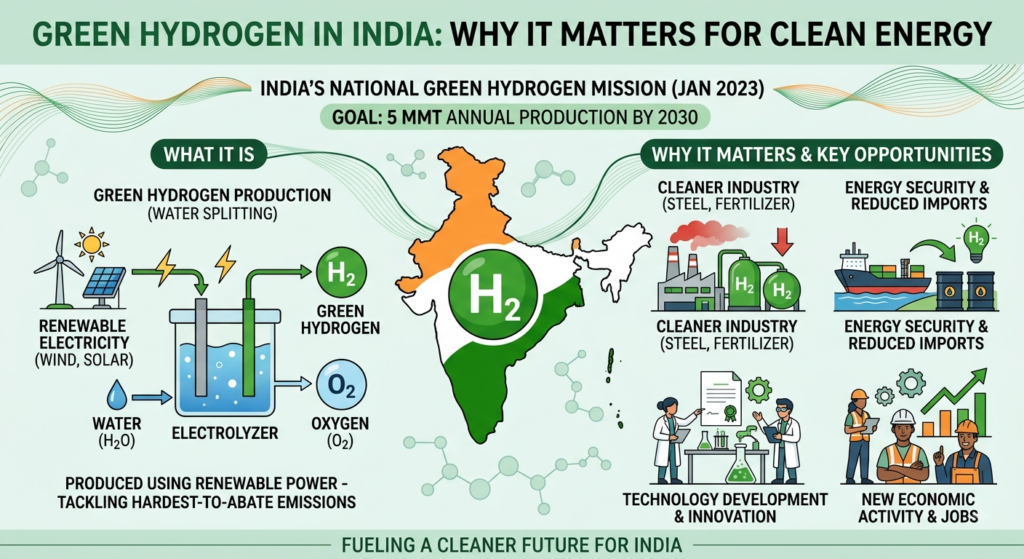
Hydrogen functions as a highly versatile energy carrier used across industrial manufacturing, synthetic fuels, and electricity generation. Green Hydrogen in India is produced when water is separated into hydrogen and oxygen through electrolysis powered by renewable sources such as solar and wind power. India also recognizes biomass-based production pathways within its official regulatory frameworks.
By leveraging expanding solar and wind infrastructure, the country can direct excess renewable generation toward hydrogen production. This integration strengthens domestic grid stability while providing zero-emission fuel for heavy industries that cannot easily rely on battery storage or direct power lines.
Why Does Green Hydrogen Matter for India?
India faces two critical energy mandates: satisfying rapidly expanding domestic energy demand and reducing long-term dependence on imported fossil fuels. With an established national commitment to reach net-zero carbon emissions by 2070, green hydrogen serves as a vital tool to align economic expansion with environmental protection.
| Key Energy Objective | Strategic Role of Green Hydrogen | Expected Impact by 2030 |
|---|---|---|
| Industrial Decarbonization | Replaces fossil-based gray hydrogen and coal in heavy manufacturing | Reduces industrial carbon footprint in steel & fertilizer units |
| Fossil-Fuel Independence | Substitutes imported natural gas and crude oil derivatives | Lowers energy import costs and builds domestic supply security |
| Renewable Energy Integration | Converts variable solar/wind power into storable chemical energy | Solves seasonal storage challenges and balances grid demand |
| Technology Leadership | Encourages domestic electrolyser manufacturing and R&D | Positions India as a global exporter of green equipment |
Supporting Industrial Decarbonization
Green Hydrogen in India provides a practical pathway to decarbonize hard-to-abate sectors such as steelmaking, chemical refining, and fertilizer manufacturing. By replacing conventional fossil-derived inputs with clean hydrogen, industrial producers can significantly reduce overall greenhouse gas outputs without sacrificing structural output quality.
Reducing Fossil-Fuel Dependence
Implementing a robust green hydrogen roadmap significantly strengthens national energy security. While it does not fully replace traditional fuel sources overnight, shifting strategic industrial processes toward locally generated hydrogen minimizes vulnerability to global energy price spikes and international supply chain disruptions.
Utilizing India’s Renewable Energy Potential
India possesses exceptional solar irradiance and strong wind corridors. However, renewable generation varies based on weather patterns and time of day. Green Hydrogen in India acts as an efficient energy storage medium, converting peak renewable electricity into a clean, transportable fuel that can be stored and used whenever industrial demand requires.
The core production lifecycle follows a streamlined operational flow:
Solar/Wind Energy → Electrolyser System → Green Hydrogen → Storage & Distribution → Industrial Utilization
Which Sectors Can Use Green Hydrogen in India?
Multiple commercial sectors stand to gain from the adoption of Green Hydrogen in India. Heavy manufacturing and long-distance transportation represent the primary adopters for initial commercial deployment:
- Steel Manufacturing: Replaces coal and natural gas in direct reduced iron (DRI) processes to yield low-carbon green steel.
- Fertilizer Production: Substitutes fossil-based gray ammonia with green ammonia derived from clean hydrogen.
- Petroleum Refining: Replaces grey hydrogen in hydrotreating and desulfurization processes within refinery complexes.
- Maritime & Heavy Mobility: Supplies green methanol and green ammonia to fuel long-distance shipping vessels and heavy freight trucks.
Job Creation in the Green Hydrogen Economy
The rapid development of Green Hydrogen in India extends well beyond simple gas production. It creates a comprehensive industrial value chain that requires skilled talent across several emerging engineering and operational fields.
Key employment drivers within the hydrogen ecosystem include:
- Equipment Manufacturing: Production of advanced electrolyser stacks, power electronics, and high-pressure storage tanks.
- Infrastructure Construction: Installation of specialized pipelines, distribution terminals, and renewable energy plants.
- Operations & Maintenance: Routine servicing of water purification facilities, safety networks, and automated control systems.
- Research & Certification: Safety testing, quality assurance protocols, and ongoing technology refinement.
Government initiatives associated with the National Green Hydrogen Mission incorporate targeted skill-building programs to ensure the workforce is equipped for high-tech operational environments.
Challenges Facing Green Hydrogen in India
Despite its immense potential, expanding Green Hydrogen in India presents structural hurdles that require sustained policy support and private investment:
- High Production Costs: Initial capital expenditure for advanced electrolysers and specialized power connections remains elevated compared to traditional fossil fuels.
- Infrastructure Gaps: Dedicated hydrogen pipelines, specialized storage units, and transport networks are still in early development stages.
- Resource Allocation: Hydrogen production requires pure water inputs, necessitating responsible water sourcing and desalination solutions in water-stressed regions.
- Regulatory & Safety Frameworks: Standardized safety rules, transportation codes, and certification systems must keep pace with rapid technical deployment.
The Future Outlook for Green Hydrogen in India
Green Hydrogen in India is transitioning rapidly from high-level policy formulation to commercial demonstration projects and industrial hubs. Ongoing pilot projects in green steel production, heavy mobility, and port-based green ammonia export terminals are laying the ground work for nationwide scale. As technological efficiencies drive down costs, hydrogen will become an increasingly competitive element of India’s broader clean energy matrix.
A Thought on Responsible Development
The global discussion surrounding clean energy technologies is fundamentally about how human society manages natural resources and technological innovation. The spiritual teachings associated with Sant Rampal Ji Maharaj emphasize disciplined living, ethical governance, environmental stewardship, and avoiding unnecessary harm to nature.
In the context of modern industrial advancement, these core principles encourage a balanced strategy—one that pursues technical excellence while maintaining deep respect for natural ecosystems and future generations. Green Hydrogen in India represents a powerful scientific tool, and its ultimate success will depend on how responsibly, ethically, and equitably it is integrated into society.
Also read : Awareness of Religious Hypocrisy
Frequently Asked Questions (FAQs)
1. What is the role of Green Hydrogen in India?
Green Hydrogen in India serves as a zero-emission energy carrier produced by splitting water molecules using renewable solar or wind power, enabling the decarbonization of heavy industries and transport systems.
2. What are the key goals for Green Hydrogen in India by 2030?
Under the National Green Hydrogen Mission, the primary goal for Green Hydrogen in India is to achieve an annual production capacity of at least 5 million metric tonnes (MMT) by the year 2030.
3. Which major industries will utilize Green Hydrogen in India first?
The main sectors utilizing Green Hydrogen in India include steel manufacturing, fertilizer production, petroleum refining, chemical processing, and international maritime shipping.
4. How does Green Hydrogen in India support energy independence?
By using domestic solar and wind energy to generate clean hydrogen, Green Hydrogen in India reduces reliance on imported fossil fuels like natural gas and crude oil, keeping energy expenditures within the domestic economy.
5. What are the biggest operational challenges for Green Hydrogen in India?
The primary challenges facing Green Hydrogen in India include high initial capital costs for electrolysers, limited specialized storage and pipeline infrastructure, and the need for sustainable water management.
Related Stories








Discussion (0)