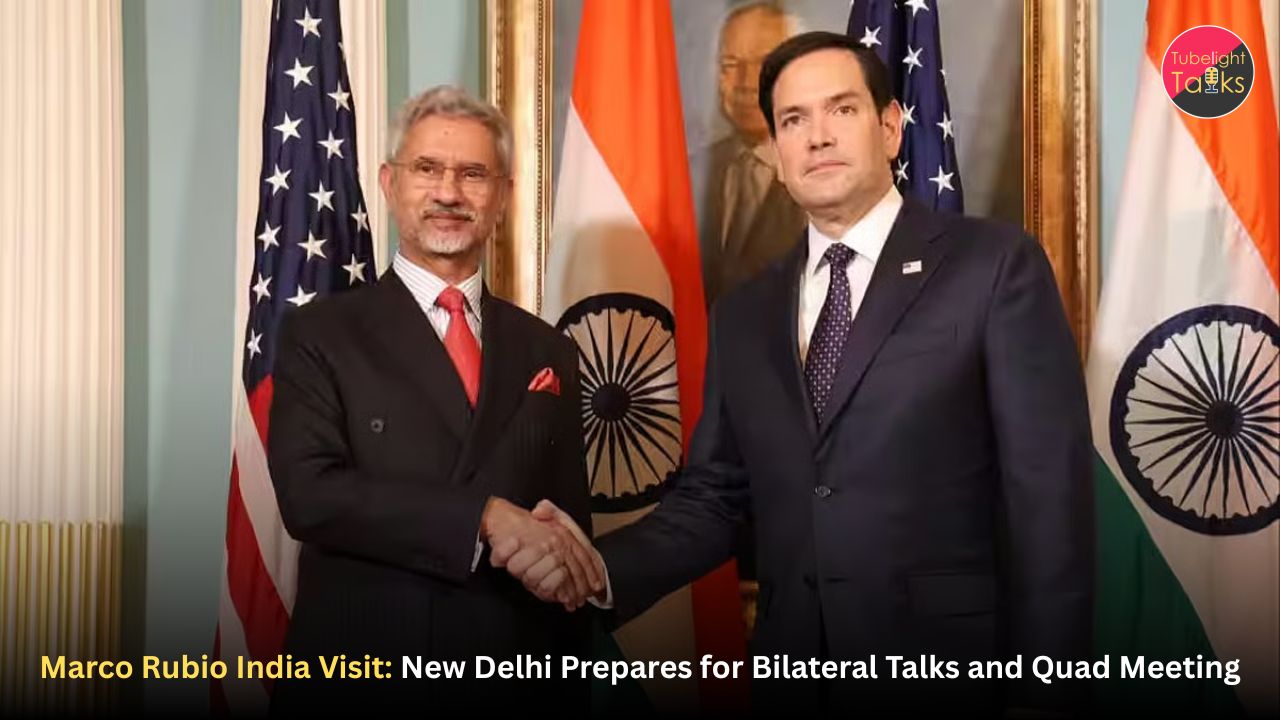
Marco Rubio’s India Visit: New Delhi Prepares for High-Stakes Bilateral Talks and Quad Diplomacy
US Secretary of State Marco Rubio is expected to arrive in New Delhi later this month for bilateral talks with Indian leaders and a Quad Foreign Ministers’ meeting involving India, the United States, Japan and Australia. The visit will be Rubio’s first official trip to India since taking charge as Secretary of State in President Donald Trump’s renewed administration.
It comes at a sensitive moment in global diplomacy, with the US-Iran crisis, China’s regional assertiveness, delayed trade negotiations, critical minerals competition and Indo-Pacific security all shaping the agenda. India is expected to use the visit to reinforce strategic autonomy while deepening cooperation with Washington on trade, defence, technology, energy and regional stability.
Marco Rubio’s India Visit: Why It Matters
First Official Trip to India as Secretary of State
Rubio’s expected India visit carries diplomatic weight because it is his first trip to the country as America’s top diplomat. Reports in April said US Ambassador Sergio Gor confirmed that Rubio looked forward to visiting India in May after meeting Foreign Secretary Vikram Misri in Washington. That meeting focused on bilateral ties, especially trade, critical minerals, defence and the Quad.
For New Delhi, the visit offers an opportunity to reset and stabilize relations after months of friction over tariffs, trade expectations, visa debates, energy policy and wider geopolitical pressures. For Washington, the visit is a chance to reassure India that the US still treats it as a central strategic partner in the Indo-Pacific.
Timing Before the Quad Ministerial
India is exploring or preparing to host a Quad Foreign Ministers’ meeting in New Delhi in late May, tied to Rubio’s visit. Reports said India had sounded out Japan and Australia about convening the meeting around May 26, while other reports described the Quad ministerial as expected in New Delhi in late May.
This timing matters because the Quad has faced questions over momentum. The long-delayed Quad summit and shifting priorities in Washington have created uncertainty. A foreign ministers’ meeting in India would signal that the grouping remains active and relevant.
Bilateral Agenda: Trade, Minerals, Defence and Energy
Trade Talks Near a Critical Stage
Trade is expected to be one of the most important subjects during Rubio’s visit. India and the US have been negotiating a broader trade arrangement while trying to resolve tariff-related disputes and market-access concerns. Earlier reports said both countries were working toward the goal of expanding bilateral trade to $500 billion by 2030.
For India, the challenge is to protect sensitive sectors while gaining better access for Indian exports, services, technology firms and manufacturing. For the US, the focus is likely to include lower tariffs, market access, energy purchases, digital trade, agriculture, medical devices and investment opportunities.
A successful visit could help move trade talks closer to conclusion. But any agreement must balance ambition with domestic political realities in both countries.
Critical Minerals and Supply Chain Security
Critical minerals are another key agenda item. These minerals are essential for electric vehicles, batteries, semiconductors, defence systems, clean energy equipment and advanced electronics. The US wants trusted supply chains outside overdependence on China, while India wants to strengthen its manufacturing and clean-energy ecosystem.
Rubio’s discussions with Indian officials are expected to build on earlier talks that included critical minerals, defence and the Quad.
This area is strategically important because future economic power will depend heavily on access to secure raw materials and processing capacity. India and the US could cooperate in exploration, refining, recycling, investment and technology transfer.
Defence and Indo-Pacific Security
Defence cooperation remains a core pillar of India-US ties. The two sides have expanded military exercises, technology initiatives, maritime cooperation and defence-industrial discussions over recent years. Rubio’s visit is expected to cover regional security, maritime domain awareness and defence supply-chain cooperation.
The timing is sensitive. China’s influence in the Indo-Pacific, tensions around Taiwan, maritime disputes in the South China Sea and instability in West Asia all affect strategic calculations. India will likely emphasize a free, open and inclusive Indo-Pacific while preserving its independent foreign policy.
Energy and Civil Nuclear Cooperation
Energy is also expected to feature in the talks. Earlier India-US discussions under Rubio included energy and civil nuclear cooperation, with Washington showing interest in India’s steps to open nuclear power to wider participation.
For India, energy cooperation can support long-term power security, clean energy expansion, LNG trade, nuclear technology, grid modernization and green transition planning. For the US, India is a major energy market and a strategic partner in diversifying global energy systems.
Also Read: Vietnam President To Lam India Visit: Why It Matters Now
Quad Foreign Ministers’ Meeting: What Is at Stake?
Keeping the Quad Relevant
The Quad brings together India, the US, Japan and Australia. It is not a military alliance, but it is an important strategic grouping focused on Indo-Pacific cooperation, maritime security, supply chains, technology, health security, climate resilience, disaster response and infrastructure.
A New Delhi ministerial would help keep the grouping active after delays and uncertainty. It would also allow the four countries to coordinate messages after major geopolitical developments, including US-China tensions and the impact of the Middle East crisis on energy and shipping.
China Will Be the Unspoken Center
Even when Quad statements avoid direct confrontation, China is often the central strategic concern. Beijing’s maritime assertiveness, economic pressure tools, border tensions with India, technology controls and influence across the Indo-Pacific have made Quad coordination increasingly important.
However, India prefers careful language. New Delhi does not want the Quad to become an explicitly anti-China military bloc. It wants practical cooperation that strengthens India’s interests without limiting strategic autonomy.
Japan and Australia’s Role
Japan and Australia bring their own strategic concerns into the Quad. Japan is deeply concerned about East China Sea and Taiwan-related risks. Australia is focused on regional stability, maritime security, Pacific partnerships and balancing economic ties with security concerns.
The New Delhi meeting will therefore need to align four different national perspectives while producing a credible common agenda.
India’s Diplomatic Balancing Act
Strategic Autonomy Remains Central
India’s relationship with the US has grown dramatically, but New Delhi continues to preserve strategic autonomy. India works with the US through the Quad and technology partnerships, but it also maintains relations with Russia, Iran, the Gulf, Europe, ASEAN and the Global South.
Rubio’s visit may test this balance. Washington may seek stronger Indian alignment on China, Iran, energy flows or trade rules. India will cooperate where interests converge, but it is unlikely to accept language or commitments that restrict independent decision-making.
Managing Trade and Visa Frictions
India-US ties are strong but not free from friction. Previous tensions over tariffs, Russian energy purchases and H-1B-related issues have affected business confidence and public debate. Reuters reported last year that H-1B fee changes and trade tensions had strained parts of the relationship, even as both sides stressed the importance of sustained engagement.
Rubio’s visit can help reduce these irritants if both sides approach them pragmatically. Indian technology workers, students, exporters and investors will be watching closely.
Also Read: Jaishankar-Rubio Meeting at G7 FMM: Trade, Security, and the Signals for India–US Ties
Why the Visit Matters for India
New Delhi as a Diplomatic Hub
With India expected to host both major multilateral and bilateral engagements, New Delhi is positioning itself as a central diplomatic hub. Hosting the Quad ministerial strengthens India’s image as a country that can engage multiple power centers while advancing its own priorities.
Opportunity for Indian Business
If Rubio’s visit produces progress on trade, critical minerals, defence technology or energy cooperation, Indian businesses could benefit. Sectors such as electronics, renewable energy, pharmaceuticals, defence manufacturing, semiconductors, digital services and logistics may see new opportunities.
Signal to the Indo-Pacific
A successful visit would send a message that India-US ties remain strong despite occasional disagreements. It would also reassure Quad partners that the grouping remains operational and not merely symbolic.
Diplomacy, Power and Righteous Conduct
Marco Rubio’s India visit shows how nations must constantly balance interests, security and cooperation in a changing world. But true partnership is meaningful only when guided by truth, fairness and welfare. The teachings of Sant Rampal Ji Maharaj and Sat Gyaan emphasize truth, humility, compassion, righteous conduct and true worship according to holy scriptures. His teachings guide people away from intoxication, corruption, dishonesty, violence, greed and misuse of authority.
In diplomacy too, these principles are relevant. Agreements between nations should not be driven only by power or profit, but by peace, honesty and benefit for ordinary people. Sat Gyaan teaches that outer progress becomes stable only when human conduct is pure and truthful.
FAQs on Marco Rubio India Visit
1. When is Marco Rubio expected to visit India?
Marco Rubio is expected to visit India later in May 2026, with reports linking the trip to a possible Quad Foreign Ministers’ meeting in New Delhi.
2. Why is Rubio’s India visit important?
It is important because it is his first official visit to India as US Secretary of State and comes at a critical point for India-US trade, defence, energy and Indo-Pacific cooperation.
3. What issues will be discussed in bilateral talks?
The agenda is expected to include trade, critical minerals, defence, energy, civil nuclear cooperation, technology, supply chains and regional security.
4. What is the Quad meeting about?
The Quad Foreign Ministers’ meeting will bring together India, the US, Japan and Australia to discuss Indo-Pacific cooperation, maritime security, regional stability, technology and strategic coordination.
5. Why are critical minerals important?
Critical minerals are essential for batteries, electric vehicles, semiconductors, defence systems and clean energy technologies. India and the US want more secure and diversified supply chains.
6. What will India focus on during Rubio’s visit?
India is likely to focus on strengthening cooperation with the US while maintaining strategic autonomy, protecting economic interests and keeping the Quad practical rather than openly confrontational.
Related Stories






Discussion (0)