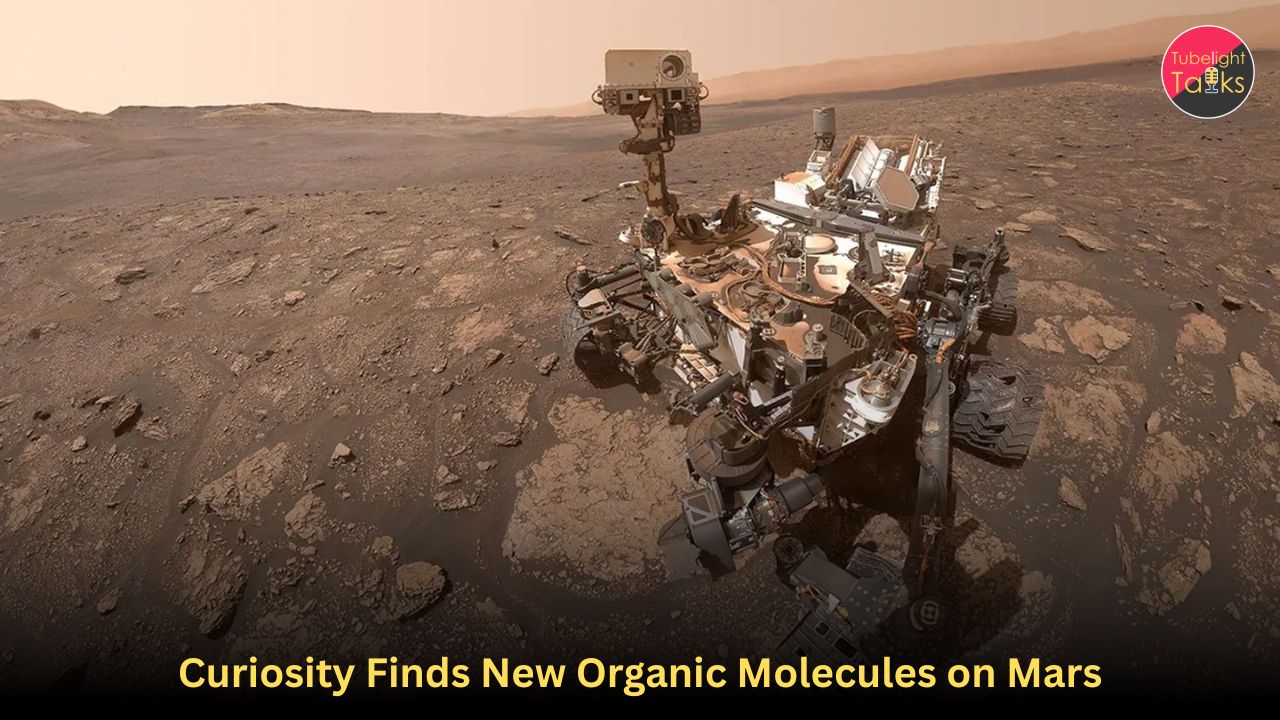
Curiosity Rover Finds New Organic Molecules on Mars
NASA’s Curiosity rover has identified the most diverse collection of organic molecules yet found on Mars. A rock sample drilled in 2020 from the “Mary Anning” site revealed 21 carbon-containing molecules, including seven detected on Mars for the first time.
What Curiosity Found
The organic molecules include compounds such as benzothiophene, methyl benzoate, naphthalene and other aromatic molecules. These were detected using Curiosity’s Sample Analysis at Mars instrument suite and a wet chemistry experiment.
Why Organic Molecules Matter
Organic molecules are carbon-based compounds associated with life chemistry, though they can also form through non-biological processes. Their presence does not prove life existed on Mars, but it strengthens the case that ancient Mars had life-supporting chemistry.
Also Read: Artemis II Marks Humanity’s Return Around the Moon
Ancient Mars Was More Habitable
The sample came from Gale Crater, a former lakebed rich in clay minerals. Scientists believe the organic material may have been preserved for about 3.5 billion years, when Mars was warmer and wetter.
Life Is Still Unconfirmed
NASA has clearly stated that scientists cannot yet determine whether the molecules formed through biological or geological processes, or arrived through meteorites. Definitive life detection would require more advanced analysis and possibly returned samples.
Future Mars Missions
The discovery increases interest in Mars sample return missions and future rovers capable of drilling deeper below the radiation-damaged surface. The more scientists learn about organic preservation, the better they can design life-detection missions.
Exploration and Humility
Discoveries on Mars remind humanity that creation is vast and still largely unknown. Sant Rampal Ji Maharaj teaches that spiritual knowledge reveals the deeper purpose of existence beyond material exploration. Scientific curiosity should therefore be joined with humility.
Call to Action
Students should follow planetary science, chemistry, astrobiology and space robotics. Mars research is opening new career paths in science and engineering.
FAQs: Curiosity Finds New Organic Molecules on Mars
Q1. Did Curiosity find life on Mars?
No, it found organic molecules, not confirmed life.
Q2. How many molecules were found?
NASA reported 21 carbon-containing molecules, including seven new to Mars.
Q3. What is benzothiophene?
It is a sulfur-containing organic molecule detected in the Martian sample.
Q4. Why is Gale Crater important?
It was once a lake environment suitable for preserving organics.
Q5. What is the next step?
Scientists need deeper drilling, advanced instruments and sample return studies.
Related Stories










Discussion (0)