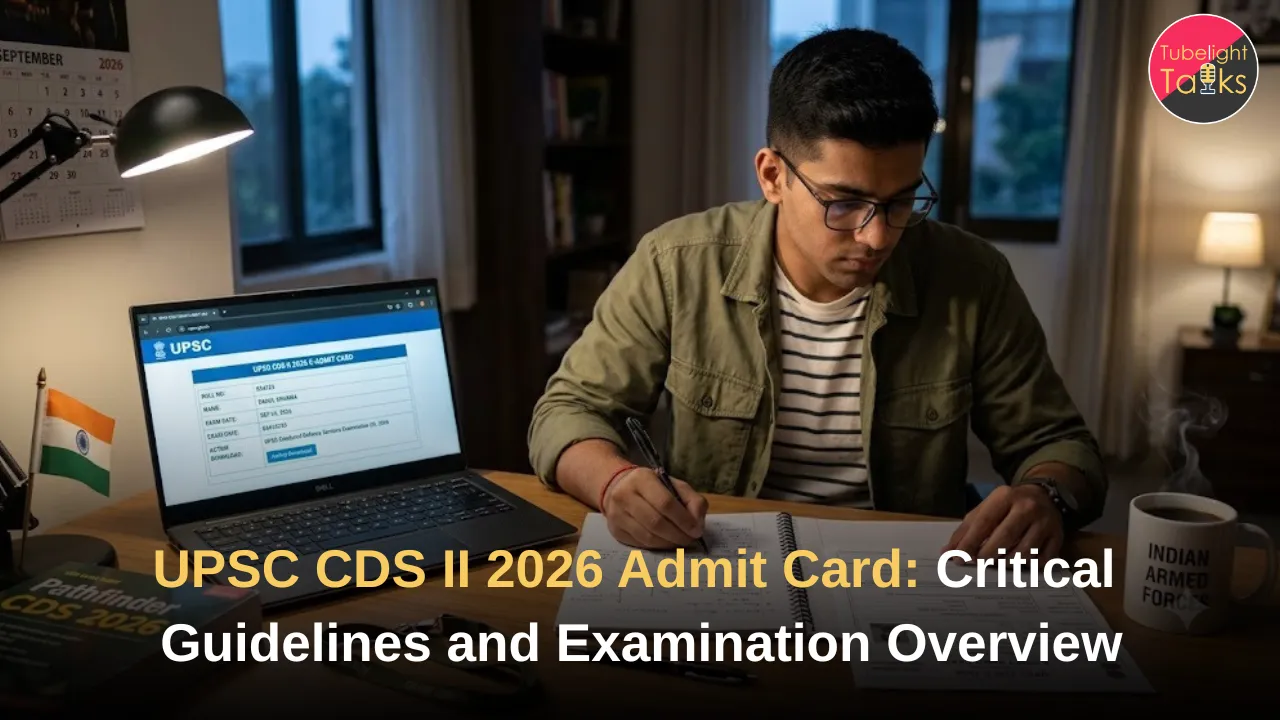
UPSC CDS II 2026 Admit Card: Critical Guidelines and Examination Overview
The official release of the UPSC CDS II 2026 admit card marks an essential milestone for thousands of defence aspirants across India. Conducted by the Union Public Service Commission, the Combined Defence Services Examination serves as the premier gateway for inducting officers into the armed forces. Aspirants seeking entry into the Indian Military Academy, Indian Naval Academy, Air Force Academy, and Officers Training Academy can now access their credentials online. The commission has issued the hall ticket ahead of the scheduled written test on September 13, 2026, giving candidates adequate time to verify center allocations.
Because thousands of applicants access the commission’s servers simultaneously, candidates should retrieve their electronic hall tickets well before the examination date. Verifying the information printed on the document ensures that any discrepancies can be addressed immediately through official administrative channels.
Examination Overview and Key Parameters
The Combined Defence Services Examination demands rigorous intellectual preparation, physical resilience, and thorough procedural awareness. The commission maintains stringent schedules and administrative rules that all applicants must strictly observe throughout the testing cycle.
| Examination Component | Official Specification |
| Conducting Body | Union Public Service Commission (UPSC) |
| Examination Name | Combined Defence Services (CDS) II 2026 |
| Date of Examination | September 13, 2026 (Sunday) |
| Document Issued | UPSC CDS II 2026 Admit Card |
| Official Portals | upsc.gov.in / upsconline.nic.in |
| Target Training Institutions | IMA (Dehradun), INA (Ezhimala), AFA (Hyderabad), OTA (Chennai) |
| Mode of Evaluation | Offline Objective Test (OMR) followed by SSB Interview |
Aspirants who qualify in the objective written examination earn an invitation to the multi-day Services Selection Board evaluation. That stage thoroughly assesses personality attributes, psychological endurance, and officer-like qualities.
Step-by-Step Procedure to Download Your Hall Ticket
Accessing the official recruitment portal during peak hours requires a smooth and systematic approach. The commission provides multiple verification paths to ensure registered applicants can retrieve their credentials without operational friction.
Also Read: Major Exam Reform Task Force Led by Nandan Nilekani
Candidates should follow these straightforward steps to obtain their documents:
- Navigate to the Official Portal: Open a secure web browser and visit the primary UPSC portal at upsc.gov.in or upsconline.nic.in.
- Locate the Active Notice: Scan the homepage announcements or select the dedicated examination section to find the link for the Combined Defence Services Examination (II) 2026.
- Select Login Authentication: Choose between your system-generated Registration ID or your assigned Examination Roll Number.
- Submit Required Identifiers: Input your chosen identification number, registered Date of Birth, and the alphanumeric captcha code displayed on the screen.
- Review and Save the PDF: Inspect the displayed information, save the electronic file to local storage, and print multiple sharp physical copies.
Applicants are strongly advised to keep extra printed copies in secure folders. These physical prints remain mandatory during subsequent recruitment phases and document verifications.
Verification Checklist: UPSC CDS II 2026 Admit Card Details
The UPSC CDS II 2026 admit card serves as an indispensable identity verification instrument at security check-in points. Candidates must systematically audit each entry printed on the credential before arriving at the venue.
Key details requiring immediate verification include:
- Candidate Identity: Verify that your full name matches your official secondary school certificate and government identification documents.
- Registration and Roll Numbers: Confirm that your registration sequence and roll number match your initial confirmation slip.
- Examination Center Details: Note the specific venue address, institution name, sub-center code, and landmark indicators.
- Shift Allocations: Check the start and conclusion timings for each individual paper to plan your travel efficiently.
- Photograph and Signature Clarity: Ensure your uploaded photograph and signature appear sharp, legible, and uncorrupted.
If your photograph appears blurred or distorted, bring two recent passport-size photographs along with valid photo identification to the examination center supervisor.
Mandatory Instructions and Venue Protocol
The Union Public Service Commission enforces a zero-tolerance policy regarding conduct at its testing centers. Failure to comply with these explicit rules can lead to immediate expulsion and long-term disqualification from future recruitment drives.
Candidates must present a clean printout of their hall ticket along with an original government photo identification card. Acceptable identification includes an Voter ID card, Passport, Driving License, or other valid state-issued proof matching the application record.
Candidates must strictly use a black ballpoint pen to darken bubbles on the Optical Mark Recognition sheets and complete attendance registers. Using pencils, gel pens, or blue ink leads to machine rejection of the response sheet during automated scanning.
All electronic equipment, including mobile phones, smartwatches, fitness trackers, Bluetooth peripherals, and programmable calculators, is strictly prohibited on campus. Invigilators permit only basic mechanical analog watches after manual inspection.
Structure of the Examination and Scoring Metrics
Mastering the competitive structure of the examination requires understanding paper weightings and negative marking protocols. The written stage tests candidates on academic competence, analytical alertness, and situational awareness.
Candidates applying for the Indian Military Academy, Indian Naval Academy, and Air Force Academy complete three sequential papers:
- English (Code 01): 100 maximum marks across a two-hour testing window, assessing grammar, syntax, vocabulary, and contextual comprehension.
- General Knowledge (Code 02): 100 maximum marks across two hours, evaluating national events, modern history, geography, basic physical sciences, and governance.
- Elementary Mathematics (Code 03): 100 maximum marks across two hours, covering arithmetic, algebra, mensuration, trigonometry, and practical geometry.
Candidates competing exclusively for the Officers Training Academy attempt only the English and General Knowledge sections, totaling 200 marks over four testing hours.
Every incorrect answer incurs a penalty of one-third of the marks assigned to that question. Strategic restraint is therefore essential; guessing blindly can quickly negate marks earned from well-reasoned answers. Candidates should systematically prioritize high-confidence items during their initial review of each test booklet.
Comprehensive Preparation for Examination Day
Achieving an optimal performance level requires disciplined revision and mental composure rather than frantic late-stage cramming. Aspirants should organize their study schedules to match the exact shift timings established by the commission.
Focus your remaining revision sessions on summarizing established concepts, reviewing critical mathematical formulae, and refining operational vocabulary. Revisit past question papers to familiarize yourself with the question formats and phrasing styles favored by the commission.
Prioritize physical stamina and proper sleep schedules leading up to the test date. Mental fatigue degrades calculation speed and increases the risk of misreading questions during multi-hour testing blocks. Plan your local transit route to the designated center well in advance to prevent transit-related delays on test day.
Finding True Peace Beyond Worldly Competitions
The pressure to excel in competitive examinations like the UPSC CDS can cause immense mental stress, anxiety, and sometimes deep despair. Millions of youths invest their prime years chasing prestigious careers, power, and societal respect. While fulfilling worldly duties and aiming for a righteous career is necessary, one must remember that all physical achievements, titles, and wealth remain behind when our time on earth ends. True peace cannot be found in temporary material successes or the relentless race of the modern world.
Our human birth is incredibly rare, and its highest purpose is not merely accumulating wealth or societal status, but attaining spiritual liberation (Moksha) from the painful cycle of birth and death. The stress of modern life stems from forgetting our true spiritual identity and our connection with the Supreme Creator.
Through the profound spiritual teachings of Sant Rampal Ji Maharaj, millions have realized that true contentment comes from the authentic worship of Supreme God Kabir. His discourses reveal hidden truths from the Holy Vedas, Bhagavad Gita, Quran, and Bible, proving that devotion based on true spiritual knowledge acts as a shield against the miseries, anxieties, and depressions of this temporary world. By walking the path of true worship, one achieves not only a balanced, peaceful worldly life but also secures eternal salvation.
To understand the deeper meaning of human life and find permanent relief from worldly anxieties, explore the spiritual discourses on the spiritual YouTube Channel of Sant Rampal Ji Maharaj. Click this link to order your completely free copy of the sacred book ‘Gyan Ganga’ by Sant Rampal Ji Maharaj.
Frequently Asked Questions
1. What is the confirmed date for the CDS II written test?
The Union Public Service Commission has officially scheduled the examination for September 13, 2026. Testing takes place in designated morning, afternoon, and evening shifts across testing centers nationwide.
2. How can candidates access their UPSC CDS II 2026 admit card online?
Applicants can download their hall ticket by accessing the official portals at upsc.gov.in or upsconline.nic.in. Enter your registered Roll Number or Registration ID along with your Date of Birth to view and print the document.
3. What steps are required if personal details contain errors?
If your hall ticket contains typographical errors, missing photographs, or mismatched details, contact the commission’s facilitation desk immediately. Bring valid government photo identification and original application copies to your venue supervisor on examination day.
4. Why is a black ballpoint pen mandatory for marking answers?
The evaluation system uses automated optical mark readers calibrated specifically for dense black carbon pigments. Blue inks, gel formulations, and pencil marks do not register accurately during digital scanning and lead to sheet invalidation.
5. Are digital timepieces permitted inside the test center?
No electronic devices of any kind are permitted inside the examination halls. Candidates may wear only simple mechanical analog timepieces, and these remain subject to manual inspection by exam invigilators.
Related Stories





Discussion (0)