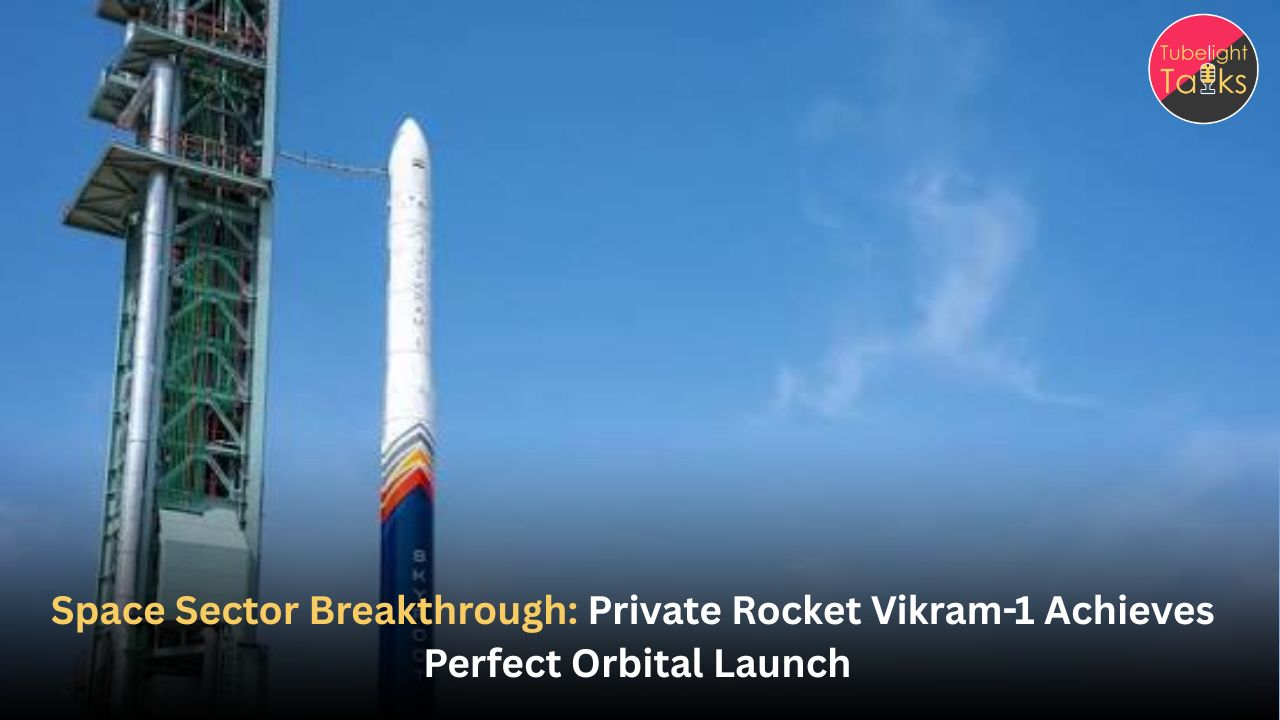
Space Sector Breakthrough: Private Rocket Vikram-1 Achieves Perfect Orbital Launch
India’s commercial space landscape changed forever following the flawless orbital insertion executed by the Private Rocket Vikram-1, the country’s first privately developed orbital-class launch vehicle. Officially codenamed “Mission Aagaman” (signifying Arrival), the multi-stage solid fuel and liquid-velocity vehicle successfully lifted off to place a cluster of technology demonstration payloads into a precise low Earth orbit.
The breakthrough marks the definitive maturity of India’s private aerospace sector, transitioning local companies from contract component manufacturers for the Indian Space Research Organisation (ISRO) to independent global commercial launch operators.
How the Private Rocket Vikram-1 Joins the Global Space Elite
Demolishing the Institutional Monopoly
The success of Mission Aagaman carries vast geopolitical weight, officially elevating India into a highly exclusive tier of nations that possess functioning, end-to-end private orbital space access. India is now only the third country globally to achieve this complex structural milestone through a vehicle designed, tested, and integration-managed entirely by a private startup enterprise.
The mission payload parameters integrated critical miniature observation instruments alongside highly unique micro-payload additions, including symbolic digitized planetary postcards compiled directly from files provided by Prime Minister Narendra Modi.
Also Read: Lunar Oxygen Prototype: Scientists Extract Oxygen From Simulated Moon Soil for Future Lunar Bases
Vikram-1 Launch Specifications
- Mission Directive: Mission Aagaman (First Private Orbital Deployment).
- Target Destination: Low Earth Orbit (LEO) configuration.
- Structural Composition: Advanced carbon-composite multi-stage propulsion architecture.
- Payload Profile: Multi-client technology demonstrator satellites and public digital postcards.
The flawless trajectory tracking and stage separation verified by local ground telemetry networks prove that private Indian space enterprises can deliver lower costs per kilogram for small satellite operators globally.
Catalyzing the Commercial Space Economy
The commercial implications of the Private Rocket Vikram-1 extend far beyond a single successful launch. By demonstrating a reliable, rapid-assembly, and cost-effective orbital delivery system, India is now positioned to capture a significant share of the booming global small-satellite launch market. Industry analysts project that this milestone will attract substantial foreign direct investment into local aerospace startups, fostering a robust domestic supply chain and creating thousands of high-skilled engineering jobs. Startups can now offer competitive launch-on-demand services to international universities, telecommunications companies, and climate monitoring agencies.
Paving the Way for Next-Generation Access
Furthermore, this triumph completely validates the government’s strategic decision to deregulate the space sector and empower private innovators through bodies like IN-SPACe. With the Private Rocket Vikram-1 proving the viability of advanced carbon-composite structures and cutting-edge propulsion systems, the runway is clear for heavier payload capacities and higher-frequency launch schedules. Next-generation launch vehicles are already on the drawing board, promising to further slash the cost of space access and establish India as a premier, undisputed global hub for commercial spaceflight.
Service, Humility and Public Duty
The stunning advancements in private space exploration demonstrate the massive creative potential of the human mind when directing material energy toward exploring the physical cosmos. Yet, Sant Rampal Ji Maharaj’s spiritual guidance gently reminds humanity that piercing the upper atmosphere cannot bring true internal peace. SatGyan teaches that while rockets traverse physical space, the permanent soul requires the divine knowledge of Supreme God Kabir to cross the ocean of earthly existence. True global development occurs when world leaders and scientists approach these monumental achievements with pure humility and transparent service, utilizing material science to expand knowledge while aligning their personal paths with the eternal laws of spiritual consciousness.
FAQs on Vikram-1 Mission Aagaman
Q. What historic milestone did the Vikram-1 rocket achieve during its recent launch?
Vikram-1 successfully completed “Mission Aagaman”, making India only the third country in the world to successfully place satellites into low Earth orbit using a privately developed launch vehicle.
Q. What kind of payloads were carried aboard the private Vikram-1 rocket?
The rocket deployed multiple advanced technology demonstration payloads alongside symbolic digital postcards, including contributions from Prime Minister Narendra Modi.
Q. How does the success of Vikram-1 impact the broader Indian space sector?
It marks the successful transition of the Indian space ecosystem away from a singular state monopoly, establishing local private enterprises as independent commercial launch providers on the global market.
Related Stories










Discussion (0)