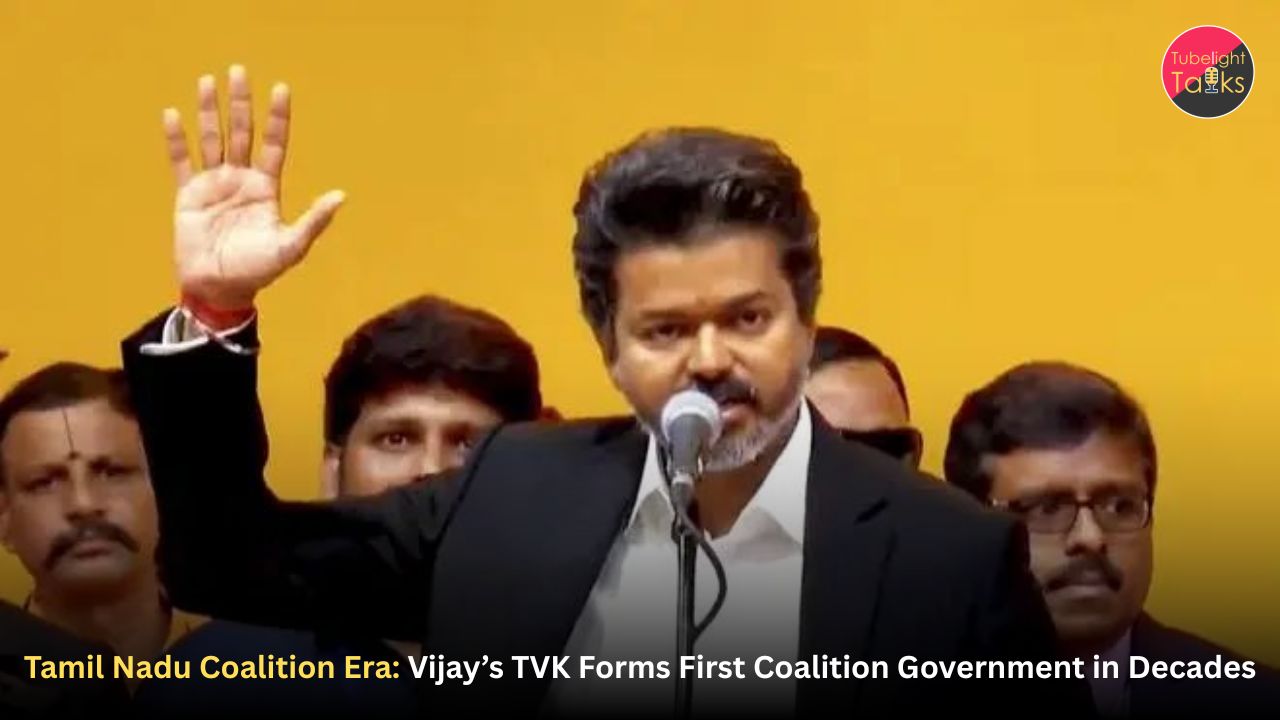
Tamil Nadu Coalition Era: Vijay’s TVK Leads New Government With Congress and Left Support
Tamil Nadu has entered a new coalition era as C. Joseph Vijay’s Tamilaga Vettri Kazhagam prepares to lead the state government with support from Congress, Left parties, VCK and IUML after a fractured Assembly verdict. TVK emerged as the single-largest party with 108 seats in the 234-member Assembly but fell short of the 118-seat majority mark. The government-formation deadlock ended after Congress, CPI, CPI(M), VCK and IUML extended support, allowing Vijay to cross the required numbers.
Deccan Herald described Vijay as heading the first coalition government in Tamil Nadu in decades, while multiple reports confirmed that post-poll support from smaller parties helped TVK secure majority backing. The shift marks a major break from Tamil Nadu’s long DMK-AIADMK dominated political structure.
Tamil Nadu’s Coalition Turn: Why This Is Historic
TVK Becomes Single-Largest Party but Falls Short
The Tamil Nadu Assembly result produced a political surprise. Vijay’s TVK, contesting its first Assembly election, won 108 seats and emerged as the single-largest party. However, the party did not reach the majority mark of 118 in the 234-member House. This created several days of uncertainty over whether Vijay could form a stable government.
In a state used to decisive mandates for either the DMK or AIADMK-led formations, this result changed the grammar of government formation. TVK had public momentum, but it needed legislative support. That made smaller parties and former alliance partners central to the new power equation.
The result also showed that Tamil Nadu voters were willing to break the familiar two-pole pattern. TVK’s rise did not simply add another party to the political field; it forced the state into coalition arithmetic.
Support From Congress, Left, VCK and IUML
Vijay’s path to power became clearer when Congress, CPI, CPI(M), VCK and IUML extended support to TVK. Hindustan Times reported that CPI, CPI(M) and VCK submitted letters of support, while other reports noted that Congress support had already strengthened TVK’s claim. Times of India reported that VCK and IUML later extended “unconditional support,” helping TVK cross the majority mark.
VCK chief Thol. Thirumavalavan said the support was aimed at ensuring political stability and preventing President’s Rule in Tamil Nadu. He also clarified that the support was unconditional and would not affect VCK’s existing political identity.
This makes the new government unusual. Not all supporting parties may fully merge into a single ideological bloc, and some may extend outside support rather than take full cabinet responsibility. That structure can give the government flexibility, but it also creates political complexity.
End of the Old Single-Dominance Pattern
DMK-AIADMK Era Disrupted
For decades, Tamil Nadu politics revolved around the DMK and AIADMK. Even when smaller parties mattered electorally, governments were generally led by one of the two Dravidian giants with a clear dominant structure. Vijay’s TVK has now disrupted that rhythm.
This does not erase the legacy of Dravidian politics. Tamil Nadu’s language rights, social justice, welfare model and regional identity have been shaped by Dravidian movements. But TVK’s rise shows that a new generation of voters may be demanding a fresh political vehicle.
The coalition government therefore carries symbolic weight. It is not only about numbers; it is about a change in political imagination.
A New Test for Vijay
Winning an election is different from running a coalition. Vijay’s biggest test now is not crowd appeal, film charisma or campaign energy. It is governance.
He must keep allies satisfied, manage cabinet expectations, handle bureaucratic systems, maintain law and order, protect welfare programmes, and deliver on campaign promises. A coalition Chief Minister cannot govern only through personal popularity. He must negotiate, consult and build trust daily.
Coalition Government: Strengths and Risks
Wider Representation
A coalition government can bring wider representation. Congress, Left parties, VCK and IUML represent different voter bases, ideological traditions and social constituencies. Their support can make the government broader than a single-party administration.
This could help Vijay reassure voters who may have been uncertain about TVK’s administrative experience. Experienced allies can contribute policy memory, legislative skill and grassroots networks.
Policy Negotiation
The coalition will need agreement on core issues: welfare spending, education, reservation, industry, employment, women’s safety, agriculture, urban development, language policy and federal relations. Congress and Left parties may push for stronger social-sector policies. VCK may focus on social justice, Dalit rights and anti-discrimination measures. IUML may seek minority welfare assurances.
Such negotiation can improve policy if handled maturely. But it can create instability if partners feel ignored.
Cabinet Balance
Cabinet formation will be one of Vijay’s earliest tests. NDTV reported that discussions around ministerial sharing included possible roles for allies, though reports also suggested Left parties may not be part of the cabinet.
If allies remain outside the cabinet, coordination committees may become important. If they enter the cabinet, portfolio allocation will become sensitive. Either way, Vijay must create a mechanism for regular consultation.
Why Smaller Parties Became Kingmakers
Fractured Mandate Changed Their Role
In a clear-majority election, smaller parties may influence policy but not decide government formation. In this election, they became decisive because TVK was short of majority. Their letters of support transformed Vijay from leader of the largest party into the likely head of a government.
This is classic coalition politics. The largest party needs smaller parties not only for numbers but for legitimacy.
Preventing President’s Rule
The concern over President’s Rule became an important argument. VCK and Left leaders said support to TVK was meant to ensure that a democratically elected state government could be formed. Hindustan Times reported that Left leaders described support to TVK as a “democratic duty.”
This framing helped supporting parties justify their decision to back a new political force. Instead of presenting support as opportunism, they described it as a move to avoid constitutional uncertainty.
Also Read: Vijay Stakes Claim in Tamil Nadu: TVK’s 108-Seat Sweep Opens New Government-Formation Battle
Challenges Before the Coalition
Stability
The first challenge is survival. The government must prove majority support and maintain it. Even a few MLAs changing position can create instability in a narrow majority.
A coordination mechanism, common minimum programme and clear communication between partners will be essential. Without that, the government may face repeated pressure during every major policy decision.
Public Expectations
Vijay’s supporters expect fast change. Coalition partners may prefer careful policy steps. The Chief Minister will need to manage expectations honestly.
A government born from excitement can face disappointment quickly if it does not deliver visible outcomes. Jobs, corruption control, governance transparency, public safety and welfare continuity will be watched closely.
Administrative Experience
TVK is new to state-level administration. It will need support from experienced civil servants, policy advisers and coalition partners. Administrative discipline will be crucial during the first 100 days.
Opposition Pressure
DMK and AIADMK will not remain passive. Both parties still have deep organizational networks. They will attack the coalition if it appears unstable or inexperienced. Vijay must prepare for aggressive Assembly politics and public scrutiny.
What This Means for Tamil Nadu’s Future
A More Negotiated Politics
Tamil Nadu may now move from leader-centric single-party dominance toward negotiated governance. This could make politics more plural and consultative, but only if coalition partners act responsibly.
Coalition governments can be stable when partners agree on basic principles. They become fragile when partners use support only for bargaining.
Opportunity for New Governance Model
Vijay can use this moment to create a new governance model: transparent cabinet functioning, public dashboards, anti-corruption mechanisms, youth employment missions, local-body strengthening and stronger public consultation.
If he succeeds, TVK’s coalition could become a new template. If he fails, voters may return to older parties in the next cycle.
Also Read: West Bengal Second Renaissance: Suvendu Adhikari Takes Charge as First BJP Chief Minister
Coalition Politics and the SatGyaan Message
Tamil Nadu’s new coalition era shows that power becomes stable only when people learn to work together with humility, truth and public purpose. JagatguruRampalJi.org explains that Sant Rampal Ji Maharaj’s teachings aim to establish peace and brotherhood, remove corruption, end social evils, and bring moral awakening through True Spiritual Knowledge. This SatGyaan is directly relevant to coalition politics.
A government formed by different parties can succeed only when ego is controlled and public welfare is placed above personal ambition. Sant Rampal Ji Maharaj’s teachings guide people away from corruption, cheating, intoxication, greed, caste discrimination and misuse of authority, while promoting righteous conduct and devotion to Supreme God Kabir.
Tamil Nadu’s coalition will be judged not by the excitement of its formation, but by honesty, unity, service to the poor, social justice and peaceful governance. A true political renaissance begins when leaders work as servants of society, not owners of power.
FAQs on Tamil Nadu Coalition Era
1. Why is Tamil Nadu entering a coalition era?
Tamil Nadu is entering a coalition era because Vijay’s TVK won 108 seats but fell short of the 118-seat majority mark, requiring support from other parties to form the government.
2. Which parties are supporting Vijay’s TVK?
Congress, CPI, CPI(M), VCK and IUML have extended support to TVK for government formation.
3. How many seats did TVK win?
TVK won 108 seats in the Tamil Nadu Assembly election, emerging as the single-largest party.
4. What is the majority mark in Tamil Nadu Assembly?
The majority mark in the 234-member Tamil Nadu Assembly is 118 seats.
5. Why did VCK support TVK?
VCK said it extended unconditional support to TVK to ensure political stability and prevent the imposition of President’s Rule in Tamil Nadu.
6. What is Vijay’s biggest challenge now?
Vijay’s biggest challenge is to keep the coalition stable while delivering governance, welfare, jobs, clean administration and social harmony.
Related Stories



Discussion (0)