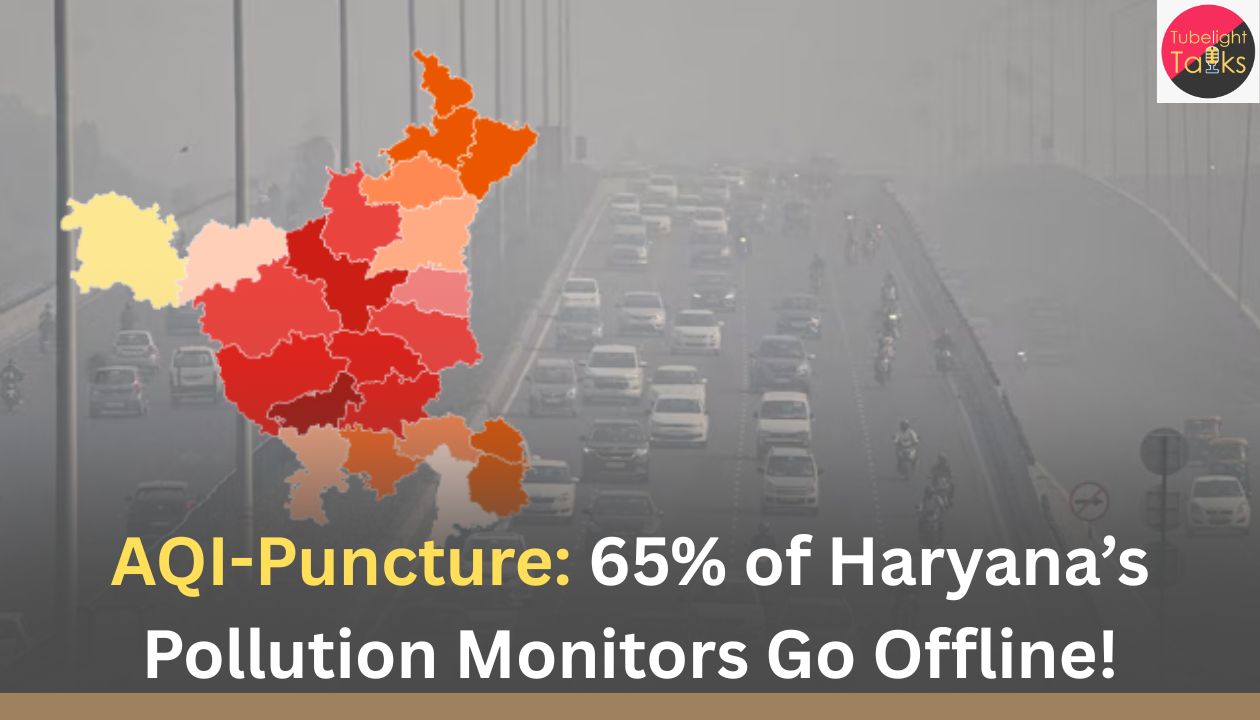
AQI-Puncture: 65% of Haryana’s Pollution Monitors Go Offline!
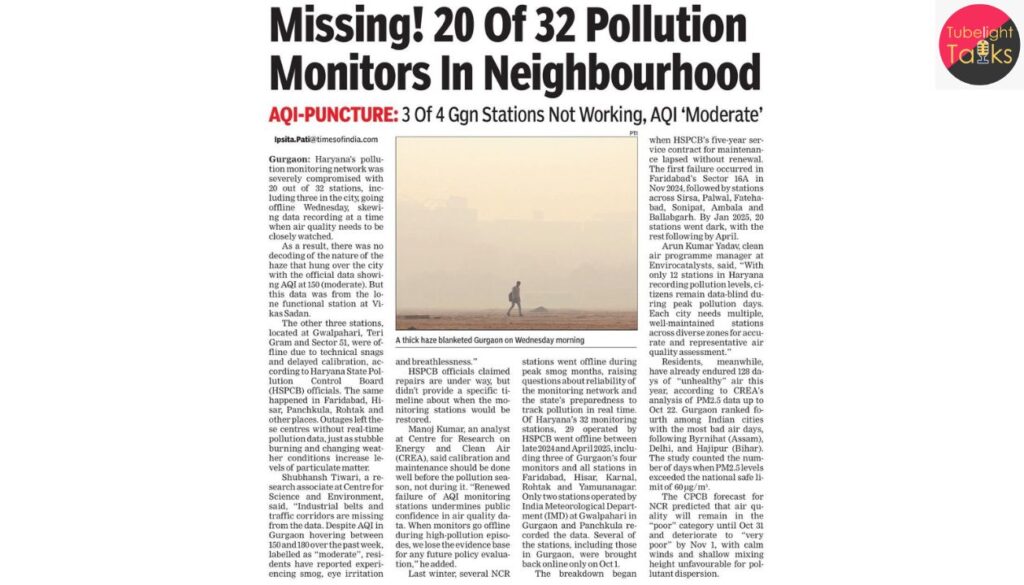
Haryana’s Pollution Monitors: Over half of Haryana’s air-quality monitoring machines have stopped working, raising serious concerns about how the state will monitor pollution in the coming weeks. Reports say around 20 of the 32 monitoring stations are currently offline. This technical failure has come at the worst possible time — when stubble burning, vehicle smoke, and cold weather are already reducing air quality across the region.
What Happened
Officials from the Haryana State Pollution Control Board (HSPCB) said many monitoring stations stopped sending data because their old maintenance contracts expired. Some machines have power issues, broken sensors, or diesel generator faults. Cities like Gurugram, Faridabad, Hisar, and Rohtak are among the worst affected.
Because of this, people are not getting the real picture of air pollution, and authorities cannot take proper action under the Graded Response Action Plan (GRAP).
Why Does It Matter?
These air-quality stations collect data about tiny particles and gases in the air and calculate the Air Quality Index (AQI). This helps citizens and the government know how bad the air is. When most stations stop working, the readings become wrong. For example, Gurugram’s official AQI shows “moderate”, but people see heavy smog and feel irritation in their eyes and throat. Experts say,
“It’s like trying to fight an enemy blindfolded.”
What Officials Said?
HSPCB officials have accepted the issue and said new repair contracts have been signed with ENVEA India and ACOEM. Work is going on to restart all the offline stations soon. They said generators and sensors are being checked, and all 32 stations are expected to become functional again by mid-November 2025.
What Are the Risks?
Health Danger: Without real-time data, people continue breathing harmful air without knowing it. Weak Government Action: Without data, the state cannot apply pollution-control rules properly. Loss of Public Trust: People stop believing AQI numbers when they don’t match reality. No Early Warning: Dangerous smog days may come without warning.
Also Read: Surge in Air‑Pollution Following Diwali 2025 Across India
Experts Suggest
1. Fix all stations immediately — especially in big cities.
2. Avoid contract gaps — new maintenance teams must be ready before old ones end.
3. Inform people clearly when data is missing or machines are offline.
4. Calibrate sensors regularly for correct readings.
5. Take strict action even without data – control dust, burning, and heavy traffic.
Sant Rampal Ji Maharaj Ji’s Contribution to Environmental Purity
Sant Rampal Ji Maharaj, who leads 13 Satlok Ashrams across India, encourages people to live in harmony with nature. Each year, eight major samagams are organized in these ashrams. During these events, the devotees perform Garibdas Ji Maharaj Ji’s Amarvani Path and conduct Jyoti Yagya (Yadnya) — sacred rituals that are completely free from animal sacrifice, smoke pollution, or waste generation.
According to Bhagwat Geeta, such shubh and shastra-anukul anusthans help purify the environment and create a positive spiritual atmosphere. Thousands of people participate in these events with complete discipline — avoiding intoxicants, non-vegetarian food, and any harmful activities. This collective purity and adherence to divine knowledge contribute to both inner peace and environmental balance.
Conclusion
This incident is a big warning for Haryana. When 65% of pollution monitors go offline during the smog season, it becomes a public health emergency. Without reliable data, the fight against pollution becomes weak and unclear. The government must act fast to repair the system and protect people’s right to clean air. Transparency, urgency, and responsibility are the only ways forward.
FAQs
1. What is AQI?
AQI means Air Quality Index. It shows how clean or polluted the air is. A higher number means more pollution.
2. Why are Haryana’s monitoring stations offline?
Because the old maintenance contracts ended and the machines were not repaired on time.
3. Which areas are most affected?
Major cities like Gurugram, Faridabad, Rohtak, and Hisar have missing or partial data.
4. When will the machines start working again?
Officials say all machines will be repaired and restarted by mid-November 2025.
5. How does this affect public health?
Without accurate data, people breathe polluted air unknowingly, which can cause asthma, cough, and heart issues.
Related Stories






Discussion (0)