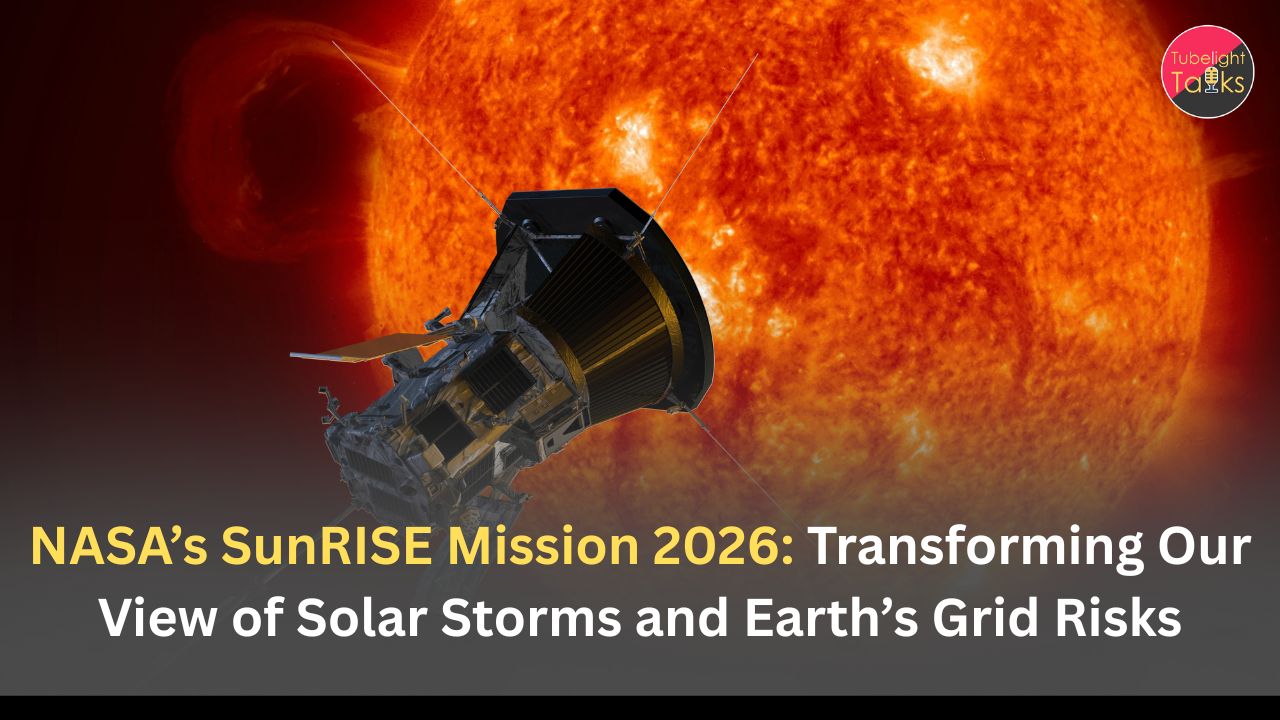
NASA’s SunRISE Mission 2026: Transforming Our View of Solar Storms and Earth’s Grid Risks
NASA’s SunRISE Mission 2026: Scheduled for launch in mid-2026, NASA’s SunRISE (Sun Radio Interferometer Space Experiment) mission marks a groundbreaking advance in heliophysics. By deploying six CubeSats working as a distributed radio telescope, SunRISE will study solar radio bursts and map the Sun’s magnetic activity from the outer corona into interplanetary space.
Its findings are set to change how we predict solar particle storms—phenomena capable of disrupting satellites, endangering astronauts, and posing significant risks to Earth’s power grids and communication systems.
Background: The Challenge of Solar Storms
Solar storms arise when the Sun releases massive bursts of energetic particles accelerated by magnetic reconnection events. These storms can interfere with Earth’s magnetosphere, threatening space and ground infrastructure with electrical surges and radiation. Understanding where and how these bursts originate is critical for early warnings and mitigation strategies.
Mission Overview: SunRISE’s Innovative Approach
SunRISE consists of six small satellites orbiting in close formation approximately 10 kilometers apart, creating an interferometric radio telescope in space. This configuration will generate detailed 3D maps of solar radio emissions, pinpointing the exact regions on the Sun where solar particle storms initiate.
Such observations cannot be made from the ground due to Earth’s ionosphere blocking key radio wavelengths, making SunRISE’s space-based vantage unique.
Scientific and Practical Impact
By revealing the dynamics of solar radio bursts and their acceleration mechanisms, SunRISE will enhance space weather forecasting accuracy. This allows forecasters to predict the arrival and trajectory of solar storms more precisely, enabling satellite operators and power grid managers to take timely protective measures, reducing potential economic and safety impacts.
Complementing Global Sun Studies
SunRISE complements other heliophysics missions including NASA’s Parker Solar Probe, Solar Orbiter (ESA-NASA collaboration), and Solar Terrestrial Relations Observatory. Together, these missions piece together the complex puzzle of solar behavior and its effects on the heliosphere and Earth’s environment.
Experts’ Views
Heliophysicists view SunRISE as a vital tool poised to revolutionize our understanding of the Sun’s magnetic environment and particle acceleration zones. Its capabilities represent a leap forward in solar storm monitoring, crucial for an increasingly space-reliant society.
Pursuit of Truth for Humanity’s Protection
Sant Rampal Ji Maharaj’s Satgyan stresses that scientific inquiry, when pursued with truth and righteousness, safeguards humanity and fosters progress. SunRISE exemplifies this ideal by combining wisdom and technology to shield humanity from the Sun’s tempestuous nature through informed preparation and knowledge-sharing.
Key Facts
- SunRISE launch planned for summer 2026 as a rideshare on a United Launch Alliance Vulcan Centaur rocket.
- Comprised of six CubeSats forming a 10 km-wide radio telescope in space.
- Mission will map solar radio bursts and magnetic fields from the Sun’s outer corona to interplanetary space.
- Enhances space weather forecasting by locating and tracking solar particle storms.
- Supported and managed by NASA’s Jet Propulsion Laboratory and led scientifically by the University of Michigan.
Also Read: Multipolar Space Race 2026: Commercial Space Stations and Lunar South Pole Missions
FAQs: NASA’s SunRISE Mission 2026
1. What is NASA’s SunRISE mission?
A constellation of six CubeSats studying solar radio bursts and magnetic activity to improve space weather predictions.
2. How do solar storms affect Earth?
They can disrupt satellites, power grids, and pose hazards to astronauts outside Earth’s magnetic field.
3. Why is SunRISE important compared to ground-based telescopes?
The mission observes radio frequencies blocked by Earth’s atmosphere, providing unique insights unattainable from the ground.
4. What technology does SunRISE use?
Six small satellites operating as a synchronized radio telescope using interferometry to create 3D maps of solar activity.
5. How will SunRISE help protect Earth?
By improving early warnings for solar storms, allowing timely protective actions for satellites and power infrastructure.
Set to Transform Heliophysics
The 2026 SunRISE mission is set to transform heliophysics and space weather science by unveiling the hidden dynamics of solar storms with unprecedented clarity. Its innovative constellation approach expands humanity’s capability to forecast and mitigate the Sun’s disruptive space weather impacts.
With SunRISE, NASA advances our preparedness for solar hazards, embodying the pursuit of truth and protection and fostering safer coexistence with our star’s powerful and unpredictable nature.
Related Stories










Discussion (0)